 Whalesbook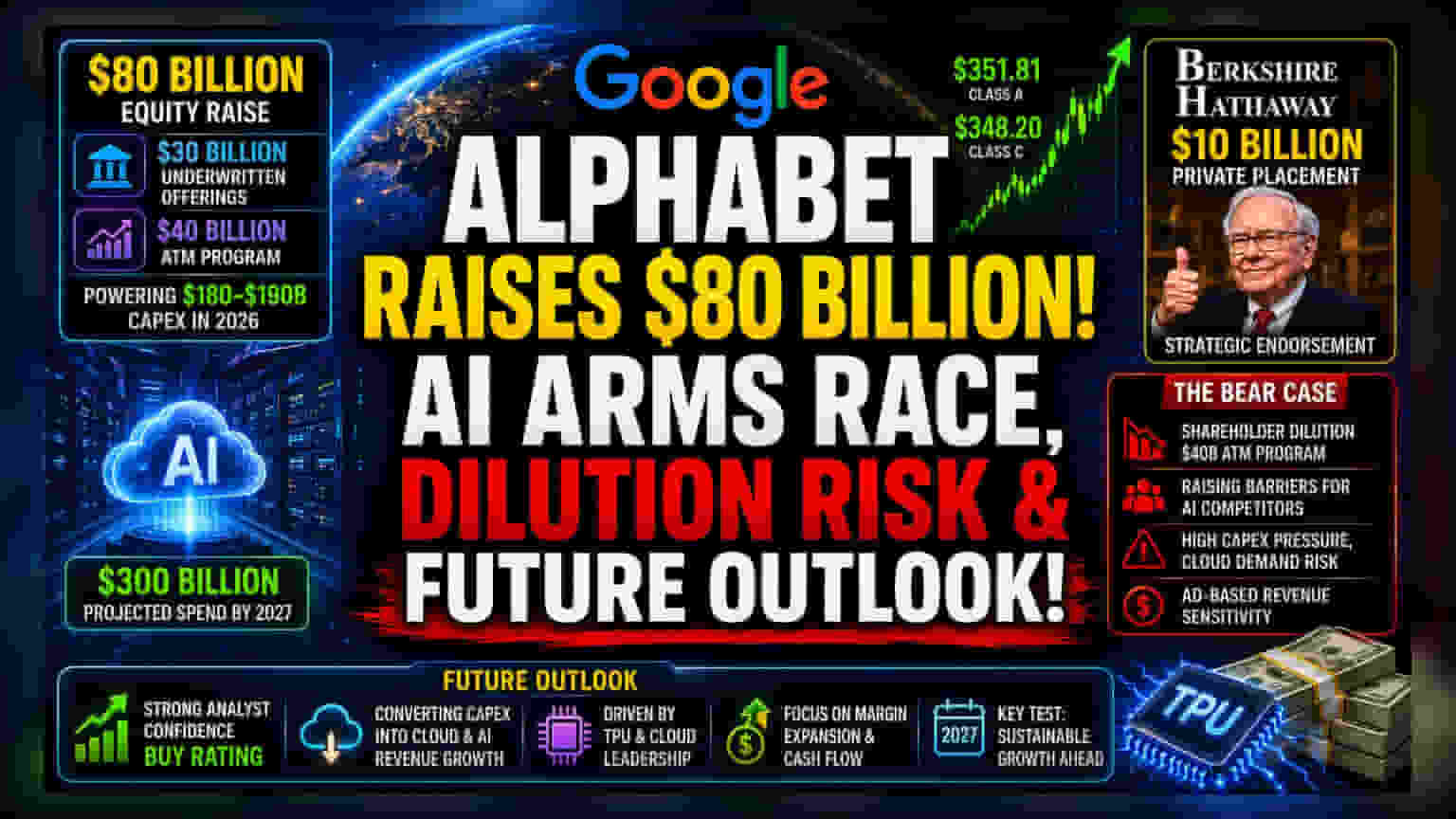


The Capital Intensity Escalation
Alphabet's move to raise $80 billion in equity capital marks a significant escalation in the ongoing arms race for artificial intelligence dominance. Rather than relying solely on organic operating cash flow, which reached $174 billion over the twelve months ending March 31, 2026, the company is opting for aggressive external financing. The strategy, which involves $30 billion in underwritten offerings and a $40 billion at-the-market (ATM) program, signals that Alphabet’s capital expenditure requirements—projected to reach $180–$190 billion in 2026 alone—are creating a new financial baseline for hyperscalers. With analysts suggesting that expenditures could balloon to $300 billion by 2027, this capital raise provides the necessary buffer to secure long-term infrastructure capacity against supply constraints.
Institutional Endorsement and Strategy
The involvement of Berkshire Hathaway, which has committed $10 billion to a private placement, acts as a high-profile validation of Alphabet's long-term AI-compute strategy. By acquiring Class A and Class C shares at $351.81 and $348.20 respectively, Berkshire has deepened a position initiated in the third quarter of 2025. This move by the Omaha-based conglomerate contrasts with traditional growth-oriented funding, suggesting that value-conscious institutional capital is increasingly viewing AI-native compute infrastructure as a core, defensible asset class similar to traditional utilities.
The Bear Case: Dilution and Competitive Pressure
Despite the strategic rationale, the structure of this raise introduces persistent risks. The $40 billion ATM program, set to commence in the third quarter, subjects existing shareholders to potentially unscheduled, ongoing dilution rather than a singular, predictable event. Furthermore, Alphabet’s massive scale of investment is arguably playing hardball with smaller AI players like Anthropic and OpenAI; by monopolizing available capital and supply chains, the company may be effectively raising the barrier to entry for prospective IPOs in the sector. Investors must also contend with the fact that these capital outlays are happening during a period where Alphabet’s core advertising business remains the primary engine for its multi-trillion-dollar valuation, making the company increasingly sensitive to any potential deceleration in cloud demand.
Future Outlook
Brokerage consensus remains broadly positive, with current analyst sentiment leaning heavily toward a buy rating and an average price target reflecting confidence in the company's long-term trajectory. However, the success of this capital infusion will be measured by its ability to convert record-high infrastructure spending into tangible revenue growth through its proprietary Tensor Processing Units and cloud services. As Alphabet moves toward the 2027 fiscal year, the market will monitor whether these capital commitments translate into sustainable margin expansion or if they remain a persistent drag on free cash flow.