 Whalesbook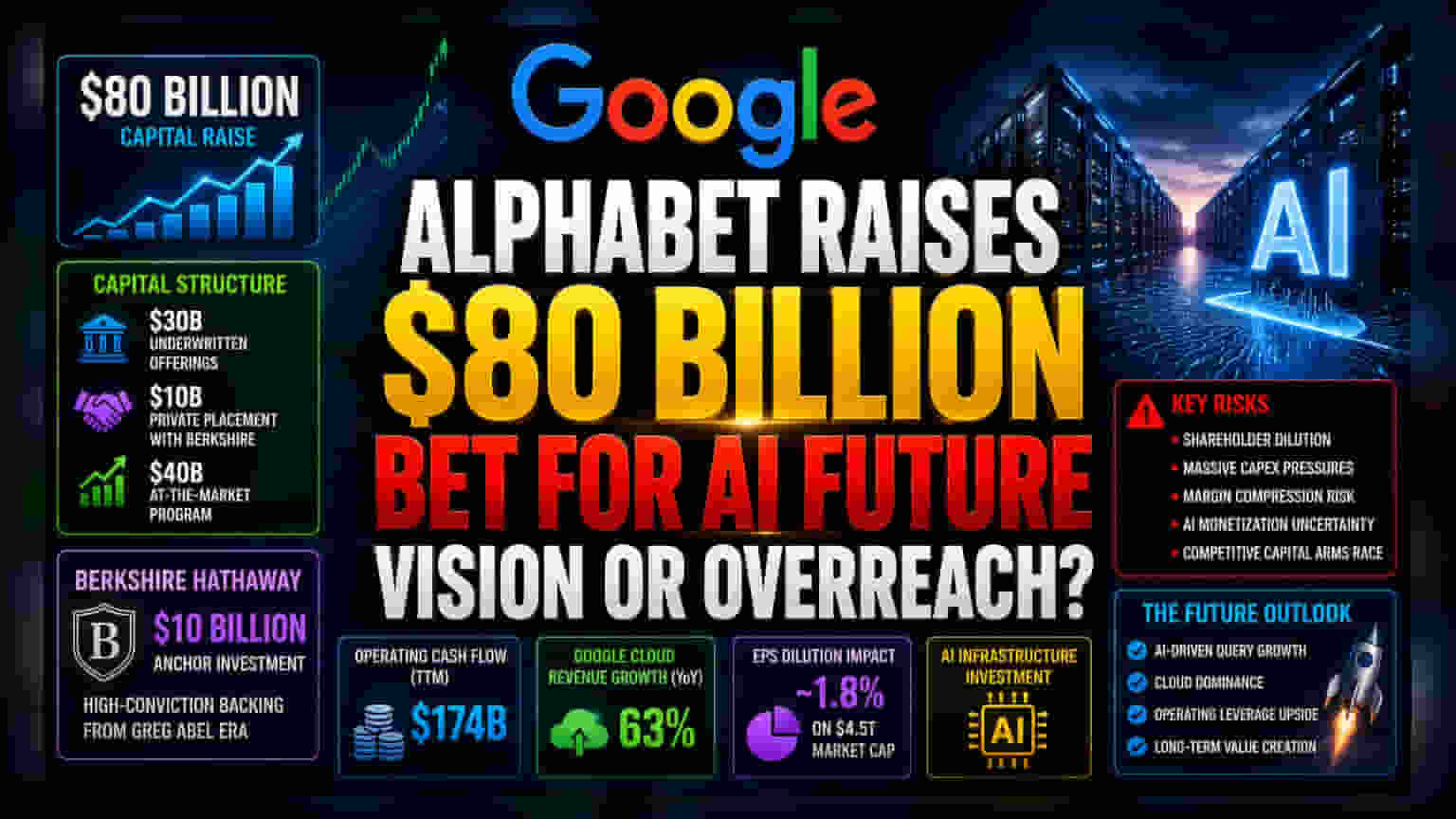


The Capital Expenditure Paradox
Alphabet’s decision to tap public markets for $80 billion stands as a departure from its historical reliance on organic cash flow. While the company generated $174 billion in operating cash flow over the trailing twelve months, the sheer velocity of AI infrastructure demand has outpaced even its formidable balance sheet. By utilizing a multi-layered structure—including $30 billion in underwritten offerings, a $10 billion private placement with Berkshire Hathaway, and a $40 billion at-the-market program—management is aggressively positioning the firm to secure long-term compute dominance. This strategy prioritizes immediate infrastructure scaling over the preservation of share count, a trade-off that has introduced short-term volatility to the stock.
The Strategic Valuation Lens
Market participants are currently parsing the significance of Berkshire Hathaway’s $10 billion anchor investment. Coming under the leadership of new CEO Greg Abel, the deal serves as a high-conviction institutional endorsement of Google’s AI hardware roadmap. Unlike typical debt-funded expansions, this equity-heavy approach protects Alphabet's balance sheet flexibility but invites scrutiny regarding earnings-per-share (EPS) dilution. Despite the headlines, the dilution impact is approximately 1.8% on a $4.5 trillion market capitalization, a figure that appears manageable given Google Cloud's 63% year-over-year revenue growth. The move effectively forces a sector-wide revaluation of capital intensity in the AI race, setting a high bar for competitors who lack the same level of internal profit generation.
The Forensic Bear Case
From a risk-averse perspective, the size of this offering triggers alarms about the true cost of AI supremacy. Critics argue that if demand were as robust as implied, the company might have leveraged its existing cash surplus rather than diluting equity. Furthermore, the $40 billion at-the-market program, while partially earmarked for employee equity tax obligations, suggests management is creating a long-term liquidity buffer for potential margin compression. There is also the competitive threat: by soaking up massive amounts of available investor capital, Alphabet is effectively increasing the cost of funding for emerging rivals like Anthropic and SpaceX. Should AI monetization fail to scale in line with these massive expenditures, Alphabet faces the dual threat of slowing EPS growth and a permanently bloated cost base.
The Future Outlook
Looking ahead, the market remains fixated on how effectively these billions will translate into compute capacity and, ultimately, revenue. While some analysts have adjusted their short-term outlooks downward due to the expected supply of new shares, the fundamental narrative remains tied to AI-driven query growth and Cloud dominance. Brokerage consensus suggests that if the deployment of this capital mirrors the recent successful expansion of Google’s Gemini foundation models, the long-term impact on operating leverage could outweigh current shareholder concerns.