

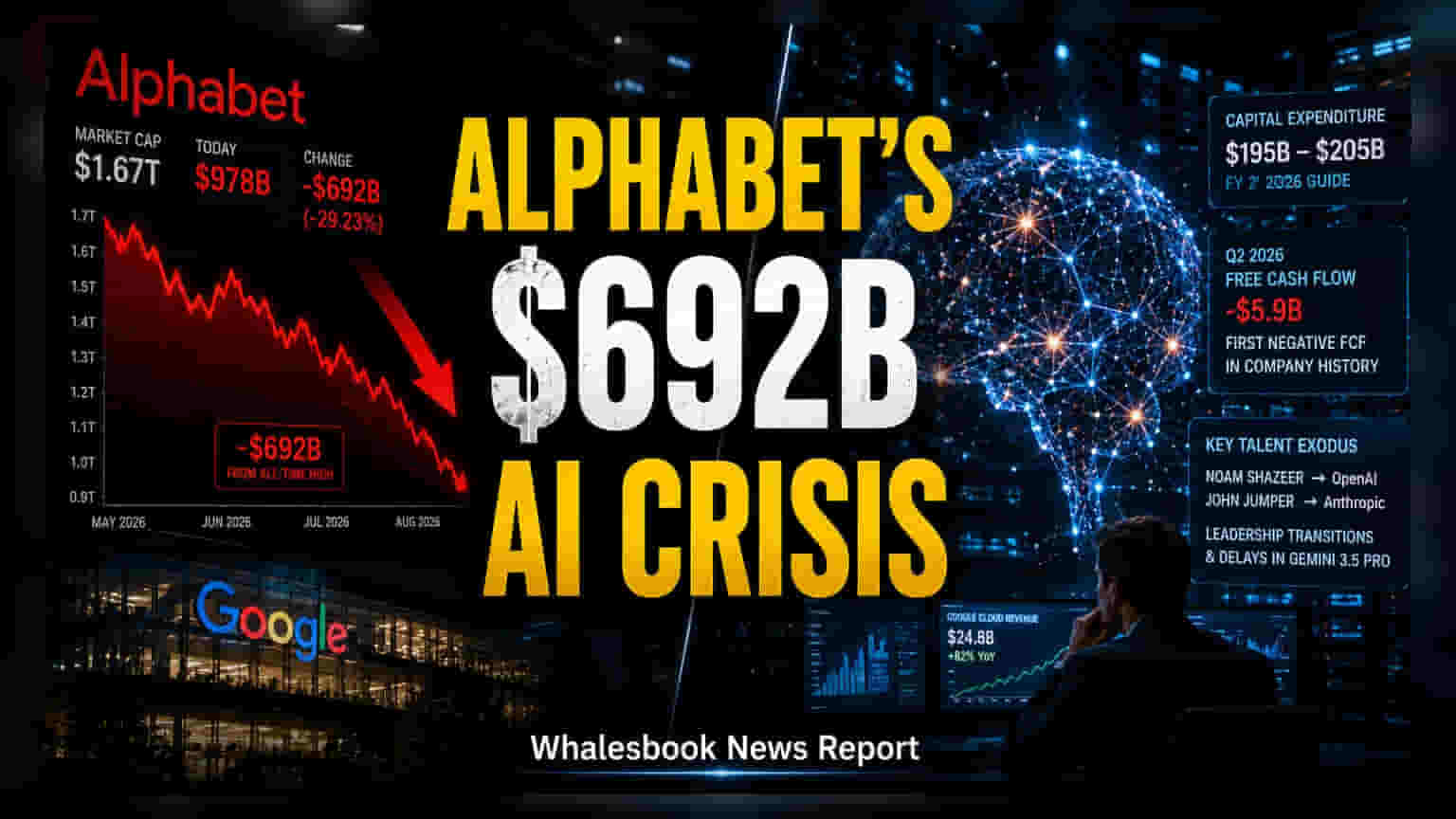
Alphabet Inc. has seen its market value decline by $692 billion since its May 2026 peak as investors weigh record AI infrastructure spending against key talent departures. Despite strong cloud growth, negative cash flow and delayed product timelines have pressured the stock. Investors are now closely evaluating whether the company's aggressive $200 billion investment plan will deliver promised returns.
Alphabet Inc. has experienced a significant shift in market sentiment, with its total market capitalization declining by $692 billion from its all-time high in mid-May 2026. This downward trend reflects growing investor anxiety regarding the company's strategy in the intensely competitive artificial intelligence sector. While the tech giant continues to report strong underlying performance in segments like cloud computing, market participants have shifted their focus to the sustainability of the company's massive financial commitments.
Record Spending and Financial Strain
The core of the investor concern lies in Alphabet's aggressive capital spending strategy. The company has guided for capital expenditure between $195 billion and $205 billion for 2026, a figure that has raised eyebrows regarding how quickly these investments can be converted into profit. In the second quarter of 2026, Alphabet reported negative free cash flow of $5.9 billion, a historical first for the company. To fund these massive infrastructure buildouts, the firm has turned to the debt markets, raising over $50 billion, alongside issuing nearly $85 billion in shares during the first half of the year. Investors are now questioning the long-term impact of this debt reliance on the company's balance sheet and whether the returns from its compute and server investments will justify the cost.
Talent Exodus and Operational Hurdles
Beyond financial metrics, the internal stability of the Google DeepMind division has become a point of contention. The technology sector has witnessed a notable exodus of key engineering talent, with high-profile figures such as Noam Shazeer moving to OpenAI and John Jumper joining Anthropic. This loss of specialized expertise, combined with leadership shifts involving key figures like Demis Hassabis and Jeff Dean, has fueled market concerns about potential internal friction. This operational transition coincides with delays in major product rollouts, specifically the Gemini 3.5 Pro model, which remains behind the initial schedule. The ability to maintain innovation speed while navigating these personnel changes is now a critical area for analysts and shareholders.
Cloud Growth vs. Market Expectations
Despite these challenges, the company’s core business segments remain robust. Alphabet’s Q2 2026 earnings showed revenue of $119.8 billion, representing a 24% year-over-year increase, while Google Cloud revenue surged by 82% to reach $24.8 billion. However, this growth has not been enough to offset the broader skepticism regarding AI monetization. The market is currently prioritizing evidence of efficient capital allocation and sustained innovation leadership over top-line growth figures.
Looking ahead, investors will be monitoring the company's ability to normalize its cash flow and prove that its massive infrastructure investments can deliver a clear competitive advantage. Key areas to watch include the official launch and performance metrics of the Gemini 3.5 Pro model, future updates on capital spending efficiency, and the company's ability to retain top engineering talent in a hyper-competitive AI landscape.