

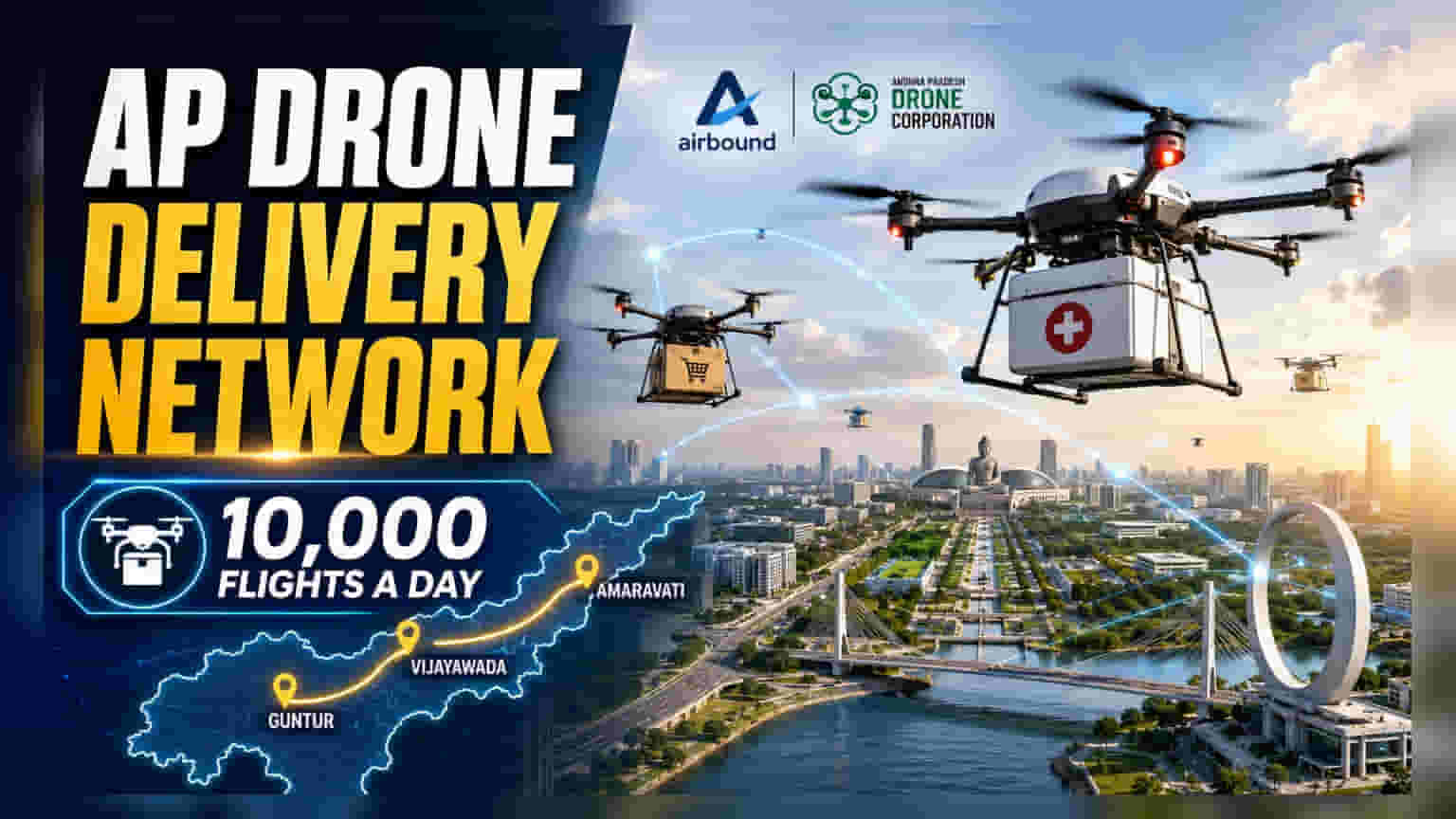
Bengaluru-based startup Airbound has partnered with the Andhra Pradesh Drone Corporation to establish a drone delivery network across the Amaravati Capital Region. The project aims to reach 10,000 daily flights to improve logistics efficiency in healthcare and commerce, highlighting the state's aggressive push for drone infrastructure.
What Happened
Bengaluru-based drone technology firm Airbound has signed a Memorandum of Understanding (MoU) with the Andhra Pradesh Drone Corporation (APDC) to develop a large-scale drone delivery network. The initiative, dubbed the Amaravati Capital Region Drone Delivery Network, aims to connect key urban centers including Amaravati, Vijayawada, and Guntur. The partnership sets an ambitious target of reaching 10,000 daily drone flights within the next year to speed up the movement of essential healthcare supplies, e-commerce goods, and commercial packages. This collaboration marks a significant step in the state's ongoing efforts to position itself as a central hub for India's drone economy.
The Technology and Efficiency Goal
At the core of this project is Airbound's proprietary hardware: a blended-wing-body tailsitter aircraft. The company reports that these drones weigh approximately 1.5 kilograms and utilize a carbon fiber design to achieve a 1.5:1 payload-to-weight ratio. The company claims this configuration can drive delivery costs as low as ₹0.10 per kilometer, potentially reducing traditional logistics costs by up to 20 times. While these performance metrics are based on company claims, the successful integration of such technology could theoretically improve mid-mile connectivity in regions where traditional road logistics face delays or high costs.
Why It Matters for the Drone Ecosystem
This project is part of a larger policy push by the Andhra Pradesh government, which has introduced the AP Drone Policy 4.0 (2024-29) and launched initiatives like the AP Drone Mart portal to foster a drone-as-a-service environment. For the broader logistics and drone sector in India, such projects serve as real-world tests for scalable, autonomous aerial networks. The involvement of the Union Civil Aviation Ministry underscores the national push to operationalize drone logistics through the Digital Sky platform and regulatory frameworks, aiming to move beyond small-scale pilots to high-volume commercial corridors.
Business Reality and Investor View
Investors should note that Airbound is a privately-held startup and is not listed on the stock exchanges. Therefore, there is no direct stock market impact from this specific partnership. However, for those tracking the drone and aerospace sector, this deal is a signal of the industry's transition from experimental use cases to integrated infrastructure. While the potential for cost reduction is high, the project's success depends on several factors: the ability to execute high-frequency operations, navigating Beyond Visual Line of Sight (BVLOS) regulations, and maintaining cost-effective operations at scale. The drone sector is currently witnessing increased venture capital interest, but it remains a capital-intensive and technology-heavy industry.
Risks and Execution Challenges
While the project goals are significant, investors and industry observers often monitor the gap between pilot-stage claims and full-scale commercial deployment. Challenges include the need for consistent air traffic management, local regulatory clearances for specific corridors, and the logistical complexity of maintaining a fleet of 10,000 daily flights. The project is currently in the initial phases, which include route mapping and coordination, and will likely require sustained infrastructure investment.
What Investors Should Track Next
For those interested in the broader drone and logistics space, key monitorables include the pace of the phased rollout in Guntur, any updates on regulatory approvals for high-density corridors, and whether this model is successfully replicated in other regions. Additionally, tracking broader sector performance—such as state-level drone policies and the adoption rates of drone-as-a-service models—will provide a better understanding of how sustainable this growth is for the Indian logistics landscape.