 Whalesbook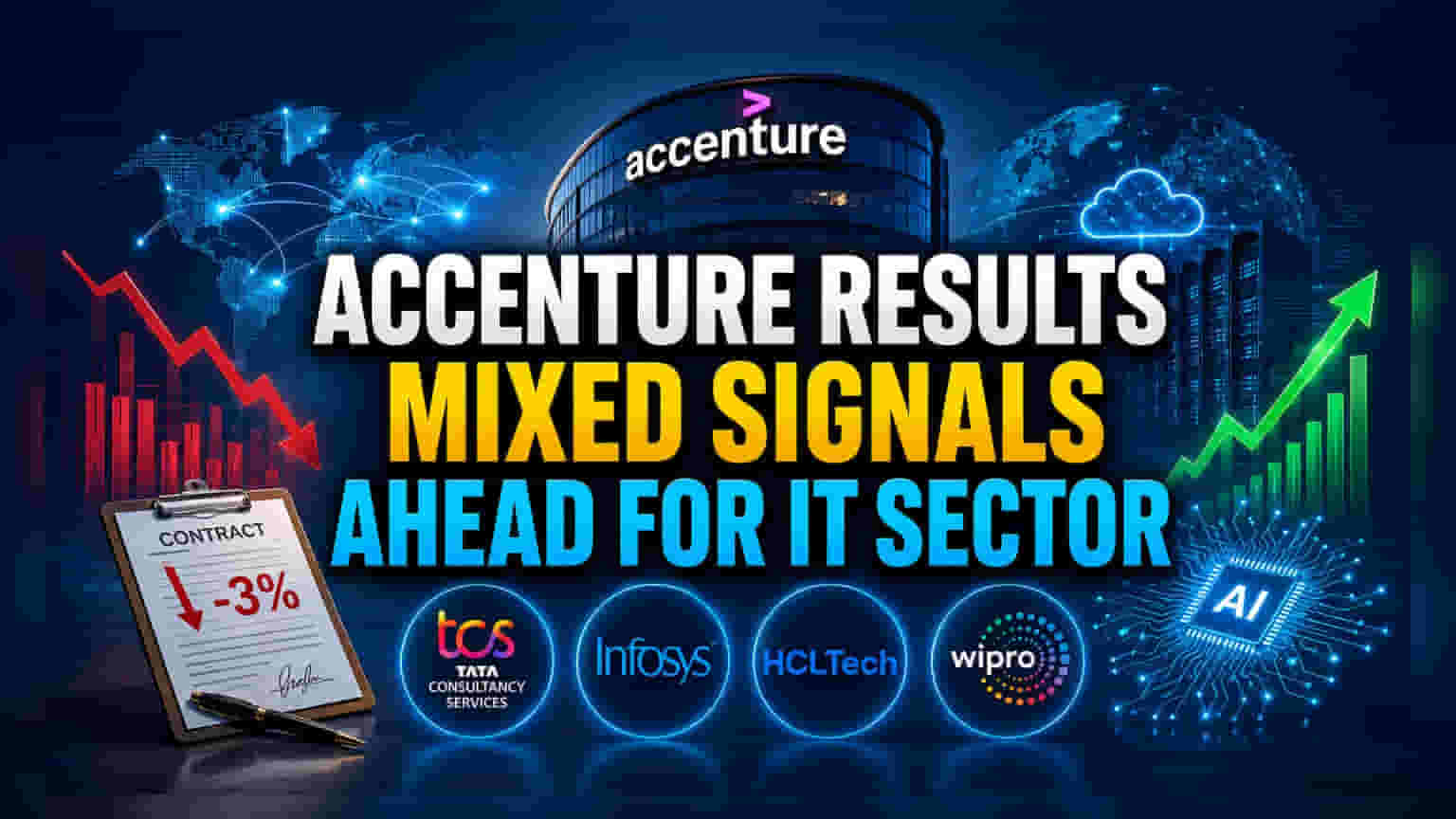
Accenture’s latest earnings show slow growth and lower booking numbers, signaling a cautious environment for the global IT sector. For Indian investors, this suggests that the recovery for companies like TCS and Infosys will be gradual, as global clients continue to prioritize cost-saving projects over large-scale digital transformations.
What Happened
Accenture, a global bellwether for the technology services industry, recently released its fiscal third-quarter results, providing a crucial update on client spending patterns. The company reported revenue of $18.72 billion, marking a 3% increase when excluding currency fluctuations. While this met the company's internal expectations, other metrics were softer. Specifically, new contract bookings fell by 3% to $19.3 billion. Following these results, the company tempered its revenue growth guidance for the full year, citing a cautious environment where clients are hesitant to commit to large-scale projects.
Why This Matters For Indian IT
Indian IT investors often look at Accenture’s performance as an early indicator of what to expect from major domestic players like TCS, Infosys, HCLTech, and Wipro. Because Accenture competes for similar global contracts, its health reflects the broader demand in the US and European markets. The key takeaway from these results is that the recovery is 'incremental'—meaning it is slow and steady rather than a sudden boom. The data confirms that while business is not shrinking, it is not accelerating either.
Consulting Versus Managed Services
For investors, the distinction between project types is vital. Accenture noted that 'Managed Services'—which involves maintenance, cloud infrastructure, and operational support—continues to show steady demand. This is often 'sticky' revenue that ensures stable cash flow for IT firms. However, 'Consulting,' which typically covers high-value, discretionary digital transformation projects, is experiencing a slowdown. Clients are currently prioritizing efficiency and cost-cutting initiatives. This suggests that while Indian IT firms may see stable performance in their core maintenance and support businesses, revenue from high-margin advisory and transformation projects may remain muted in the near term.
The AI Reality Check
Artificial intelligence remains a hot topic, with many global firms actively exploring its potential. However, Accenture’s commentary serves as a reminder that revenue generation from AI-specific engagements is still in its early stages. While it is a significant long-term opportunity, investors should manage expectations regarding immediate revenue spikes. The shift from experimental 'proof of concept' projects to large-scale, revenue-generating AI deployments takes time, and the current booking data suggests that this transition is still in the works.
How Investors May Read This
Investors may monitor the gap between 'Total Contract Value' (TCV) and actual revenue realization. A common challenge in the current environment is that even after a deal is announced, the time it takes for that deal to turn into actual revenue is lengthening. Clients are taking longer to finalize contracts and approve spending. For Indian IT firms, the focus will likely remain on their ability to capitalize on vendor consolidation—where clients bring multiple projects under fewer, larger, and more trusted partners—rather than waiting for a sudden surge in new, discretionary IT spending.
What Investors Should Track
Moving forward, the primary monitorables for the sector remain consistent. Investors may track commentary from Indian IT management teams regarding deal conversion velocity and client spending sentiment in the US and Europe. Additionally, watching for stability or growth in operating margins will be important, as companies look to protect profitability in a slower growth environment. Finally, any updates on when large-scale discretionary spending might resume will be a key signal for a more meaningful recovery in the IT sector.

