

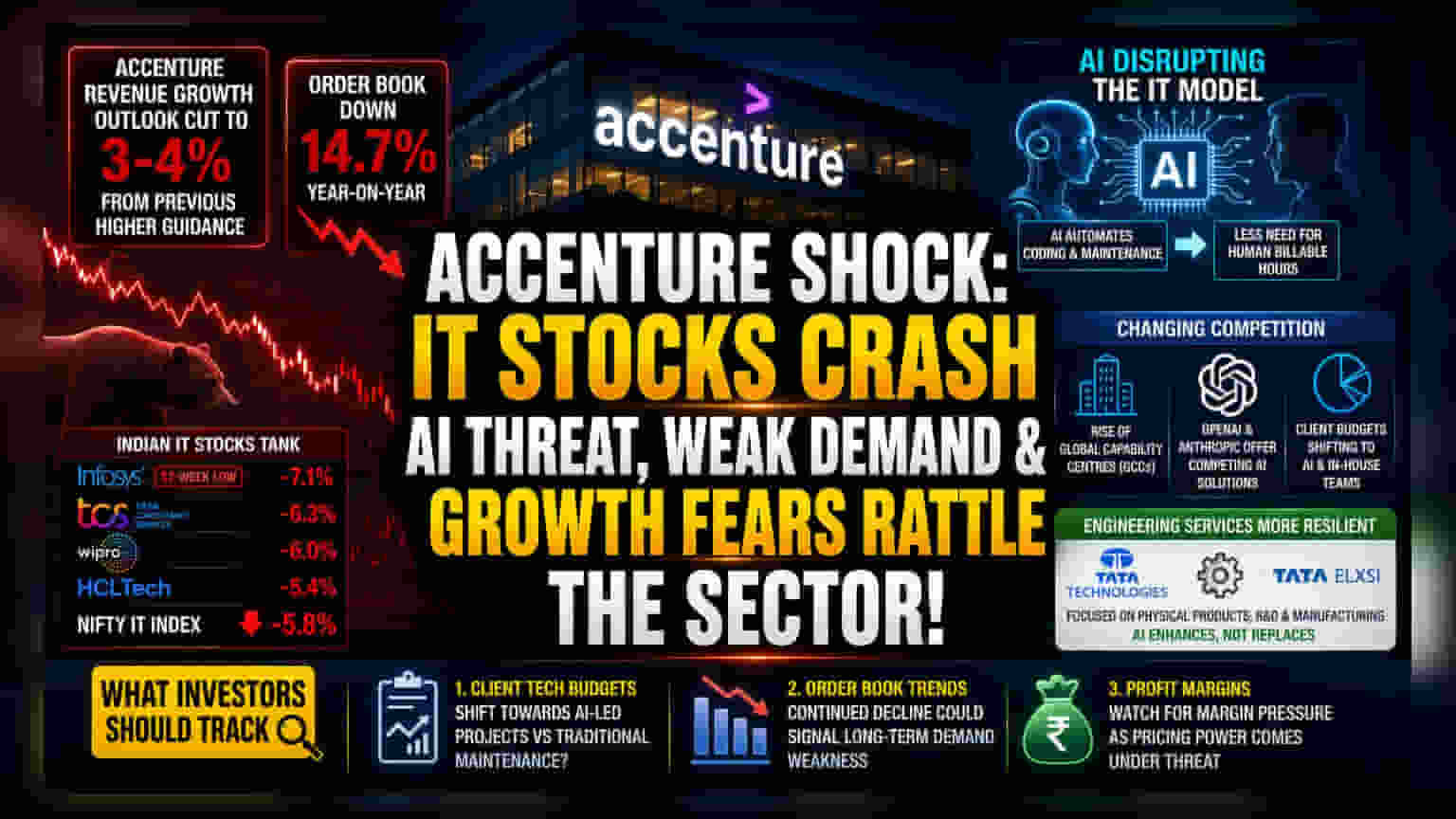
Accenture's slashed growth forecast and 14.7% drop in orders have triggered a sharp decline in Indian IT shares. Investors are increasingly concerned that AI automation is shrinking demand for traditional coding and maintenance services. The sector is now facing structural questions about whether it can adapt its labor-intensive business model to a world where software development is becoming cheaper and more automated.
What Happened
Accenture, a global bellwether for the IT outsourcing industry, recently reported a significant downward revision to its annual revenue growth forecast, now expected at just 3-4%. The company also disclosed a 14.7% drop in its order book year-on-year, signaling weak demand for consulting and IT services. Following this announcement, Indian IT stocks faced heavy selling pressure. Major names, including Infosys, saw their share prices hit 52-week lows, while the Nifty IT index experienced a sharp decline.
Why Investors Are Worried About AI
For years, the Indian IT sector has grown by providing large teams to handle coding, software testing, and application maintenance for global clients. This model relies on “billable hours,” where companies earn revenue based on the number of hours their employees spend on a task. Investors are concerned that artificial intelligence is fundamentally changing this dynamic. AI tools can now automate routine coding and software maintenance, potentially reducing the need for human labor. If clients can use AI to do this work faster and cheaper in-house, the revenue model for traditional IT outsourcing providers may come under pressure.
The Changing Competitive Landscape
Beyond automation, the rise of Global Capability Centres (GCCs) is adding to the challenge. Many multinational corporations are choosing to build their own technology teams in India rather than hiring external IT service providers. Furthermore, companies like OpenAI and Anthropic are increasingly offering their own AI-driven solutions that compete directly with the services traditionally sold by outsourcing firms. While clients are spending more on technology overall, they are shifting their budgets away from external service providers and toward AI tools and internal teams, which impacts the growth outlook for large IT exporters.
Engineering Services vs. Software Services
Not all parts of the IT sector are equally exposed to this shift. Analysts point out that firms focused on engineering and R&D services, such as Tata Technologies and Tata Elxsi, may be more resilient. Their work is often tied to physical products, hardware, and manufacturing—areas where AI is being used to build new products rather than simply replacing existing tasks. While software services might face significant disruption, engineering services may see a much more moderate impact, as they often require specialized physical infrastructure and human expertise that is harder to replace with basic software automation.
What Investors Should Track Next
Going forward, investors may want to monitor a few specific indicators to gauge the health of the sector. First, watch for commentary in quarterly results regarding client tech budgets and whether they are allocating more money to AI-driven projects versus traditional maintenance. Second, track the order book data for major IT firms; a consistent decline could signal that the shift in client spending is long-term. Finally, observe the profit margins of these companies; if margins begin to fall, it may indicate that firms are struggling to maintain pricing power in an environment where AI makes their services easier to automate and, therefore, potentially less valuable.