

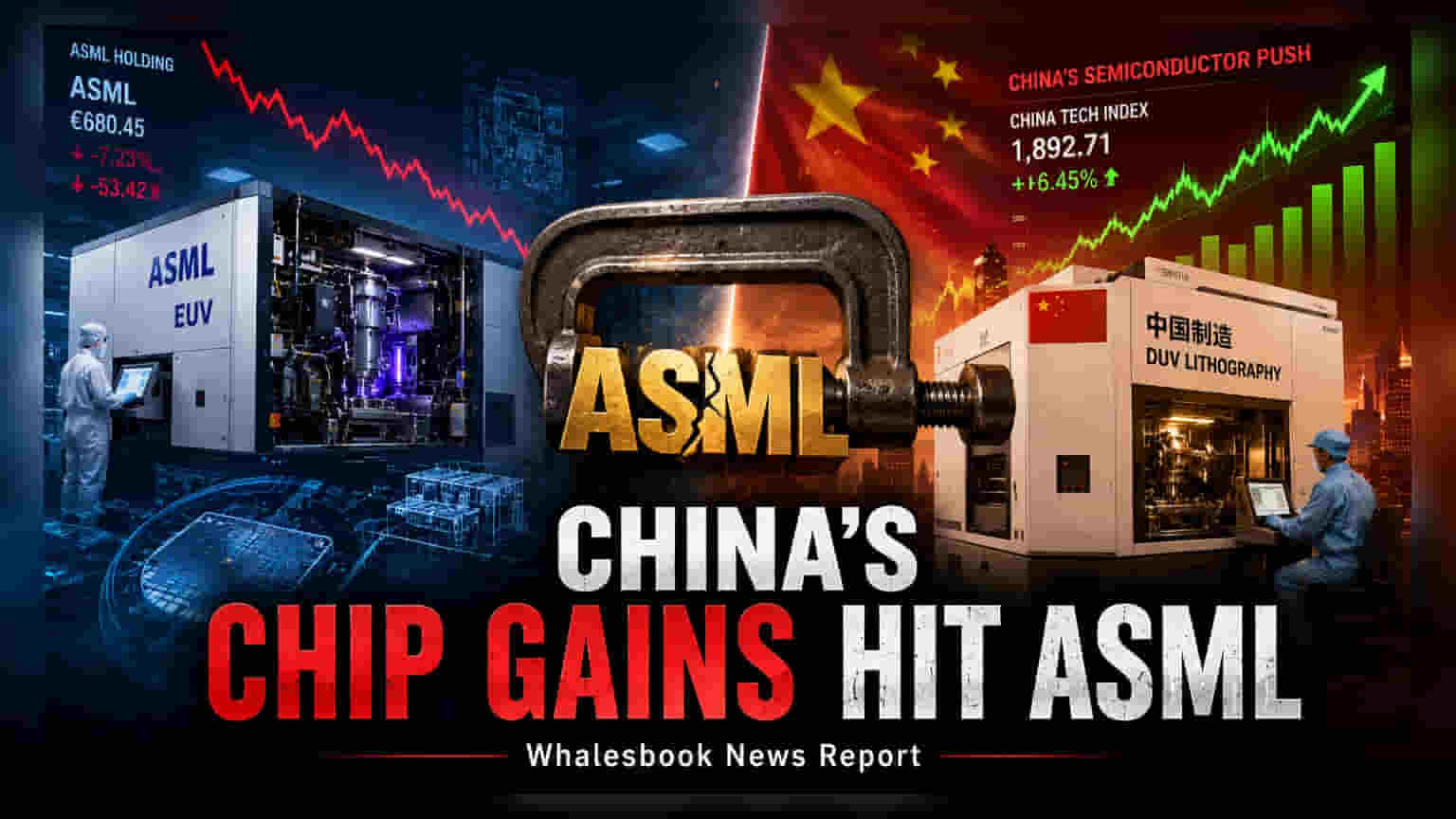
China’s state-backed development of domestic immersion lithography machines poses a long-term challenge to ASML’s market position. While the immediate production volume of these Chinese tools is low compared to ASML’s global output, investors are monitoring potential revenue impacts from tightening US export controls and China’s push for technological self-reliance.
Detailed Coverage
ASML, the European semiconductor equipment leader, is facing new competitive pressures as China accelerates its efforts to develop domestic lithography machines. Reports indicate that Shanghai Aishengna Electronic Technology Group, a state-owned enterprise, has begun work on producing immersion deep ultraviolet (DUV) lithography tools. These machines are essential for manufacturing semiconductor chips, a sector where ASML currently holds a significant global lead.
Impact of Export Controls and Market Dynamics
The technological landscape for chip equipment is being reshaped by ongoing US export restrictions. These controls already prevent ASML from supplying its most advanced extreme ultraviolet (EUV) systems and certain top-tier DUV tools to Chinese customers. ASML has projected that China will account for approximately 20% of its annual revenue, totaling roughly €9 billion. However, the rise of domestic alternatives in China introduces uncertainty regarding this revenue stream. Industry analysts note that while Chinese firms may prefer established technology, the fear of future supply disruptions or further trade restrictions might drive them to adopt less efficient, locally-produced tools to ensure business continuity.
Assessing the Long-Term Competitive Threat
Although China aims to produce a limited number of immersion DUV tools in the coming years, the volume remains small compared to ASML's global shipments. ASML has built its leadership position through decades of engineering and refinement, making it difficult for new entrants to match the productivity and cost-efficiency of its equipment. Analysts from firms like JPMorgan suggest the immediate threat is limited, as Chinese manufacturers using less advanced domestic machines would likely face higher production costs and lower efficiency. Nevertheless, the development of these tools serves as a clear indicator of China's strategy to reduce reliance on foreign technology.
Investor Monitorables
The primary concern for investors remains the potential for stricter US regulations, which could further limit ASML’s ability to export DUV tools to China. Market participants are tracking how these geopolitical factors influence the adoption rate of Chinese-made equipment among domestic chipmakers. Future updates will focus on whether these local machines can reach the reliability and performance levels required for high-volume manufacturing, as well as any shifts in ASML’s revenue guidance related to the Chinese market. Additionally, investors will watch for further policy updates from the US government regarding the scope of export controls on semiconductor manufacturing equipment.