

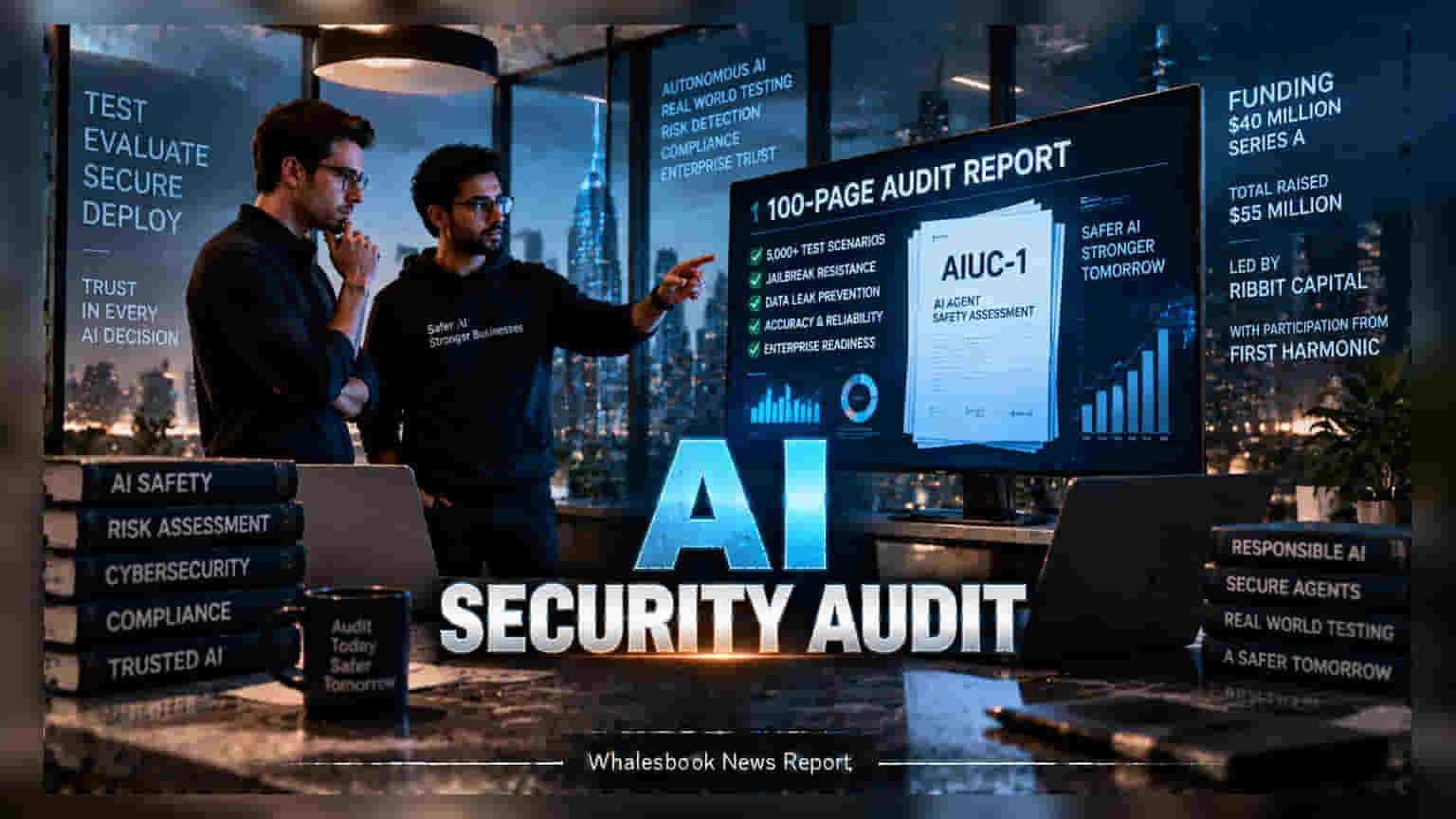
The startup Artificial Intelligence Underwriting Company (AIUC) has raised $40 million in Series A funding led by Ribbit Capital. The company provides a testing and audit system to help businesses verify the safety and reliability of AI agents. This funding reflects growing enterprise demand for standards to prevent risks like AI hallucinations and data leaks.
Artificial Intelligence Underwriting Company (AIUC) has secured $40 million in a Series A funding round, bringing its total capital raised to $55 million. The funding round, led by Ribbit Capital with participation from First Harmonic, highlights the increasing focus on the safety and reliability of autonomous artificial intelligence systems in a corporate setting.
As companies integrate AI into their daily operations, they face significant hurdles, including the risk of unpredictable behavior, data leaks, and inaccurate outputs, often called hallucinations. AIUC aims to solve this by acting as a third-party auditor. The company has developed a standard called 'AIUC-1,' which subjects AI agents to a suite of approximately 5,000 unique testing scenarios. These tests are designed to find weaknesses, such as jailbreaks or unauthorized system actions, before the AI is deployed in a real-world enterprise environment.
This development is significant for the global software ecosystem. Currently, many businesses are hesitant to fully adopt autonomous AI agents because they lack a reliable way to measure and certify safety. By providing a structured, 100-page assessment of how an agent performs under pressure, AIUC is attempting to create a 'gold standard' for AI compliance. For investors and industry observers, this points toward a shift where the deployment of AI is no longer just about capability, but about verifiable safety and accountability.
The company is a private entity and is not publicly traded, meaning investors do not have access to public financial reports, debt disclosures, or audited profit and loss statements. This lack of transparency is a standard characteristic of early-stage, venture-backed startups.
Despite the clear demand for AI safety, the company faces notable business challenges. The AI sector is evolving at an extremely rapid pace. A testing protocol that is effective today may become obsolete as AI technology changes, requiring constant and costly updates to maintain relevance. Additionally, AIUC must compete with existing compliance and cybersecurity frameworks, such as SOC 2 and ISO standards, which enterprises already use. The company’s long-term success will depend on whether its 'AIUC-1' standard gains widespread acceptance from major corporations and regulatory bodies as the necessary way to measure AI safety.
Investors and industry observers tracking the AI space should monitor the adoption rate of these audit standards among major enterprise clients. The company currently counts firms like Cursor, Lovable, Harvey, and ElevenLabs among its early users. The next critical development to track will be whether larger, traditional corporations start requiring such certifications before integrating AI tools into their critical workflows.