 Whalesbook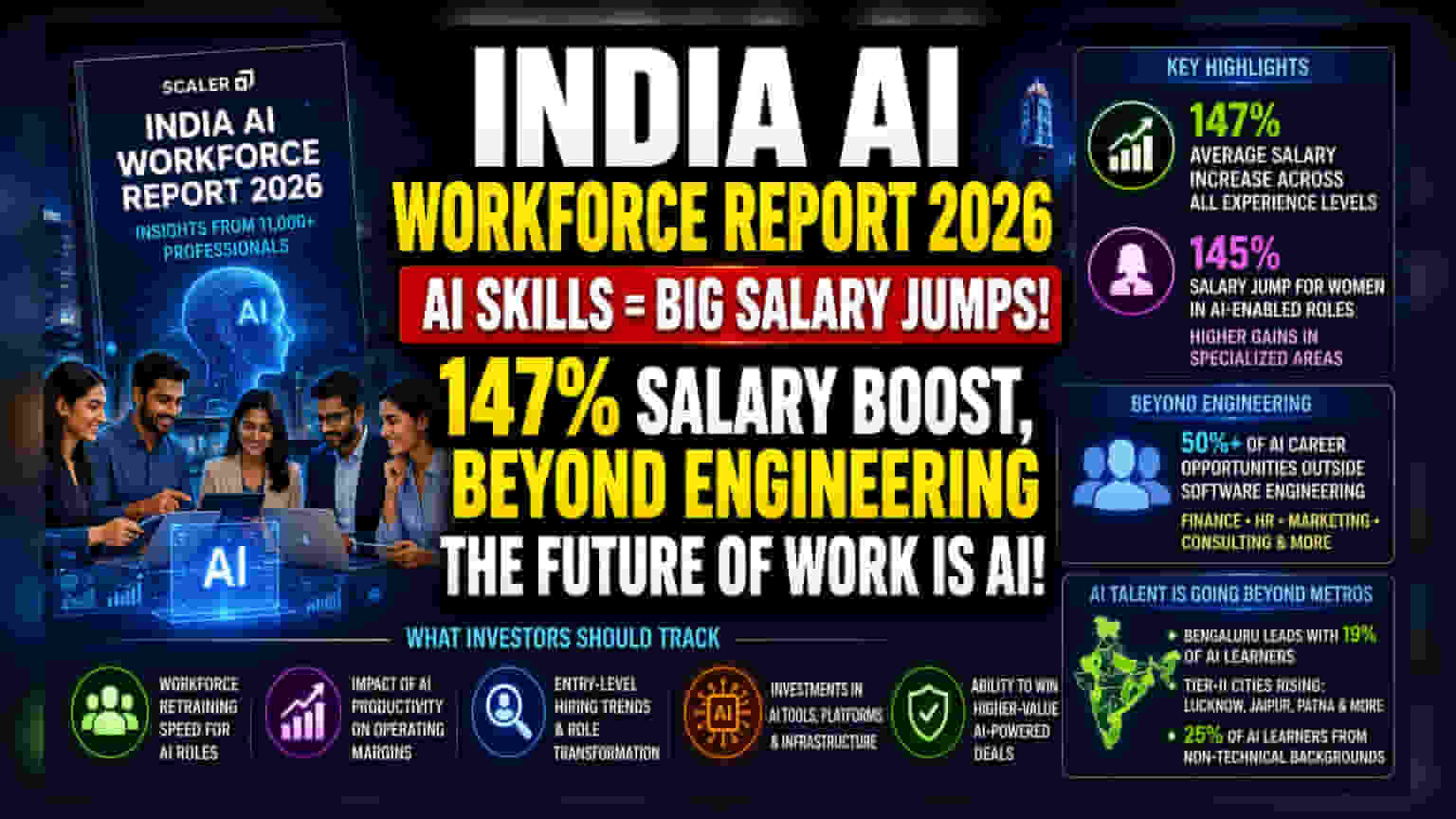
A new report from Scaler reveals that AI upskilling is leading to major salary jumps, with women seeing a 145% average increase. For Indian investors and the broader IT sector, this signals a massive shift in how companies value talent, moving away from traditional engineering-only roles toward AI-integrated functions across marketing, HR, and consulting.
What Happened
The India AI Workforce Report 2026, released by the education platform Scaler, has highlighted a major shift in the Indian job market. The study, which analyzed data from over 11,000 professionals, shows that artificial intelligence (AI) is no longer a niche skill for software engineers. Instead, it is becoming a mainstream requirement across all business functions. The report found that professionals who upskill in AI are seeing substantial financial rewards, with an average salary increase of 147% across all experience levels. Women in particular have benefited significantly, reporting an average salary jump of 145% after moving into AI-enabled roles, with some specialized areas seeing even higher gains.
Why This Matters For Investors
For investors, this trend provides a clear signal about the changing nature of the Indian IT services sector. For decades, the industry grew by hiring large numbers of engineering graduates to perform standardized tasks. Now, the shift toward AI-integrated roles indicates that value creation is moving away from the sheer number of hours worked toward the quality of output enhanced by AI tools. This is a structural change for companies like Tata Consultancy Services, Infosys, Wipro, and HCL Technologies. Investors may monitor how these firms manage their margins as they transition from a workforce-heavy model to one that emphasizes higher-value, AI-proficient talent. The ability of these companies to retrain their existing staff will be a key factor in maintaining profitability in an era where AI is rapidly automating entry-level work.
The Shift Beyond Engineering
The most notable finding is that over half of AI-enabled career opportunities are now appearing outside traditional software engineering roles. Functions such as finance, human resources, marketing, and consulting are increasingly becoming AI-driven. This means that a large part of the workforce is expected to move from simple task execution to supervising or managing AI systems. For Indian enterprises, this creates both a challenge and an opportunity. The challenge lies in the rapid need for retraining a large, existing workforce, while the opportunity lies in potentially higher productivity per employee.
Geographic and Talent Trends
While Bengaluru remains the primary hub for AI talent, accounting for 19% of learners in the study, the influence of AI is spreading to Tier-II cities like Lucknow, Jaipur, and Patna. This suggests that the cost of hiring and the competition for talent may begin to diversify geographically, potentially reducing the pressure on costs in major metros. Furthermore, the fact that 25% of AI learners come from non-technical backgrounds indicates that businesses are increasingly prioritizing domain knowledge combined with AI adaptability, rather than just technical coding skills.
Risks and Structural Changes
It is important to look at the other side of this transition. While new opportunities are emerging, there is a risk of displacement for roles that are highly repetitive and process-heavy. Many traditional IT service jobs fall into this category. If companies cannot successfully transition their workforce, they may face pressure on margins due to high training costs or the need to replace staff. Additionally, with global clients increasingly looking for AI-powered solutions, firms that are slow to pivot their service model may lose market share to more agile competitors. The market is also seeing a shift where companies are prioritizing AI infrastructure investment over headcount growth, which could change the dynamics of revenue and expense for major IT players.
What Investors Should Track
Investors looking at the IT and services sector may want to monitor management commentary in upcoming earnings calls. Key monitorables include the percentage of the workforce that has been retrained for AI-integrated roles, the impact of AI-driven productivity on operating margins, and how companies are altering their hiring strategies for entry-level positions. The speed at which large IT firms can replace the old outsourcing model with value-added AI services will be a primary indicator of their long-term competitiveness.

