

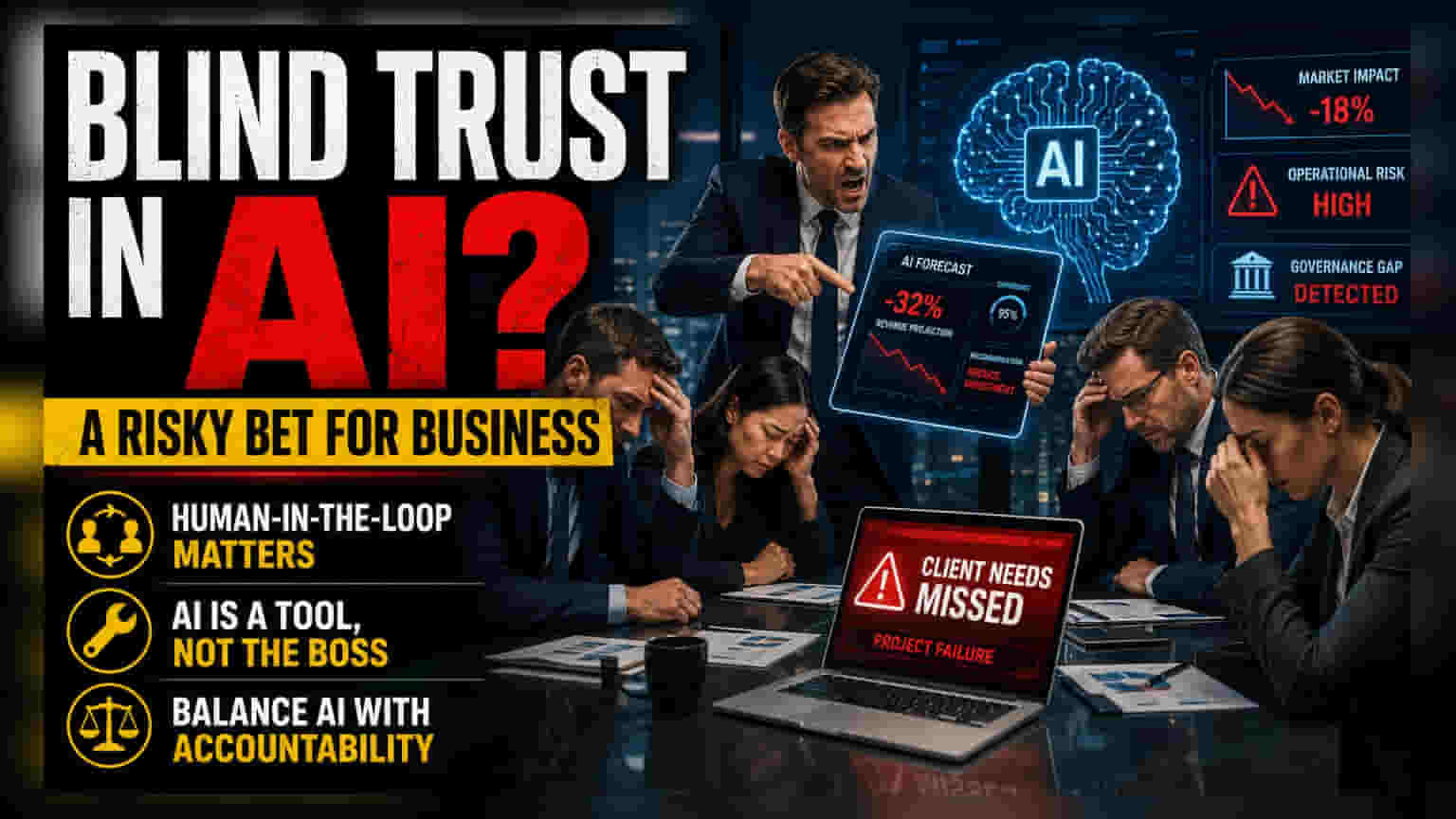
A viral report of a manager prioritizing AI predictions over human judgment has sparked concerns about corporate AI dependence. For investors, this highlights the need to scrutinize how companies balance AI efficiency with human oversight and operational reality.
What Happened
Recent discussions in professional circles have highlighted a growing issue in corporate environments: the blind over-reliance on artificial intelligence (AI) tools. A widely circulated account described a manager who began exclusively trusting AI forecasts—specifically from Anthropic’s Claude—over the actual experience and feedback of their team.
According to the report, the manager held staff accountable for client project failures that were essentially caused by the AI’s lack of real-world context. When the AI’s projections didn’t match client needs, the manager reportedly failed to use human judgment, instead blaming the employees for the discrepancy. This case study serves as a stark example of how, without proper oversight, AI tools can create operational friction rather than efficiency.
Governance And Operational Risks
For investors, the primary concern here is not the AI technology itself, but the governance surrounding its implementation. When a company adopts AI, it must ensure a 'human-in-the-loop' framework, meaning human judgment remains the final arbiter for critical decisions.
When management treats an AI model as an infallible authority, they introduce a 'black box' risk. AI systems are designed to process data and predict patterns, but they lack the nuance to understand unique client relationships, sudden market shifts, or internal operational constraints. Relying on an AI to dictate strategy without human validation is a significant corporate governance failure that can damage company culture, employee retention, and ultimately, bottom-line performance.
The Cost Of 'AI Paralysis'
Unchecked dependence on AI can lead to what is sometimes called 'AI paralysis.' In this scenario, managers stop making decisions based on data, experience, and logic, waiting instead for the AI to provide answers. If an AI system is prompted with vague or leading questions—such as 'what is wrong with this company?'—it will often generate critical reports even when the business is performing well.
This can lead to unnecessary budget freezes, halted innovation, or even questionable restructuring plans. Companies that replace critical thinking with AI-generated prompts risk losing their competitive edge. The productivity of a company is often driven by human problem-solving; if that is replaced by algorithmic output that ignores reality, the business model may suffer.
What Investors Should Track
Investors evaluating companies undergoing digital transformation should look beyond the hype of AI adoption. It is helpful to understand how a company integrates these tools into its workflow.
Key monitorables include:
- AI Governance Policies: Does the company have clear guidelines on how AI-generated output is validated by human teams?
- Operational Efficiency: Are management teams using AI to assist in efficiency, or are they using it to delegate decision-making power?
- Management Track Record: When major strategic changes are made, are they backed by comprehensive business logic, or do they seem disconnected from market realities?
Ultimately, AI should be viewed as a tool to augment expertise, not a replacement for accountability. Companies that maintain a balance between data-driven insights and human experience are generally better positioned to manage the risks associated with new technologies.