 Whalesbook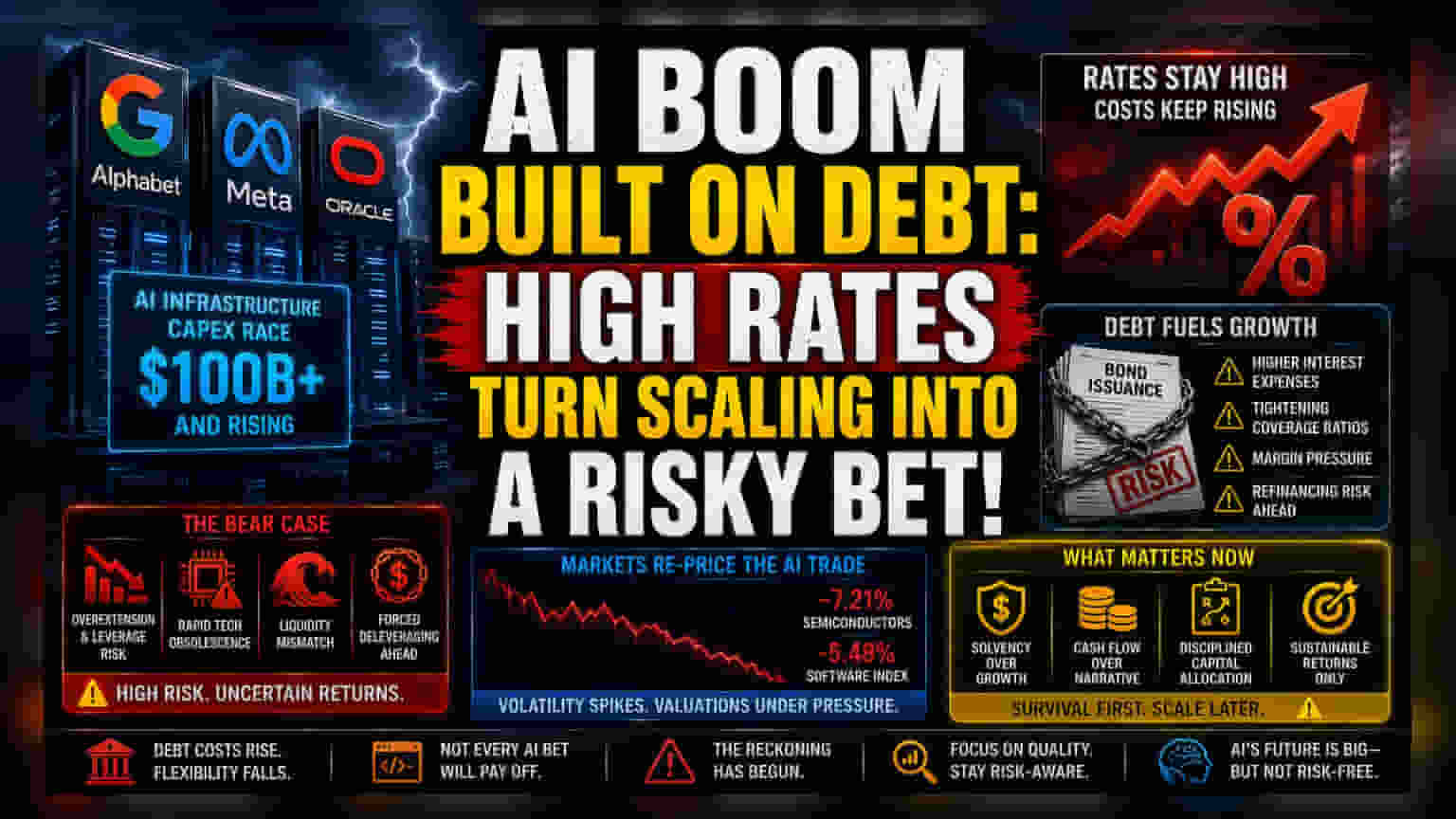


The Capital Expenditure Trap
The fundamental premise driving the artificial intelligence rally is beginning to buckle under the weight of macroeconomic reality. While markets previously treated AI infrastructure spending as a virtuous cycle of reinvestment, the transition toward aggressive debt financing has fundamentally altered the risk profile of companies like Alphabet, Meta Platforms, and Oracle. When the cost of capital was suppressed, debt-fueled scaling was an efficient mechanism to capture market share. Now, with interest rates likely to remain elevated following strong labor market data, the sheer scale of borrowing required to sustain data center growth has become a liability rather than a strategic asset.
The Sensitivity of Debt-Heavy Tech
Corporate treasuries that once sat on massive cash piles are now navigating complex bond issuance cycles to bridge the gap between internal cash flow and the $100 billion-plus capital expenditure budgets required to remain competitive. This structural change renders major tech players significantly more vulnerable to Federal Reserve policy shifts than they were during the previous decade. When refinancing occurs in a high-rate environment, the interest coverage ratios of these firms will inevitably tighten, forcing a difficult choice between slowing infrastructure deployment or accepting margin compression. This environment is particularly punishing for smaller, specialized cloud providers who lack the massive balance sheets of the industry leaders, often relying on thin margins and concentrated, project-specific contracts that may not survive a sustained period of high interest rates.
The Bear Case: Structural Overextension
Beyond the immediate impact of interest expenses, the sector faces a potential liquidity mismatch. The reliance on long-term debt to fund short-cycle technology upgrades creates a persistent refinancing risk. If the expected returns on AI hardware and software fail to materialize with the speed forecasted by management teams, the industry will be forced to confront a period of forced deleveraging. Furthermore, the high degree of market concentration in a handful of stocks means that systemic failure in one major firm’s capital strategy could trigger a sector-wide repricing event. Unlike traditional industrial companies with physical assets that hold long-term value, the rapid obsolescence of high-performance computing hardware makes using debt to fund such assets an exceptionally high-risk endeavor, especially when the underlying cash flows remain speculative.
The Valuation Reckoning
Investors are now beginning to re-evaluate the risk premium associated with AI-centric equities. The recent volatility in the semiconductor and software indices suggests that the market is beginning to price in the duration risk of these massive capital projects. As the cost of servicing debt rises, the hurdle rate for new AI initiatives effectively increases, which will likely lead to more stringent capital allocation discipline. Companies unable to demonstrate clear, immediate pathways to debt reduction will likely see their valuation multiples compress as the market prioritizes solvency and cash generation over raw expansion metrics.