 Whalesbook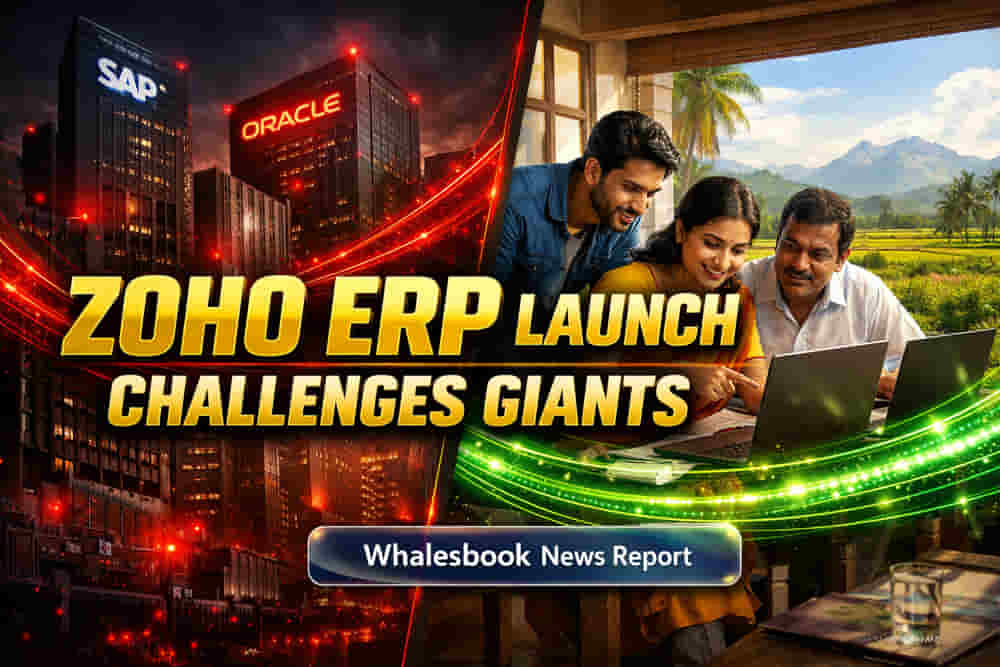
1. THE SEAMLESS LINK (Flow Rule):
Zoho ERP's debut from Kumbakonam signals a significant shift in enterprise software strategy, directly confronting the dominance of legacy ERP providers. This launch isn't merely a product release; it's a statement about democratizing advanced enterprise technology by developing it outside traditional tech hubs and offering it at competitive terms. The company is leveraging its established 'Tenkasi model' to foster product development and talent in non-metropolitan regions, a stark contrast to the global giants' established, often costly, implementation methods.
2. THE SEAMLESS LINK (Flow Rule):
Zoho ERP's debut from Kumbakonam signals a significant shift in enterprise software strategy, directly confronting the dominance of legacy ERP providers. This launch isn't merely a product release; it's a statement about democratizing advanced enterprise technology by developing it outside traditional tech hubs and offering it at competitive terms. The company is leveraging its established 'Tenkasi model' to foster product development and talent in non-metropolitan regions, a stark contrast to the global giants' established, often costly, implementation methods.
The Challenger Emerges from Rural Roots
The introduction of Zoho ERP marks a direct bid by the Indian software giant to disrupt the global ERP market, estimated to be worth over $135 billion in 2024. Developed in Kumbakonam, a town far removed from typical tech epicenters, the platform aims to serve as a powerful, compliance-ready, homegrown alternative to solutions from SAP, Oracle, and Microsoft Dynamics. CEO Shailesh Davey highlighted that the deep R&D for Zoho ERP was significantly supported by talent cultivated in Kumbakonam, underscoring the company's strategy of building global products from rural India. This approach taps into a vast, often overlooked, talent pool, mirroring Zoho's successful 'Tenkasi model'. The company plans a substantial expansion in Kumbakonam, with a new campus designed to accommodate up to 2,000 employees by 2026, supporting the product's global rollout.
AI Integration and Streamlined Implementation
Zoho ERP is positioned as 'AI-native,' embedding continuous intelligence across its functionalities rather than treating AI as an add-on layer. This includes AI-driven customizations, predictive insights, anomaly detection, and voice-based assistance through its private AI engine, 'Ask Zia'. This contrasts with traditional ERP systems where AI integration can be complex and costly. Furthermore, Zoho emphasizes its native low-code and no-code capabilities, designed to reduce reliance on third-party consultants and simplify implementation. This aims to significantly lower the total cost of ownership (TCO) and implementation timelines, which are common pain points with legacy ERP migrations that often require extensive customization and consultant dependency. The platform covers core financial management, billing, spend, supply chain, and payroll, along with industry-specific modules for manufacturing, distribution, retail, and non-profits.
Challenging Global Giants on Cost and Accessibility
Global ERP leaders like SAP and Oracle dominate the market, with SAP holding an estimated 13.7% and Oracle 6.5% of the ERP apps revenue in 2024. These systems are often perceived as expensive, with high licensing and implementation costs. Zoho's strategy, however, focuses on providing a more accessible and affordable solution. While specific Zoho ERP pricing is not public, the company's historical approach and general market positioning suggest a focus on value, subscription-based models, and lower upfront investment compared to multi-year contracts and substantial consultant fees associated with SAP and Oracle. Zoho's bootstrapped model and long-term R&D investment enable it to offer industry-leading functionality without the pressure of immediate shareholder returns, potentially translating into more competitive pricing and features. The Indian SaaS market itself is a significant growth area, projected to reach $37.3 billion by 2030 with a CAGR of 18.2%, indicating a fertile ground for homegrown solutions like Zoho ERP. Zoho aims to capture a segment of businesses that find traditional ERP solutions to be rigid, complex, and prohibitively expensive.
Future Outlook and Strategic Positioning
Zoho's launch of Zoho ERP from a rural Indian town is more than a product introduction; it represents a strategic vision for talent development, technology accessibility, and global market penetration. The company's commitment to rural development and its robust, integrated software ecosystem position it favorably against competitors who may be slower to adapt to evolving work models and cost-conscious market demands. As Zoho scales its ERP product globally, its 'hub-and-spoke' model, coupled with native AI and low-code features, could present a compelling value proposition to businesses worldwide seeking efficient, cost-effective, and customizable ERP solutions.
3. THE STRUCTURE (The 'Smart Investor' Analysis):
### The Valuation Gap and Market Entry
Zoho, a privately held company, has achieved significant scale and profitability without venture capital, with its valuation estimated at over $12 billion. This financial resilience supports its long-term R&D investments and ability to challenge established market leaders like SAP and Oracle, which command substantial market share and revenue. SAP and Oracle are generally considered premium-priced solutions, with SAP often perceived as more expensive due to licensing and implementation fees. Zoho ERP's strategic pricing, leveraging its rural development model and integrated platform, aims to undercut these traditional costs, targeting businesses that are priced out or find legacy systems overly complex. The Indian SaaS market, a key focus, is experiencing robust growth, providing a strong initial base for Zoho ERP's expansion.
### Differentiators in a Crowded Field
The core differentiators for Zoho ERP lie in its AI-native architecture and its unique development strategy. By embedding AI throughout the platform rather than adding it as a module, Zoho promises more seamless automation, predictive analytics, and operational insights, powered by its 'Ask Zia' assistant. The emphasis on native low-code and no-code tools empowers businesses to customize workflows internally, reducing dependency on costly third-party consultants and speeding up implementation, a significant departure from the often lengthy and expensive processes associated with SAP and Oracle. The development and launch from rural Tamil Nadu also serve as a powerful marketing narrative, highlighting Zoho's commitment to inclusive growth and talent development, a strategy that has fostered over 100 rural offices. This rural talent acquisition model is also cost-efficient, contrasting with the premium salaries often commanded by talent in major tech hubs.
### Path to Global Expansion and Competitive Nuances
With its launch in India, Zoho ERP is slated for a global rollout. The company's established global presence and its track record of building integrated software suites provide a foundation for this expansion. While SAP and Oracle cater to complex enterprise needs with extensive customization options, Zoho's strength lies in offering a more integrated, user-friendly, and cost-effective solution, particularly for mid-market and growing businesses that may not require the full depth or complexity of SAP's offerings. The company's vision of connecting fintech, banking, and business software further strengthens its integrated approach. The planned expansion of its Kumbakonam campus to accommodate 2,000 employees by 2026 demonstrates a commitment to scaling both the product and the talent base required for global operations.