 Whalesbook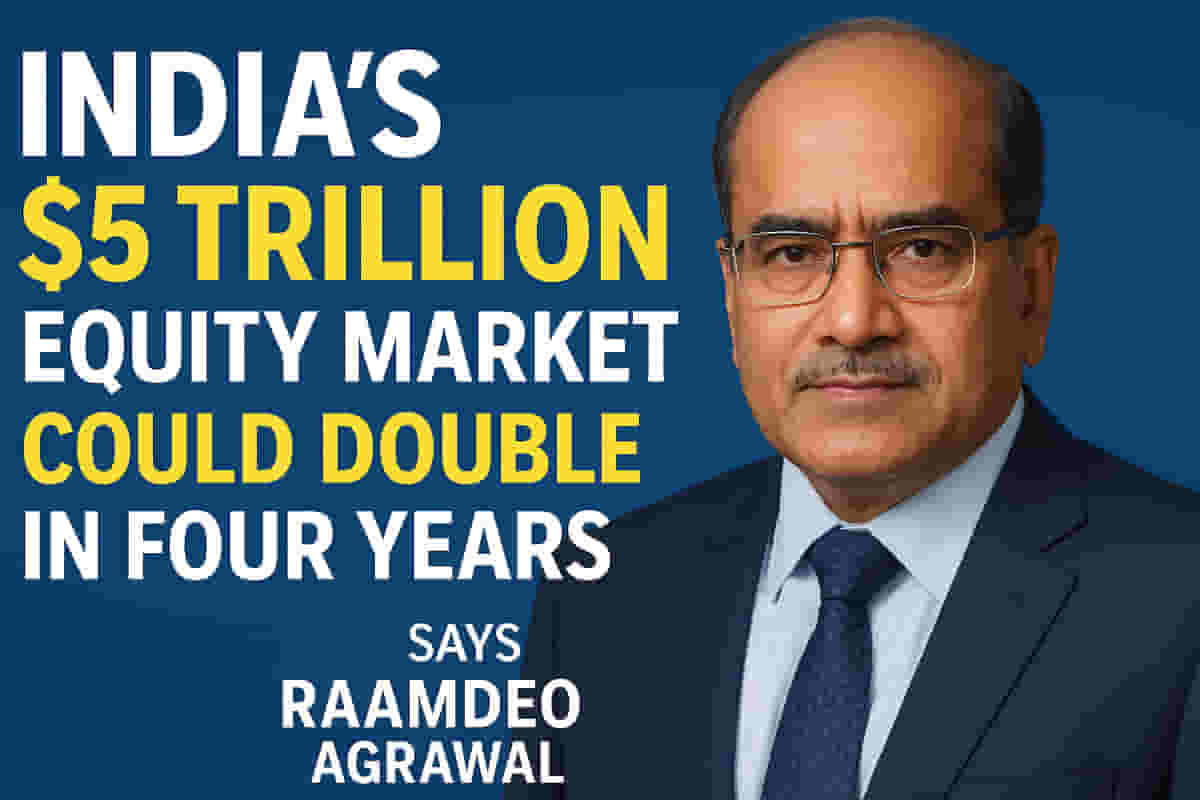
India's Equity Market Set for Massive Growth to $10 Trillion
Raamdeo Agrawal, Chairman and Co-Founder of Motilal Oswal Financial Services, has projected a significant expansion for India's equity market, forecasting it could reach $10 trillion in size within the next four to five years. This ambitious prediction, more than doubling the current $5 trillion market, is underpinned by a combination of strong economic growth, disciplined regulatory frameworks, and an increasing culture of financial participation among Indians. Agrawal shared these insights during the release of Motilal Oswal's 30th Wealth Creation Study, highlighting India's advanced stage of financialisation even with a per capita income below $3,000.
The Core Issue
Agrawal emphasized that India is "well ahead of the curve" in financialisation. He believes the system's disciplined management and proactive regulators are key drivers. The projected doubling of the market signifies robust confidence in India's economic trajectory and its integration into global financial systems.
Financialisation Without Fear
Addressing concerns about over-financialisation at lower income levels, Agrawal stated that markets possess inherent self-correcting mechanisms tied to earnings growth. He explained that market fluctuations are natural, with supply of equity increasing when valuations rise and decreasing when they fall. This dynamic response prevents structural excesses, ensuring valuations remain anchored to corporate profitability.
Evolution of Wealth
Agrawal noted a profound historical shift in the nature of wealth, moving from tangible assets like land and gold to intangible "paper wealth" represented by market capitalisation. This evolution, driven by the advent of joint-stock companies and public participation, has created a powerful wealth machine. Today's "kings" are figures like Elon Musk and Bill Gates, whose fortunes are primarily measured by their companies' market capitalisation, a concept vastly different from the physical wealth of historical rulers.
Market Cap-to-GDP Reinterpreted
The traditional valuation anchor, the market capitalisation-to-GDP ratio (often called the Buffett Ratio), is undergoing reinterpretation. Agrawal pointed out that while this ratio was historically seen as having a ceiling around one, it has risen to approximately 1.3 in India and is as high as 2.3 in the United States. He cited Warren Buffett himself suggesting this limit could extend to five times GDP, indicating that deeper markets and increased participation naturally lead to higher ratios.
The Virtuous Cycle of Wealth
Agrawal described a powerful "virtuous cycle" where wealth generated in financial markets fuels higher consumption, investment, and savings. This, in turn, propels further economic growth and corporate profitability. This cycle acts as a "new invisible hand," with markets efficiently allocating capital from savings into the real economy, driving overall prosperity.
Future Economic Projections
Looking further ahead, Motilal Oswal's "India@100" portfolio for 2047 projects India becoming a $16 trillion economy by around 2040-42. This forecast, based on extrapolating past trends of approximately 12% nominal growth, suggests a significant delta of $12 trillion in wealth injection over the next 17 years. Agrawal acknowledged potential potholes like geopolitical events or economic downturns but expressed strong faith in the overall upward trajectory, noting the base effect makes rapid growth more achievable now.
Consumption and Sectoral Growth
He highlighted that as per capita GDP crosses key thresholds like $3,000-$3,500, consumption typically explodes. India is currently under-penetrated in many sectors. At higher per capita incomes, sectors like automotive, housing, discretionary consumption, and premium services are expected to see substantial booms. He identified financials and consumer durables, particularly cars and housing, as key growth areas due to their secular nature and large ticket sizes respectively.
Investment Philosophy
Agrawal advised investors to look for companies that are either unknown or large yet unpopular when aligning with these macro themes to find potential multi-baggers.
Impact
This news suggests a period of sustained, significant growth for the Indian economy and its capital markets. For investors, it points to opportunities for wealth creation through equity participation. For businesses, it signals expanding domestic demand and investment potential. For the broader economy, it indicates increased capital availability, higher consumption, and a stronger global economic standing.
Impact Rating: 9/10
Difficult Terms Explained
- Financialisation: The process where financial markets and financial instruments become increasingly dominant in an economy, with more people and businesses using them for saving, investment, and raising capital.
- Buffett Ratio: A valuation metric developed by investor Warren Buffett that compares a country's total stock market capitalisation to its Gross Domestic Product (GDP). It's used to gauge whether the stock market is overvalued or undervalued relative to the overall economy.
- Market Capitalisation-to-GDP Ratio: The same as the Buffett Ratio, measuring the total market value of a country's publicly traded companies against its annual GDP.
- Securitisation: The financial practice of pooling various types of contractual debt, such as mortgages, auto loans, and credit card debt, and selling them as a way to obtain funds.
- Virtuous Cycle: A positive feedback loop where improvement in one area leads to improvement in another, which in turn reinforces the initial improvement, creating continuous positive growth.
- Wealth Effect: An economic phenomenon where people tend to spend more when they feel wealthier, typically due to an increase in the value of their assets like stocks or real estate.
- Per Capita Income: The average income earned per person in a given area (city, region, country) in a specified year, calculated by dividing the area's total income by its total population.