 Whalesbook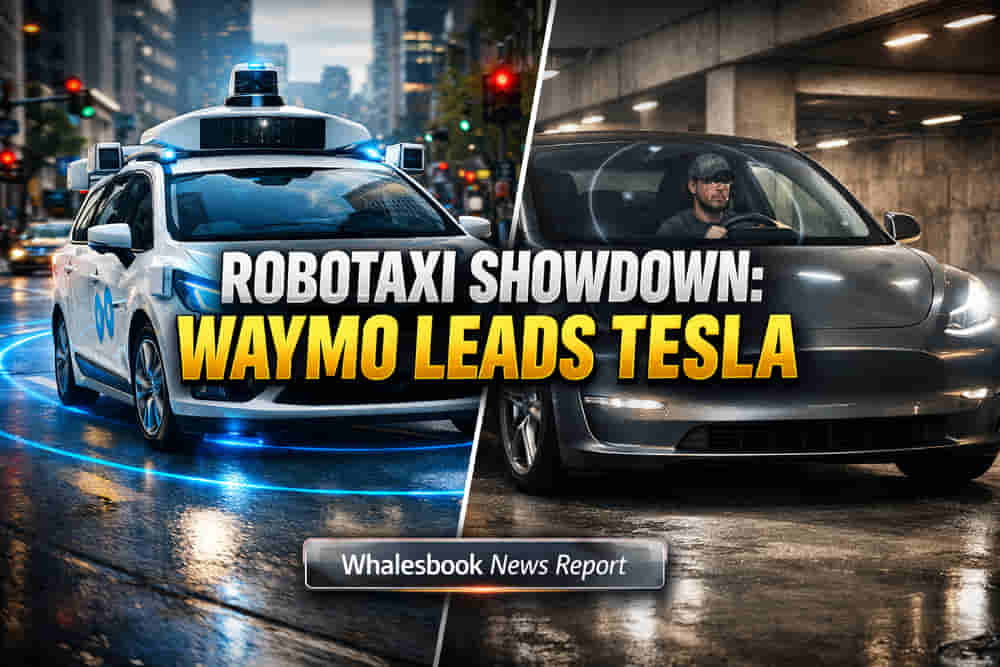
The Robotaxi Race: Waymo Pulls Ahead of Tesla
The race to dominate the future of transportation is heating up, but the leader might surprise you. While Tesla, led by Elon Musk, boasts a massive valuation and promises a vast robotaxi network, Alphabet's Waymo is quietly racking up millions of actual driverless rides, presenting a stark contrast in progress.
Wall Street has heavily favored Tesla's vision, but a closer look at real-world operations reveals Waymo has a significant operational lead. This analysis breaks down the robotaxi battle, showing who is truly winning on the streets today.
The Core Issue: Operational Reality vs. Future Promises
When it comes to deploying actual driverless vehicles, Waymo is significantly ahead. Tesla launched its Austin robotaxi service in June 2025 with around 30 vehicles, but crucially, these cars still required human monitors in every passenger-carrying vehicle, although some driverless testing has reportedly begun.
In contrast, Waymo began its Austin operations in March 2025 with 200 vehicles already on the road, and importantly, all its cars operate completely driverless. Local observations confirm this, with a University of Texas professor noting she frequently sees Waymos but has never encountered a Tesla robotaxi.
The Scale Game: Miles Driven and Cities Covered
Waymo has demonstrated impressive scale, completing 14 million paid rides in 2025 alone. The company operates in six major cities including Austin, Phoenix, San Francisco, Los Angeles, and Atlanta, with plans to expand to 20 more cities by the end of 2026, operating a fleet of over 2,500 vehicles.
Tesla's robotaxi efforts are currently limited to testing in two cities, Austin and San Francisco, and these operations still involve safety drivers. Waymo has logged an astounding 100 million fully autonomous operational miles, dwarfing Tesla's claims, which often refer to supervised miles across its vast fleet of 8.5 million vehicles.
The Technology Battle: Sensors and Strategy
The two tech giants employ fundamentally different technological strategies. Tesla relies on a "vision-only" system, using cameras exclusively, which is theorized to be cheaper and allow existing Teslas to become robotaxis via software updates.
Alphabet's Waymo adopts a more comprehensive approach, integrating cameras, lidar, radar, and high-definition maps within carefully defined "geofenced areas." While more expensive, this multi-sensor redundancy is seen as more reliable, particularly in challenging conditions like fog or glare where cameras can struggle.
The Timeline Test: Promises vs. Progress
Elon Musk has a history of making highly ambitious, often unmet, predictions regarding Tesla's autonomous capabilities. Promises of cross-country autonomous drives within two years (starting 2016), one million robotaxis by mid-2020, and operations in 8-10 cities by January 1st (from October 2025) have not materialized.
Waymo, originating from Google's self-driving project started in 2009, has pursued a more deliberate path. Launching commercial service in Phoenix in 2018, it has steadily expanded its operations city by city, focusing on regulatory approvals and building a sustainable business.
The Regulatory Reality
Regulatory bodies tend to favor Waymo's cautious, controlled approach. Waymo's commitment to operating within specific, well-mapped geofenced areas with multiple safety systems provides greater assurance than Tesla's broader "cars can drive anywhere" ambition.
Consequently, Waymo has secured regulatory approval for driverless operations in several cities, a milestone Tesla is still working towards for its supervised testing phase. This regulatory acceptance is crucial for scaling autonomous services.
Financial Implications and Market Reaction
Despite Waymo's current operational dominance, Tesla's stock has reached record highs, largely fueled by investor anticipation of its future robotaxi empire and a significant share of a multi-trillion dollar market. Alphabet, however, trades at much lower valuation multiples, even while operating a functional robotaxi business today.
This discrepancy highlights a potential disconnect between market speculation and current operational reality. If Waymo continues to build its business and market leadership, Tesla investors may face disappointment if regulatory approvals and widespread deployment lag significantly.
Future Outlook
The autonomous vehicle industry is poised for massive growth, and being the first to market with a reliable, scalable, and regulatory-approved service is a significant advantage. Waymo's consistent progress suggests it is building a robust foundation for this future market.
While Tesla's vision-only technology might eventually prove viable, the immediate challenge lies in overcoming technological limitations and securing the necessary regulatory approvals to achieve Musk's ambitious goals. The competition remains fierce, but the current scorecard heavily favors Waymo.
Impact
This ongoing competition in the robotaxi space has significant implications for the future of personal transportation, urban planning, and the automotive industry. Consumers may soon have access to safer, more convenient mobility options. Investors face decisions based on current operational success versus future technological promises. The development of widespread autonomous driving technology could redefine cities and daily commutes.
Impact rating: 8/10
Difficult Terms Explained
- Robotaxi: A self-driving taxi service that operates without a human driver.
- Vision-only systems: Autonomous driving technology that relies solely on cameras to perceive the environment, omitting sensors like lidar and radar.
- Lidar: A remote sensing method that uses light in the form of a pulsed laser to measure variable distances to the Earth. In vehicles, it creates a 3D map of the surroundings.
- Radar: A detection system that uses radio waves to determine the range, angle, or velocity of objects.
- Geofenced areas: Specifically defined geographical boundaries within which an autonomous vehicle is permitted to operate.
- Sensor redundancy: The use of multiple, different types of sensors to ensure that if one sensor fails or is compromised, others can still provide necessary data for safe operation.
- Autonomous miles: The total distance a vehicle has traveled operating entirely without human intervention or supervision.
- Supervised miles: Distance traveled by a vehicle where a human driver is present and ready to take control at any moment.