 Whalesbook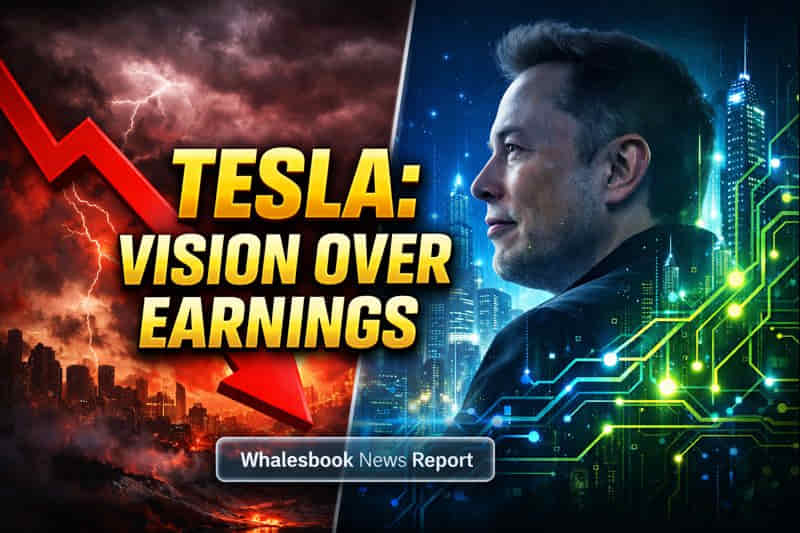
1. THE VALUATION PARADOX
Tesla Inc. (TSLA) is exhibiting a market behavior increasingly detached from conventional financial metrics. While analysts have substantially lowered their earnings expectations for the company in 2026 – with net income forecasts tumbling by 56% from $14.1 billion to $6.1 billion – their average 12-month price targets have concurrently risen [cite: original text]. This divergence highlights a market that values the company more like a venture capital-backed startup, leveraging bold vision over current earnings and cash flows, according to DataTrek Research co-founder Nicholas Colas [cite: original text]. The electric vehicle manufacturer's trailing twelve-month price-to-earnings (P/E) ratio stands exceptionally high, ranging from approximately 260x to over 310x as of mid-January 2026. This multiple dwarfs that of its "Magnificent Seven" technology peers, which collectively trade around 29 times forward earnings. Even within the broader S&P 500, Tesla's valuation multiple is among the highest.
The AI and Robotics Bet
Much of Tesla's market capitalization, estimated at around $1.45 trillion, is attributed to CEO Elon Musk's ambitious long-term strategies in artificial intelligence, robotics, and autonomous driving, rather than its automotive sales performance. The company is shifting its Full Self-Driving (FSD) software from a one-time purchase to a recurring monthly subscription model, priced at $99, beginning in February 2026. This strategy aims to unlock new revenue streams, alongside anticipated progress in the rollout of Robotaxis and the production of Optimus humanoid robots, with Musk targeting end-of-year sales for the robots. Investors are keenly watching for guidance on these future growth engines, especially as traditional EV sales face headwinds. The energy storage division also continues to be a bright spot, achieving record deployments and demonstrating superior profitability compared to the automotive segment.
Fundamental Headwinds and Competition
Despite the forward-looking narrative, Tesla's core automotive business is encountering significant challenges. The company reported 418,227 vehicle deliveries for the fourth quarter of 2025, a 15.6% decrease year-over-year and below analyst expectations. Full-year 2025 deliveries totaled approximately 1.64 million vehicles, marking the second consecutive year of declining sales volume. This performance has allowed BYD to surpass Tesla as the world's largest battery electric vehicle manufacturer in 2025. Tesla's market share has also eroded, dropping to an estimated 10.8% in 2024, with projections indicating a sharp decline to around 3.1% by October 2025. This pressure is compounded by intensifying global competition, particularly from manufacturers in China and South Korea, and a challenging European market where Tesla's sales saw significant declines. Consensus estimates project a 35% slide in earnings per share for Q4 2025 to around $0.43, and analysts foresee negative free cash flow beginning in the second quarter of 2026.
Analyst Divergence and Outlook
Wall Street sentiment on Tesla remains divided. While the company holds a consensus 'Hold' rating based on 10 buy, 8 hold, and 7 sell ratings among 25 analysts, recent price targets show a wide dispersion. Some analysts maintain price targets that imply significant upside, while others have issued much lower figures. Notably, recent ratings from Barclays, UBS, and Wells Fargo in mid-January 2026 averaged a price target of $265.67, suggesting a potential downside of nearly 40% from current levels. Conversely, some bullish targets remain as high as $600. With the Q4 2025 earnings report scheduled for January 28, 2026, investors will be closely scrutinizing Elon Musk's commentary on the progress and scaling potential of Tesla's AI, robotics, and autonomous driving initiatives. His forward-looking guidance is deemed more critical than ever in bridging the gap between the company's lofty valuation and its current operational realities [cite: original text].