 Whalesbook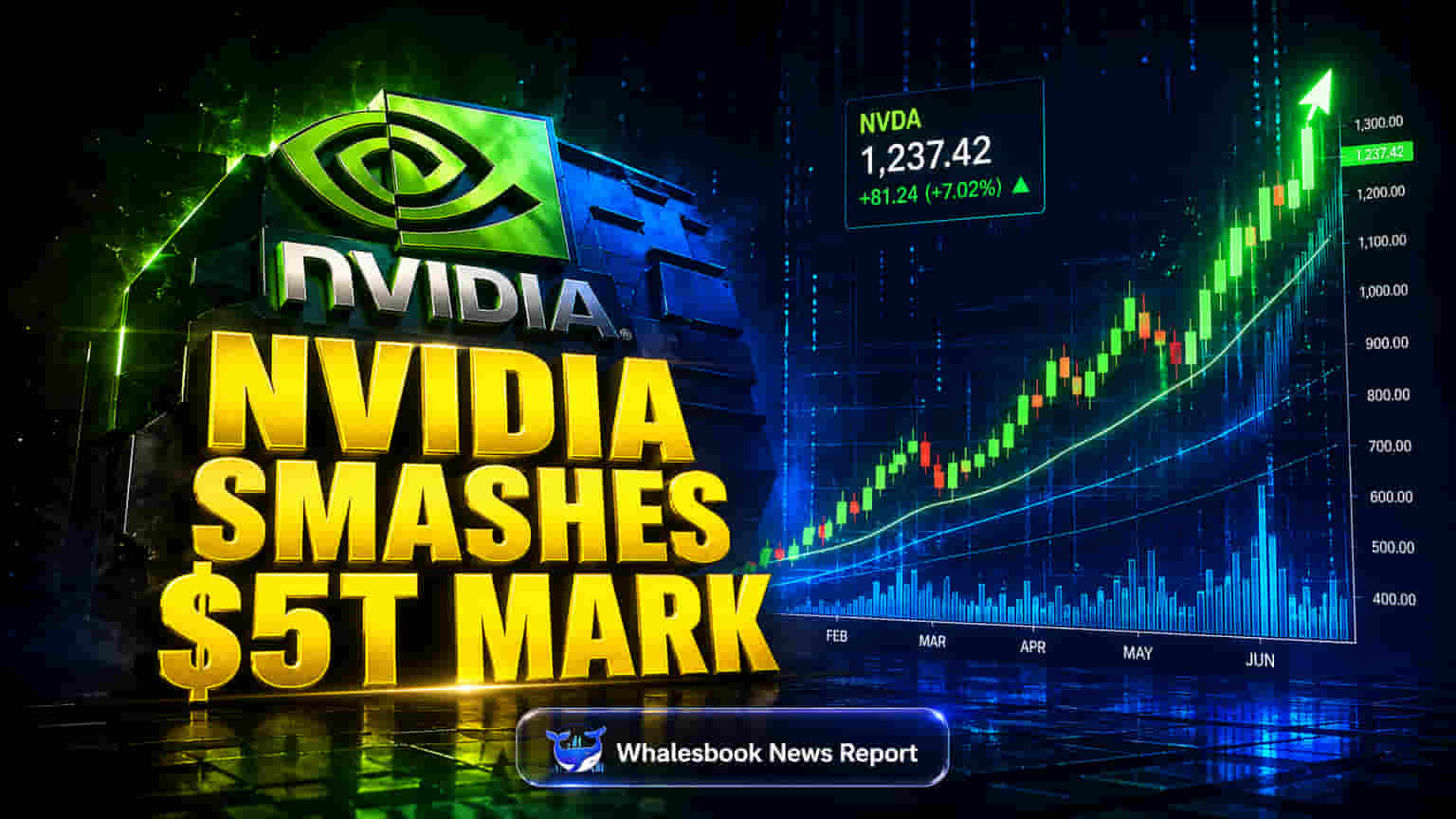


Nvidia Corp. became the world's most valuable company on Friday, April 24, 2026, as its market capitalization surged past $5 trillion for the first time. The chip giant's shares reached a record high of $208.26, up 4.3% for the session, driven by strong global demand for artificial intelligence hardware. This milestone highlights Nvidia's key role in powering the AI revolution, a sector seeing huge investment showing no signs of slowing. Market strategists cite this sustained demand as the main driver. "The amount of money that’s being spent on AI is just incredible," noted Paul Nolte of Murphy & Sylvest Wealth Management. Nvidia's performance has significantly contributed to the S&P 500 Index's 4.7% advance this year, reportedly accounting for about 20% of that growth. This rise follows a period of broader tech sector consolidation, with investors now returning to technology for stability and growth amid geopolitical tensions.
Valuation Premium and AI Demand
Nvidia's valuation is approximately $5.062 trillion as of April 2026, with a trailing P/E ratio around 40.5. While this figure represents a significant premium compared to the technology sector's average P/E of 33.38, it is partly justified by projected earnings growth. Analysts forecast 7.77 EPS for the current year. The stock's recent rally, breaking out of a year-long trading range, has seen increased trading volume, with over 213 million shares changing hands on Friday. However, this high valuation hinges on continued rapid growth in AI spending. This trajectory could prove unsustainable if demand normalizes or competitive pressures intensify. The company's price-to-earnings growth (P/E/G) ratio is 0.67, suggesting growth may outpace its P/E multiple, but this relies heavily on future performance.
Competition Heats Up
The semiconductor industry is experiencing a strong rally, with the Philadelphia Semiconductor Index reaching a record 18th consecutive session of gains, up 47% over that streak. This broad strength is supported by positive results from industry peers like Texas Instruments and Intel. However, Nvidia's competitive position faces increasing challenges. Competitors such as Advanced Micro Devices (AMD) and Broadcom are gaining ground. AMD's trailing P/E ratio, currently around 115.22 as of April 23, 2026, is significantly higher than Nvidia's, suggesting a greater reliance on future growth expectations for its current valuation. Broadcom, focusing on ASICs, is also key in the AI infrastructure supply chain. More importantly, Nvidia's largest clients, including Meta Platforms, Microsoft, and Amazon, are developing their own custom AI chips. These in-house solutions present a twofold challenge: they offer lower costs and potentially bypass Nvidia's order backlogs. Google's Tensor Processing Units (TPUs) are also a significant competitive threat to Nvidia's dominance, despite the company's emphasis on its established CUDA software ecosystem as a barrier to entry.
Regulatory Risks and Market Concentration
Nvidia's near-monopoly in high-end AI GPUs, with an estimated 84% market share, has attracted significant regulatory scrutiny worldwide. Antitrust authorities in the U.S. and Europe are investigating Nvidia's business practices, including potential bundling of GPUs and restrictive contracts. The European Commission has reportedly sent questionnaires to customers and rivals investigating potential abuses of dominance. Furthermore, stricter U.S. government controls on AI chip exports, particularly impacting sales to China, cost Nvidia an estimated $5.5 billion in lost revenue in April 2025. This has led to market share shifts, with Chinese chip makers reportedly increasing their AI GPU output. Concerns are also raised by significant recent insider selling regarding management's outlook on sustained high valuations. The concentration of AI hardware development within a few dominant players, while driving current demand, also risks creating supply chain bottlenecks and hindering broader innovation, as seen with emerging competitors like Modular aiming to challenge Nvidia's market grip.
Future Outlook
Despite the growing challenges, Wall Street analysts maintain a positive outlook, with a consensus "Strong Buy" rating among 38 analysts as of April 24, 2026. The average price target of $266.24 suggests an upside of approximately 27.83% over the next year. Projections indicate that Nvidia's data center revenue could sustain a compound annual growth rate (CAGR) of 80-90% through CY26 and CY27, with revenue targets exceeding $1 trillion by the end of CY2027. Investors are anticipating Nvidia's fiscal first-quarter 2027 earnings report on May 20, 2026, expecting significant year-over-year earnings growth. However, some caution remains regarding the sustainability of peak demand and growth rates, noting that the stock has shown little reaction to recent strong earnings. The company's ability to navigate competitive pressures and regulatory hurdles will be key to maintaining its growth trajectory.