 Whalesbook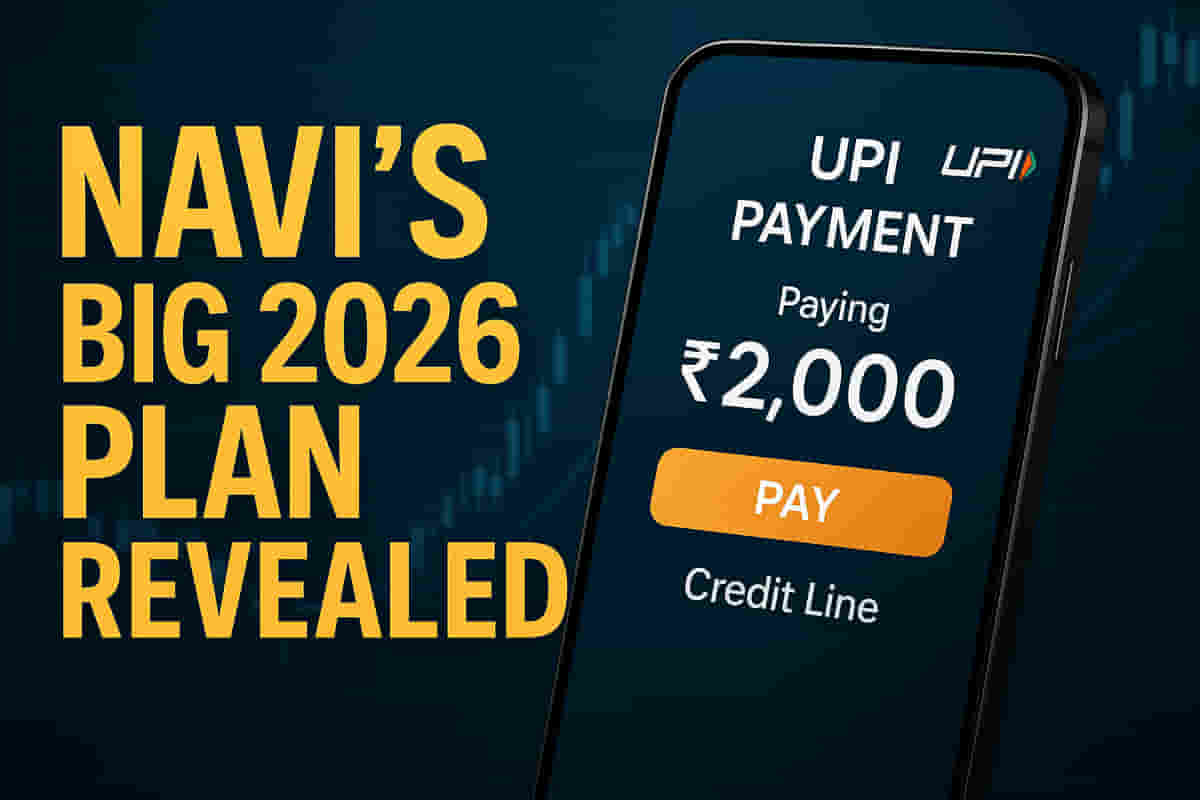


Navi, the fintech firm backed by Flipkart co-founder Sachin Bansal, is gearing up for what its CEO, Rajiv Naresh, calls a "breakout year" in 2026. The company plans to significantly scale its innovative credit-line-on-UPI product, Trezo, and is actively preparing for an Initial Public Offering (IPO).
Navi Trezo: The Future of Credit on UPI
- Navi is set to aggressively scale its credit-line-on-UPI product, Trezo, after a year focused on building robust infrastructure and refining its processes.
- CEO Rajiv Naresh expressed strong confidence that 2026 will be the pivotal year for Trezo, following 2025's preparation phase.
- The product, initially launched with Karnataka Bank in 2024, is slated to partner with a second bank in the coming year.
- Naresh believes the "credit-on-UPI" category is nascent, with significant potential to become the "most efficient way to deliver credit to the masses."
Navi's UPI Dominance
- Navi has rapidly established itself as the fourth-largest player in the Unified Payments Interface (UPI) space in India.
- The platform processes over 570 million transactions monthly, exceeding Rs 30,000 crore in value, a significant achievement since its UPI push began in early 2024.
- Naresh attributes this success to speed and design, partly due to Navi's early investment in its own payment switch, differentiating it from competitors who rely heavily on cashbacks.
- An integrated spending analyser feature is also enhancing user engagement by providing insights without disrupting the payment flow.
Strategic Choice: UPI Credit Line over RuPay Cards
- Navi deliberately chose to prioritize developing its credit-line-on-UPI product over launching co-branded RuPay credit cards, which are also linked to UPI.
- The decision was based on the credit line being simpler, more cost-effective, and capable of reaching a much larger customer base compared to physical cards.
- While not ruling out co-branded cards entirely with a "never say never" approach, Navi's immediate focus remains on its UPI-centric credit offering.
Navigating Regulatory Waters
- In 2024, Navi Finserv faced a temporary ban from the Reserve Bank of India (RBI) on sanctioning or disbursing new loans, alongside three other NBFCs.
- The RBI cited "material supervisory concerns," including excessive loan pricing policies (WALR and interest spread) and deficiencies in borrower assessment, disclosures, and loan recovery practices.
- Naresh mentioned that regulatory guidelines for credit lines were evolving throughout 2024, impacting Trezo's initial scaling.
Financial Performance and IPO Aspirations
- Navi Finserv's profitability saw a sharp decline in FY25, with net profit dropping by 67% to Rs 221.9 crore, despite a 19% rise in revenue to Rs 2,271.2 crore.
- The company aims to prioritize profitability in FY26 and FY27 as it prepares for its IPO, with the formal process expected to commence around April 2026.
- A pre-IPO funding round is also a possibility, with "all options on the table."
Diversified Business Growth
- Navi's lending business, started in 2020, continues to grow strongly, supported by a swift customer journey and advanced credit management technology.
- The mutual fund business has surpassed $1 billion in assets under management, adopting a passive-first investment strategy.
- Navi has expanded into motor insurance this year, building on its health insurance portfolio, and anticipates significant growth in this segment.
- The company is also exploring an ads business, leveraging its extensive UPI user base, though this initiative is in its early stages.
Impact
- The potential success of Navi's credit-on-UPI product could significantly expand credit access to a larger population in India, democratizing financial services.
- Navi's IPO, if successful, could offer a new investment avenue for stock market participants and provide capital for further growth and innovation.
- The company's ability to navigate regulatory challenges and improve profitability will be key indicators for its future stock market performance and investor confidence.
- The competitive landscape in digital lending and UPI services might see increased innovation and potentially lower costs for consumers.
- Impact Rating: 8/10
Difficult Terms Explained
- Credit-on-UPI: A system that allows users to avail of a credit line directly through the UPI payment interface, enabling instant loans or credit purchases.
- Fintech unicorn: A privately held startup company focused on financial technology that has achieved a valuation of $1 billion or more.
- NBFCs: Non-Banking Financial Companies are financial institutions that provide banking-like services but do not hold a banking license.
- WALR: Weighted Average Lending Rate, a metric used to calculate the average interest rate on all loans disbursed by a financial institution.
- RoC filings: Registrar of Companies filings, official documents submitted by companies to the government regulatory authority detailing financial performance and other corporate information.
- IPO: Initial Public Offering, the process by which a private company first sells shares of stock to the public.
- AMC: Asset Management Company, a firm that invests pooled money from many investors to purchase securities like stocks, bonds, and money market instruments.
- UPI: Unified Payments Interface, an instant real-time payment system developed by the National Payments Corporation of India (NPCI).