 Whalesbook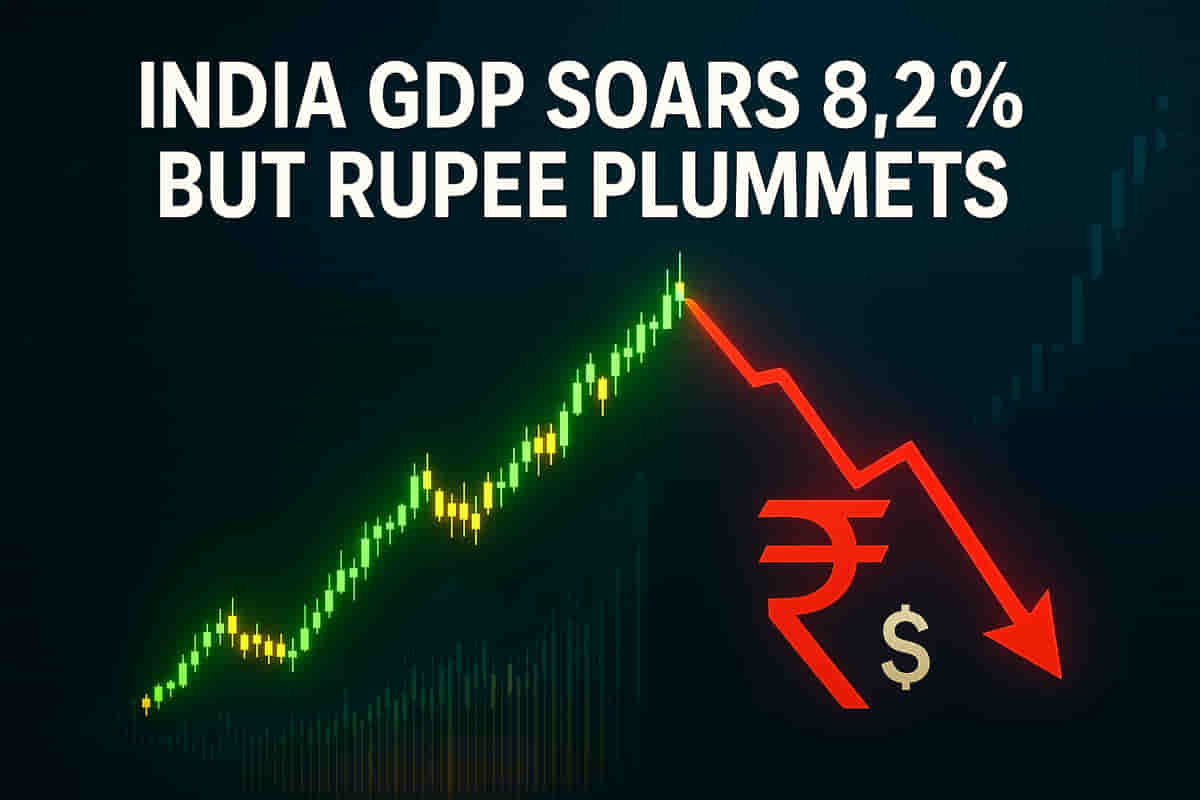
India's Economy Soars, But Rupee Hits Record Lows: A Complex Investor Scenario
India's economy showed robust growth, with its Gross Domestic Product (GDP) expanding by 8.2% year-on-year in the September quarter of 2025. Despite this strong performance, the Indian Rupee has weakened significantly, crossing the critical psychological barrier of ₹90 against the US dollar for the first time, presenting a complex economic scenario for investors.
Economic Performance vs. Currency Strength
- India's GDP registered a strong 8.2% growth in the September 2025 quarter, indicating a healthy expansion in economic activity.
- Simultaneously, the Indian Rupee has depreciated to new lows, with the USD/INR exchange rate surpassing ₹90 to a dollar.
- This situation underscores the principle that economic growth and currency strength are influenced by distinct global and domestic factors.
The "Boom with Depreciation" Phenomenon
- The article refers to the "Exchange Rate Disconnect Puzzle" and the "boom with depreciation" phenomenon observed in emerging markets.
- Research suggests that currency depreciation can occur alongside strong output and investment, a pattern documented in recent studies.
- Robust growth often increases demand for imports (raw materials, energy), which inherently requires more foreign currency, potentially pressuring the domestic currency.
Foreign Investor Outflows Explained
- A key driver of rupee weakness is the sustained outflow of capital by Foreign Portfolio Investors (FPIs) throughout much of 2025.
- These outflows are attributed to global uncertainties, rising yields on US Treasury bonds, and concerns over trade tensions or "tariff wars."
- When global capital flows reverse, emerging market currencies often suffer even if their economies continue to grow.
The Yield Puzzle: Why Higher Rates Aren't Enough
- India's 10-year government bond yield stands at around 6.5%, significantly higher than the US 10-year Treasury yield of nearly 4%, creating an attractive yield spread of approximately 250 basis points.
- Conventionally, such a spread should attract yield-seeking foreign investors into Indian debt markets and equities.
- However, this nominal yield advantage is offset by the risk premium associated with India, which includes currency volatility and inflation unpredictability.
- For a dollar-based investor, even a modest depreciation of the rupee (e.g., 3-4% annually) can entirely negate the higher returns from Indian bonds, turning effective returns negative.
Domestic Investors Step In
- Despite significant FPI selling, the Indian stock market has remained resilient.
- This resilience is largely due to a structural shift: domestic mutual funds, powered by record inflows from Systematic Investment Plans (SIPs), have increased their ownership.
- According to NSE Market Pulse data (November 2025), FPI equity ownership has fallen to a 15-month low of 16.9%, while individual investors (directly and via MFs) now hold nearly 19% of the market—a two-decade high.
Recommendations for RBI
- The Reserve Bank of India (RBI) should allow this structural adjustment in market ownership to continue.
- It should focus on preventing sharp, disorderly volatility swings rather than defending specific psychological levels like ₹90 per dollar.
- The central bank should maintain liquidity and anchor expectations through clear, confidence-building communication.
- Monetary policy should prioritize inflation and growth, avoiding aggressive interventions, while structural reforms should tackle the root causes of rupee weakness.
Impact
- The depreciation of the rupee can lead to higher import costs for India, potentially fueling inflation and increasing the price of essential goods like oil and electronics.
- It makes Indian exports cheaper, which could boost certain sectors.
- For foreign investors, it raises concerns about capital preservation and the overall return on investment.
- The rise of domestic investors signifies a maturing market but also means increased sensitivity to domestic economic factors.
- Impact Rating: 7/10
Difficult Terms Explained
- Gross Domestic Product (GDP): The total monetary value of all the finished goods and services produced within a country's borders in a specific time period.
- Exchange Rate Disconnect Puzzle: An economic phenomenon where currency exchange rates do not align with fundamental economic indicators like growth, inflation, or interest rates.
- USD/INR: The currency pair representing the exchange rate between the United States Dollar (USD) and the Indian Rupee (INR).
- Emerging Markets: Countries undergoing rapid growth and industrialization, such as India, Brazil, and China.
- Foreign Portfolio Investors (FPIs): Investors from foreign countries who invest in a country's securities (stocks, bonds) without gaining control of the company.
- Yield Spread: The difference between the yields on two different debt instruments, often used to compare the relative attractiveness of investments.
- Basis Points: A unit of measure used in finance to denote the percentage change in a financial instrument. One basis point is equal to 0.01% (1/100th of a percent).
- Nominal Yield: The stated interest rate on a bond before taking inflation into account.
- Risk Premium: The additional return an investor expects to receive for holding a risky asset compared to a risk-free asset.
- Structural Factors: Underlying, long-term conditions or characteristics of an economy that influence its performance.
- Cyclical: Relating to or denoting business or other activities that follow a cyclical pattern.
- Systematic Investment Plan (SIP): A method of investing a fixed sum of money at regular intervals in a mutual fund scheme, typically on a monthly basis.