 Whalesbook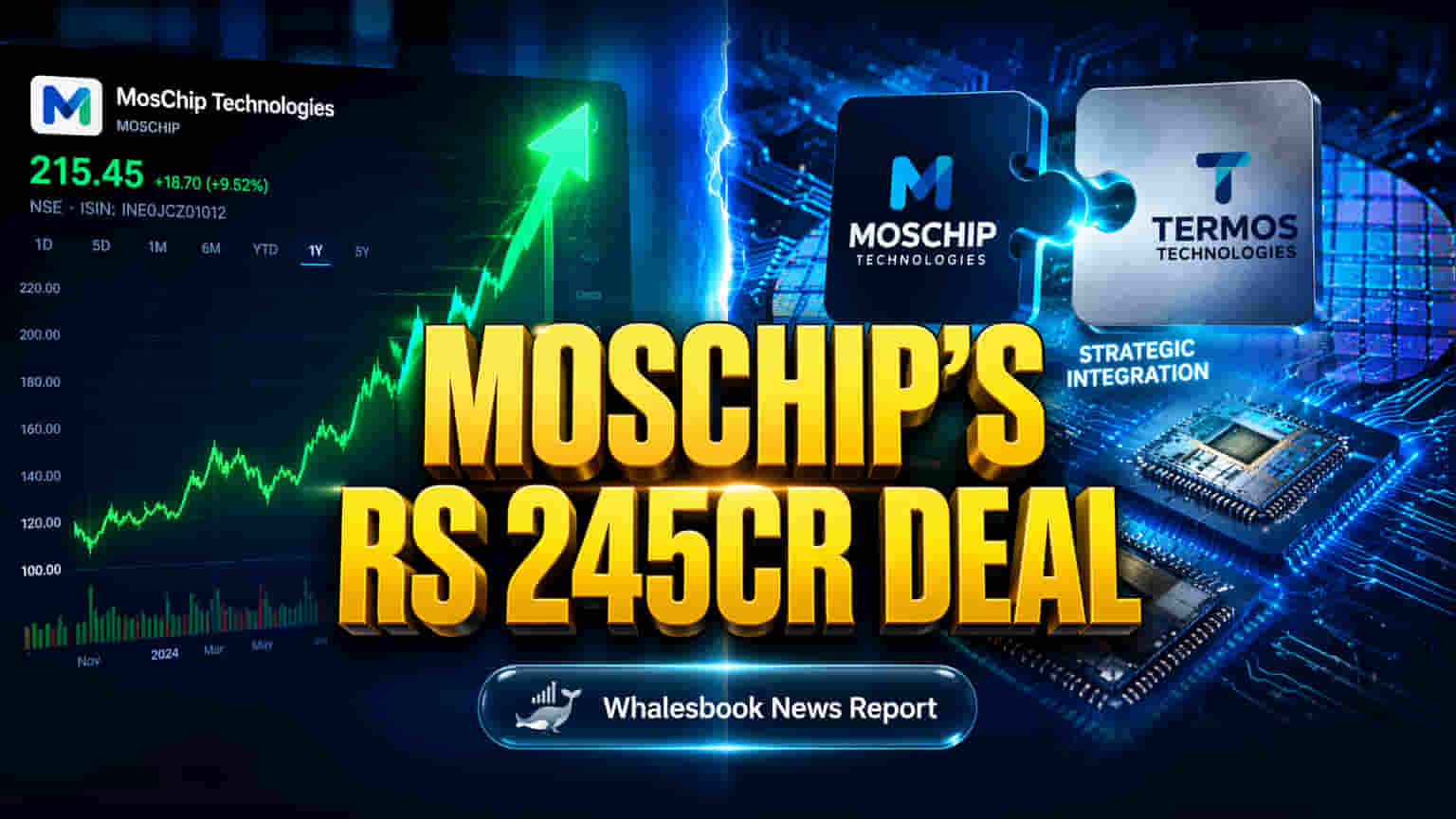


Strategic Deal Aims to Boost Engineering Services
MosChip Technologies plans to significantly enhance its software-led engineering capabilities and expand its presence in the semiconductor and automotive industries through its acquisition of Vayavya Labs. The deal aims to leverage Vayavya's expertise, but its financial structure, involving substantial new share issuance, raises questions about shareholder dilution and valuation.
Acquisition Terms and Financials
The acquisition, approved by MosChip's board on April 16, 2026, involves purchasing a 73% stake in Vayavya Labs for ₹245.49 crore. This includes ₹148.52 crore in cash and ₹96.97 crore paid through the issuance of 50,50,686 new equity shares at ₹192 each. Vayavya Labs reported a provisional turnover of ₹83 crore for the fiscal year ending March 2026, up from ₹64.4 crore in FY25. MosChip's stock rose 4.79% to ₹192.87 on the announcement day.
Market Context and Valuation Comparison
This move positions MosChip to tap into India's growing semiconductor market, which is projected to expand significantly by 2030 and 2035, driven by demand from AI and automotive sectors. Vayavya Labs specializes in areas like embedded systems and ADAS validation, aligning well with MosChip's offerings. However, MosChip, with a market capitalization around ₹3,600 crore, trades at a high Price-to-Earnings ratio of 92x-111x. This valuation is considerably higher than larger rivals such as L&T Technology Services (LTTS) at 26-38x P/E, Tata Elxsi at 38-48x P/E, and Cyient at 16-18x P/E.
Investor Concerns: Dilution and Risks
A key concern for investors is the substantial equity dilution from the preferential share issuance, which could impact earnings per share. The integration of Vayavya Labs, with its approximately 75-137 employees and ₹83 crore turnover, presents inherent risks. MosChip also faces tough competition from larger, more diversified engineering firms that have greater scale and broader service portfolios. Further complexity arises from the agreement to acquire the remaining 27% stake post-March 2028, with future valuation tied to performance, introducing potential future uncertainties.
Outlook: Balancing Growth and Risk
The success of MosChip's acquisition strategy will depend on its ability to integrate Vayavya's operations smoothly and leverage its technical skills to drive projected growth. Investors will be watching closely to see how the company balances strategic expansion with financial prudence in a competitive market.