 Whalesbook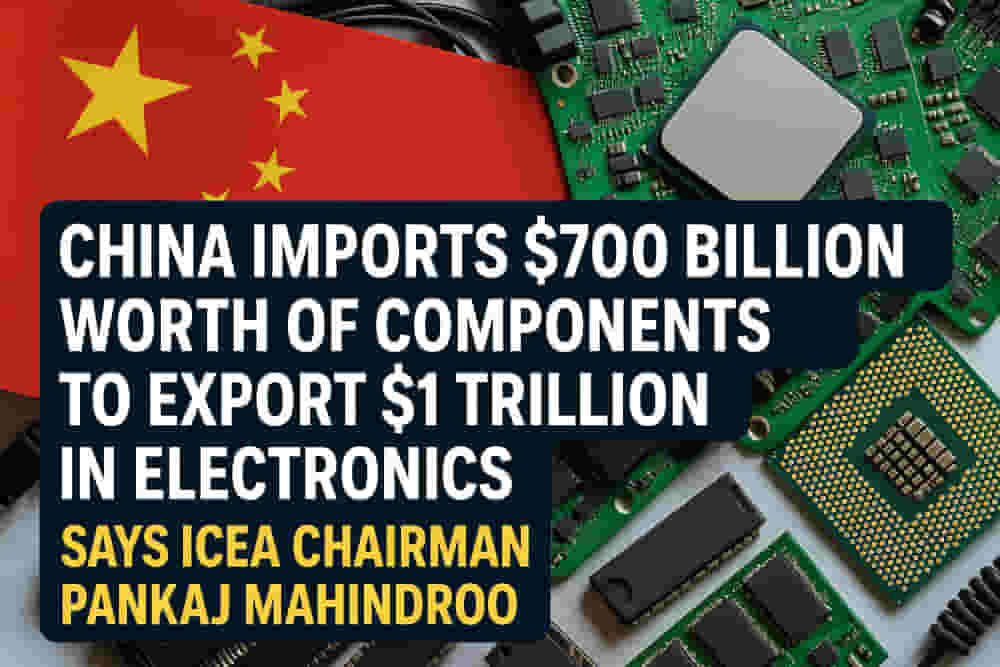


India Cellular and Electronics Association (ICEA) Chairman Pankaj Mahindroo has emphasized a crucial strategy for boosting the nation's exports: increasing component imports. Speaking at the UP Tech Next Electronics and Semiconductor Summit, he argued that to export electronics at scale, India must first import key components, mirroring successful models like China's.
The Import-Export Paradox
- Pankaj Mahindroo highlighted that China imports components worth $700 billion to achieve $1 trillion in electronics exports.
- This demonstrates that significant import of raw materials and intermediate goods is essential for large-scale manufacturing and export capabilities.
- Mahindroo stressed that India needs to export more than it imports to achieve a positive trade balance and build a robust manufacturing ecosystem.
Challenges and India's Strengths
- India faces disadvantages in capital costs and interest rates when compared to manufacturing hubs like China and Vietnam.
- A significant "fault line" for India is its often "inward-looking" approach, which Mahindroo believes hinders its merchandise export potential.
- Conversely, India's core strength lies in its vast and capable manpower, a resource that should be leveraged effectively.
Government and Policy Environment
- Mahindroo addressed the perception of government openness, stating that the government, including the Uttar Pradesh state government, is positively receiving constructive feedback.
- He advised that criticism needs to be practical, guiding the government on specific ways to support entrepreneurs and industry growth.
- He noted a past "chill factor" regarding investment in Uttar Pradesh but sees current positive developments.
Focus on Uttar Pradesh
- Mahindroo expressed strong optimism, stating he would "go long on UP," indicating a bullish outlook for the state's electronics manufacturing sector.
- He described developing Uttar Pradesh as a "national imperative."
- He urged Chief Minister Yogi Adityanath and his ministers to conduct more roadshows to attract necessary investments, noting that UP now has tangible progress to showcase.
- A key weakness identified was the lack of travel by UP leaders and bureaucrats to actively seek investments from potential partners.
Expert Panel Discussion
- The summit featured other prominent figures, including Sushil Pal, Joint Secretary at MeitY; Anurag Yadav, UP’s Principal Secretary for IT and Electronics; Manish Gupta, Director and Senior Professor at Kaushalya: The Skill University; and Rajesh Agarwal, Co-founder of Micromax and Bhagwati Products.
- Their discussions likely covered various aspects of electronics manufacturing, semiconductor development, and investment promotion in Uttar Pradesh.
Impact
- This strategy could lead to increased investment in India's component manufacturing sector, creating jobs and boosting the electronics industry's global competitiveness.
- Greater imports of components might initially increase trade deficit but are expected to drive higher value exports in the long run.
- Uttar Pradesh could see a surge in manufacturing facilities and related economic activity if state government initiatives are successful.
- Impact Rating: 7/10
Difficult Terms Explained
- Components: Parts or elements used to build a larger product.
- Scale: The size or extent of operations, referring to large-volume production or export.
- Capital Cost: The expense incurred to acquire or upgrade physical assets like buildings and machinery.
- Interest Rate: The percentage charged by a lender to a borrower for using money.
- Manpower: The human workforce available for a particular task or industry.
- Inward-looking: Focused on domestic issues and less on international engagement or trade.
- Merchandise Exports: Goods that are physically shipped to other countries.
- Risk Capital: Funds invested in new ventures or businesses with a high potential for loss but also high potential for return.
- Feedback: Information about reactions to a product, a person's performance of a task, etc., used as a basis for improvement.
- Roadshows: Promotional events organized by a company or government to attract investors or customers.
- Bullish: Expecting or predicting that prices will rise or that a particular investment will do well.