 Whalesbook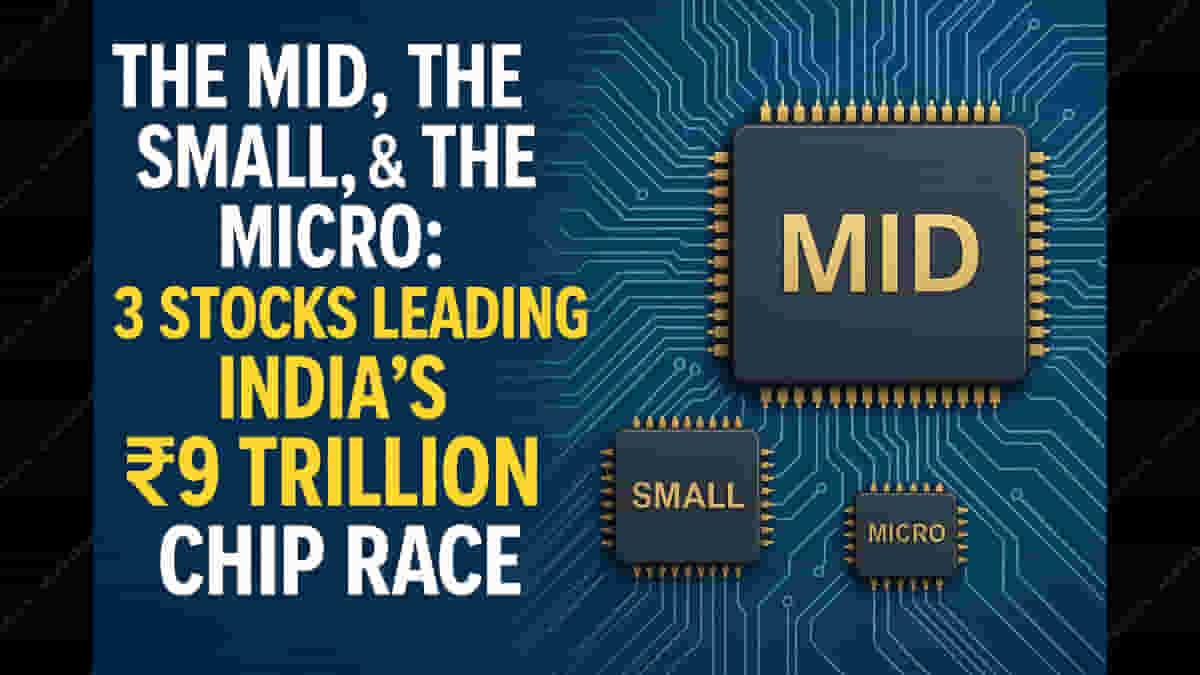


India's Semiconductor Ambition
India is embarking on a significant journey to become a global hub for semiconductor manufacturing, a critical component for modern digital economies. Currently, the nation imports nearly 90% of its semiconductor needs, creating vulnerabilities in supply chains.
Government Initiatives and Investment
The Indian government has launched the India Semiconductor Mission (ISM) with a substantial outlay of ₹760 billion to bolster domestic production. As of August 2025, the mission has already approved 10 projects across six states, attracting cumulative investments of around ₹1.60 trillion.
Market Opportunity
Industry experts predict a massive expansion for India's semiconductor market, expecting it to grow from ₹4.5 trillion in 2024 to ₹9 trillion by 2030. This growth is anticipated to significantly reduce import dependence by $10-20 billion, creating vast opportunities in manufacturing, design, and employment.
Kaynes Technology India: Expanding into OSAT
Kaynes Technology India, a leading integrated Electronic System Design & Manufacturing (ESDM) solutions provider, is transforming its business model. The company is entering the Outsourced Semiconductor Assembly and Test (OSAT) and High-Density Interconnect (HDI) Printed Circuit Board (PCB) sectors.
- Kaynes received approval to establish an OSAT facility in Gujarat with an investment of ₹33 billion, supported by central and state government contributions.
- This facility is designed to produce 6 million chips per day and is expected to deliver India's first commercially manufactured multichip module (IPM5) in Q2 FY26.
- The company reported a 47% year-on-year revenue increase to ₹15.8 billion in H1 FY26, with Profit After Tax (PAT) soaring 77% to ₹1.9 billion.
- Its order book stood at ₹81 billion as of September 30, 2025, offering strong revenue visibility.
RIR Power: Focusing on Silicon Carbide
RIR Power is a key player in manufacturing semiconductor devices and power equipment, with a strategic focus on next-generation Silicon Carbide (SiC) technologies.
- The company is setting up India's first SiC manufacturing plant in Odisha to produce advanced SiC wafers and devices.
- This ₹6.2 billion project aims to reduce import dependence and strengthen domestic capabilities, targeting high-performance power electronics for sectors like railways and defence.
- The facility is designed for 150-millimetre wafers with a competitive 85% yield.
- In H1 FY26, RIR Power's revenue grew 17% to ₹466.5 million, and PAT rose 64.8% to ₹61.0 million.
MosChip: The Fabless Design Specialist
MosChip is recognized as India's first Fabless Semiconductor company, focusing on silicon engineering, software, system design, and product engineering.
- The company is developing an indigenous Smart Energy Meter IC and co-developing an Indigenous High-Performance Computing (HPC) System on a Chip (SoC) with C-DAC.
- These projects are poised to cater to significant domestic and global markets for advanced computing and IoT applications.
- In H1 FY26, MosChip's revenue increased by 37.4% to ₹2.8 billion, with PAT surging by 35.3% to ₹230 million.
Valuation Watch: High Growth, High Expectations
While the companies show promising growth trajectories, their valuations are currently very high.
- RIR Power and MosChip exhibit steep P/E multiples, reflecting early-stage euphoria in the semiconductor sector.
- Kaynes Technology also trades at a high P/E multiple (103x), indicating little room for execution errors.
- The current valuations largely reflect future expectations rather than proven performance, underscoring the importance of successful execution in scaling these businesses.
Impact
This concerted push into semiconductor manufacturing is poised to revolutionize India's technological landscape. It will significantly bolster the nation's self-reliance in a strategically vital sector, reduce dependence on foreign supply chains, and foster substantial job creation. The growth in domestic chip production and design capabilities will likely attract further investment, driving innovation across various industries including automotive, healthcare, defence, and consumer electronics.
- Impact rating: 8/10
Difficult Terms Explained
- ESDM: Electronics System Design and Manufacturing. The process of designing and producing electronic devices and systems.
- OSAT: Outsourced Semiconductor Assembly and Test. Companies that provide specialized services for packaging and testing semiconductor chips.
- HDI PCB: High-Density Interconnection Printed Circuit Board. A type of circuit board with finer lines and spaces, allowing for more components in a smaller area.
- SiC: Silicon Carbide. A compound semiconductor material used for high-power, high-temperature applications.
- Fabless: A semiconductor company that designs chips but outsources the manufacturing to foundries.
- EMS: Electronic Manufacturing Services. Companies that provide manufacturing services for electronic products.
- IoT: Internet of Things. The network of physical devices, vehicles, and other items embedded with electronics, software, sensors, and network connectivity.
- EBITDA: Earnings Before Interest, Tax, Depreciation, and Amortisation. A measure of a company's operating performance.
- PAT: Profit After Tax. The profit remaining after all expenses and taxes have been deducted.
- P/E Multiple: Price-to-Earnings Ratio. A valuation ratio of a company's share price to its earnings per share.
- SoC: System on a Chip. An integrated circuit that integrates all components of a computer or other electronic system onto a single chip.
- HPC: High-Performance Computing. The use of supercomputers and parallel processing techniques to solve complex computational problems.
- DLI Scheme: Design Linked Incentive Scheme. A government program to support the design and development of semiconductor and display manufacturing.