 Whalesbook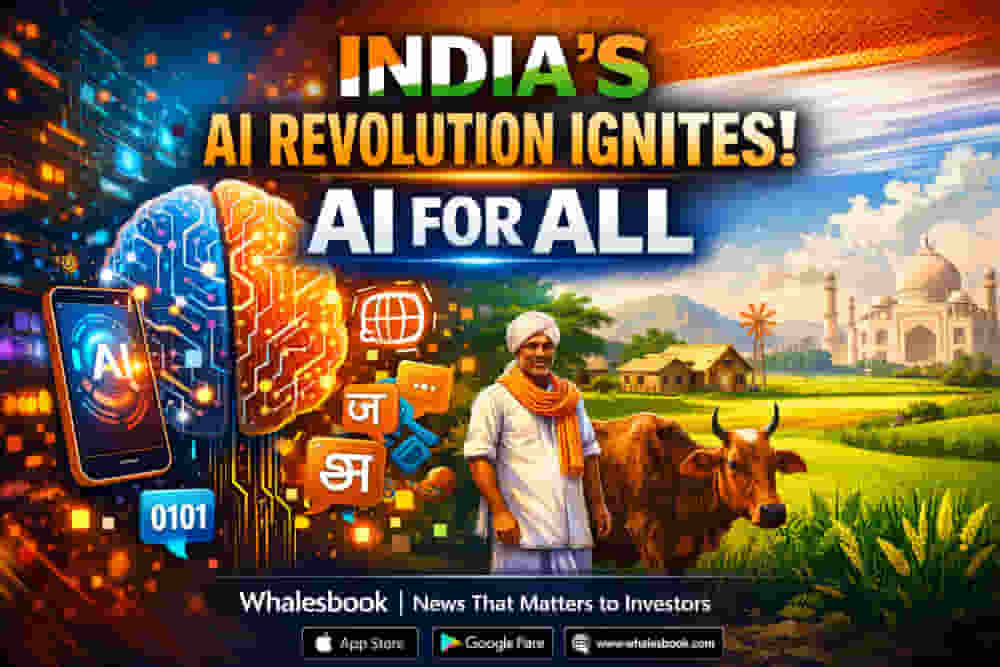
India's AI Advantage: Beyond the Labs
The global narrative on Artificial Intelligence often centers on advanced research labs in Silicon Valley. However, India is demonstrating a distinct path towards "AI for all," driven by its unique scale and existing digital infrastructure. This approach prioritizes making AI accessible and functional for its vast, diverse population, particularly in rural areas.
The country boasts over 886 million active internet users, with rural India accounting for a significant 53%, or approximately 488 million users. For these individuals, the primary gateway to the digital world is the affordable, shared Android smartphone. This mobile-first, multilingual reality shapes India's AI development, aiming to ensure that AI solutions are designed for inclusion from the outset rather than being an afterthought.
- Key Takeaway: India's AI strategy leverages existing digital infrastructure to ensure AI is accessible and functional for its diverse, mobile-first population.
The Power of Public Digital Rails
India's biggest strength in AI is not a singular model or research institute, but its commitment to building robust public digital infrastructure. Initiatives like Aadhaar (digital identity), UPI (unified payments interface), and DigiLocker (digital document storage) have transformed essential services into open, low-cost, interoperable rails.
This foundation has profoundly impacted digital behavior. The UPI system alone processed over 93 billion transactions in the second half of 2024, with an average transaction value of around ₹1,400. This highlights its widespread use for micro-payments, demonstrating how free, reliable, and interoperable infrastructure encourages adoption and normalization of digital tools among low-income users.
- Key Takeaway: Public digital infrastructure like UPI and Aadhaar provides a scalable foundation for AI innovation and widespread adoption.
Investing in Indian Realities: The IndiaAI Mission
The IndiaAI Mission aims to extend this logic into the artificial intelligence domain. Public investment focuses on computing power, datasets, and startups, with a core objective: ensuring AI models are trained on Indian realities. Projects like Bhashini, BharatGPT, and BharatGen are treating language itself as infrastructure.
These initiatives are not merely creating language packs but developing systems capable of understanding and responding across diverse Indian scripts, dialects, and code-mixed speech. For a country where users frequently switch between English, Hindi, and local languages, this native multilingual capability is essential, not just a technical feature.
- Key Takeaway: The IndiaAI Mission prioritizes training AI on local realities and developing multilingual capabilities through initiatives like Bhashini.
AI in Action: Agriculture and Public Services
The impact of this inclusive AI strategy is evident in practical applications. In Telangana's Khammam district, the Saagu Baagu project, part of the World Economic Forum's AI4AI initiative, has assisted around 7,000 chilli farmers. Through mobile chatbots, farmers receive crop-specific advice and AI-driven quality testing, connecting them to digital marketplaces.
Early results indicate profit increases of approximately 18%, with some farmers doubling their income. The technology is designed for low literacy and low bandwidth environments, making AI a direct profit driver.
In public services, Bhashini and partner institutions are building speech and translation pipelines for widely spoken languages and historically marginalized tribal tongues. This enables crucial applications like telemedicine platforms that can communicate with patients in their mother tongue, and grievance portals accessible via voice, expanding access to state services for more citizens.
- Key Takeaway: Practical applications of AI in agriculture and public services demonstrate significant economic and social benefits by addressing local needs and constraints.
A Model for Emerging Markets
India's approach to AI development is closely watched by other emerging markets facing similar challenges: reliance on low-cost Android phones, intermittent data connectivity, and multilingual populations. India has already proven its ability to build scalable, open, and affordable digital architectures like India Stack, which can be exported.
The same potential exists for AI, provided inclusion is a core strategy. Future AI models and applications in India must be natively multilingual and context-aware, optimized for mid-range phones and low bandwidth. Success will be measured by actual adoption by women, small farmers, and informal workers, not just pilot programs.
- Key Takeaway: India's inclusive AI model, built under constraints, offers a replicable blueprint for other emerging economies.
Defining the Future of AI
While India may encounter challenges and make missteps, its focus on building AI that functions effectively in crowded classrooms, challenging agricultural fields, busy hospitals, and small shops positions it to define what winning looks like for the next billion internet users. This evolution from digital payments and identity infrastructure to AI represents a natural progression for a nation focused on turning digital progress into global public goods. The true measure of "AI for all" will be its ability to uplift lives at the margins, one local language query and one affordable smartphone at a time.
Impact Rating: 8/10
Difficult Terms Explained:
- AI for all: Making artificial intelligence technologies accessible and beneficial to everyone, regardless of their economic status, location, or technical expertise.
- Silicon Valley: A region in Northern California famous for its high concentration of technology companies and venture capital firms, often seen as the global hub for tech innovation.
- Digital scale at the bottom of the pyramid: The ability to reach and serve a very large number of people in lower-income segments or rural areas with digital services.
- Public digital rails: Foundational, open, and interoperable digital infrastructure built by governments or public entities that enable private innovation and services to be built upon them, like roads or railways for digital services.
- Aadhaar: India's unique digital identity system, providing a foundational identity layer for citizens.
- UPI (Unified Payments Interface): India's real-time payment system that enables instant money transfers between bank accounts on mobile devices.
- DigiLocker: A digital locker system for government-issued documents and certificates, allowing citizens to access and store these digitally.
- Proprietary products: Products or services owned and controlled exclusively by one company, often closed to external integration.
- Interoperable: The ability of different systems, devices, or applications to connect and exchange information and use the information that has been exchanged.
- IndiaAI Mission: A government initiative aimed at driving AI development, adoption, and research within India, focusing on strategic areas.
- Bhashini: India's national language translation platform and AI initiative, aiming to break down language barriers.
- BharatGPT / BharatGen: These likely refer to Indian efforts to develop large language models (LLMs) and generative AI models tailored to Indian contexts and languages.
- Code-mixed speech: Speech that combines words or phrases from two or more languages within a single sentence or conversation.
- Table stakes: Essential requirements or capabilities that are necessary to compete in a particular field or market.
- Inclusion: Ensuring that products, services, and opportunities are accessible and beneficial to all segments of society, especially marginalized or underserved groups.
- CSR (Corporate Social Responsibility): A business model where companies integrate social and environmental concerns into their operations.
- Flagship models: The most important or prominent AI models developed by a country or company.
- Context-aware: AI systems that can understand and respond appropriately based on the surrounding circumstances or information.
- Mid-range phones: Smartphones that offer a balance of features and affordability, typically not high-end but more capable than basic models.
- Low bandwidth: Internet connections that have limited data transfer speeds.