 Whalesbook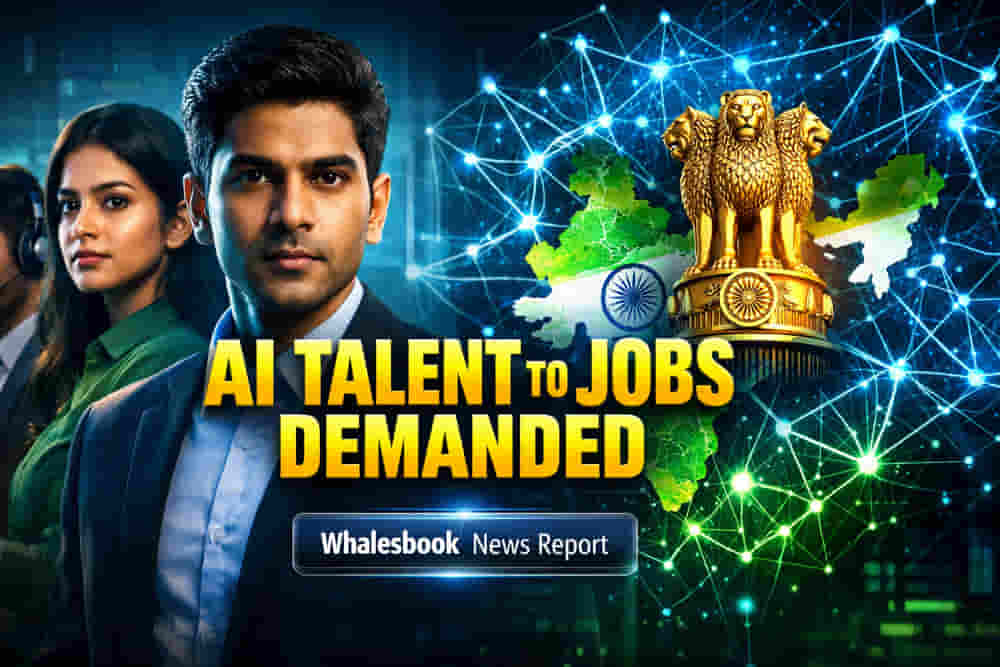


THE SEAMLESS LINK
India stands at a critical juncture, poised to harness artificial intelligence for significant economic expansion projected in the hundreds of billions of dollars. Yet, the nation faces a paradox: a vast pool of AI talent is not translating into job-ready professionals. This disconnect necessitates a strategic shift in governmental focus, moving beyond broad skilling initiatives to concrete outcomes in employability and domestic AI capacity as Budget 2026 approaches.
The Employability Chasm: Talent vs. Jobs
India commands approximately 16% of the global AI talent pool, a substantial asset. However, a stark reality persists: fewer than 25% of graduates are deemed adequately prepared for advanced digital and AI roles. Raghav Gupta, CEO of Futurense, highlighted this critical gap, noting that the challenge lies not in a lack of interest but in insufficient real-world exposure. Industry voices are therefore urging Budget 2026 to prioritize employability, fostering stronger collaboration between academic institutions and the industry. This includes encouraging more experiential learning and providing incentives for companies that invest in AI adoption alongside dedicated workforce training programs. A cohesive approach is required, aligning higher education reforms with skilling incentives and enterprise adoption to cultivate a productive workforce.
Infrastructure Gaps Hamper AI Advancement
Beyond human capital, significant structural impediments hinder India's AI ambitions. Nakul Kundra, CEO and co-founder of Devnagri, pointed to the nation's limited domestic compute capacity, with India accounting for less than 2% of global data center infrastructure. High Graphics Processing Unit (GPU) costs further exacerbate these challenges, limiting the scalability of AI development. The absence of robust, Indian language-first Large Language Models (LLMs) trained on diverse domestic datasets remains a key bottleneck, impeding progress in localized AI solutions. Budget 2026 is expected to address these by focusing on funding for indigenous AI models and establishing clear regulations around data dignity and consent. Incentives for applied AI across key sectors like banking, e-commerce, and governance are also crucial.
Forging Indigenous AI and Digital Sovereignty
Industry leaders like Narendra Sen, Founder and CEO of RackBank and NeevCloud, emphasize the strategic imperative of treating core AI infrastructure—compute and data platforms—as digital public goods. Sen likens data centers to "new sovereign territory" and AI to "new electricity," underscoring the need for sustained public investment. There is a call for a Production Linked Incentive (PLI) scheme specifically for compute, designed to support indigenous cloud platforms rather than foreign hyperscalers. By classifying AI infrastructure as a strategic national asset, India aims to ensure its data remains within its legal framework, thereby securing digital sovereignty for the future. This approach is vital for India to build its own AI capabilities and compete effectively on the global stage.
Budget 2026: The Call for Execution
The overarching message from the industry is a demand for deeper integration of India's AI strategy across education, infrastructure, and enterprise adoption. Budget 2026 is positioned as a critical determinant in India's capacity to convert its extensive talent pool into job-ready professionals, build robust local AI capabilities, and maintain global competitiveness. The focus must decisively shift from sheer scale to quantifiable outcomes that generate lasting economic value and technological independence.