 Whalesbook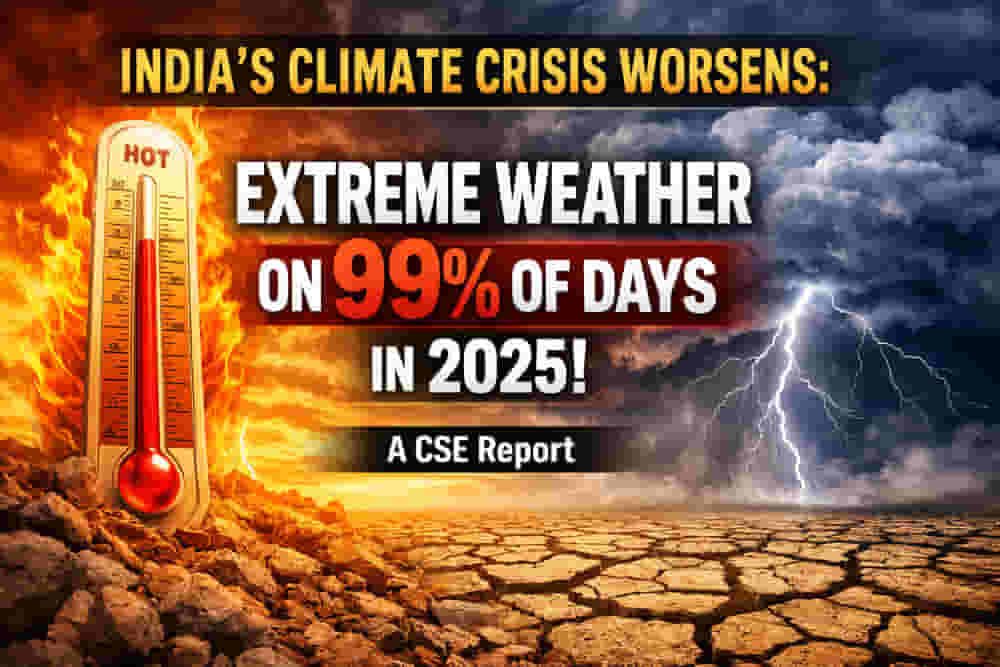
India Gripped by Unprecedented Climate Extremes in 2025
India faced an unprecedented climate crisis in 2025, with extreme weather events occurring on more than 99 per cent of days between January and November. A comprehensive analysis by the Delhi-based think tank Centre for Science and Environment (CSE) revealed that climate impacts were registered on 331 out of the 334 days during this period, underscoring the pervasive and persistent nature of the challenges.
The CSE analysis painted a grim picture, indicating that climate-related events were not confined to specific seasons but were a daily occurrence across the country for extended periods. For the third consecutive year, all 36 states and Union Territories experienced extreme weather. In 2025, the total number of extreme weather days surpassed previous years, demonstrating a worrying upward trend. Events ranged from intense heatwaves and unseasonal cold snaps to severe thunderstorms, cyclones, cloudbursts, heavy rainfall, devastating floods, and destructive landslides.
Devastating Human and Economic Toll
The human cost of these climatic extremes was immense. At least 4,419 lives were lost across India during the first eleven months of 2025. The agricultural sector bore a significant brunt, with approximately 17.4 million hectares of cropped land affected by the events. Furthermore, the analysis noted the destruction of at least 181,459 houses and the death of approximately 77,189 animals. These figures are likely underestimates, suggesting the true scale of loss is even greater. The reported number of deaths linked to extreme weather saw a sharp increase of 47 per cent compared to 2022, while agricultural damage expanded dramatically.
Regional Hotspots and State Impacts
While extreme weather was widespread, certain regions and states experienced disproportionately high impacts. Himachal Pradesh recorded extreme weather on nearly 80 per cent of days, the highest frequency nationwide. Andhra Pradesh reported the greatest number of fatalities with 608 deaths, followed by Madhya Pradesh and Jharkhand. Maharashtra witnessed the largest area of cropped land affected, with 8.4 million hectares impacted, followed by Gujarat and Karnataka. North-west India recorded the highest death toll at 1,459, highlighting its vulnerability.
Record-Breaking Temperatures and Shifting Seasons
The year 2025 also saw several broken climate records, signaling a fundamental shift in weather patterns. January was the fifth driest since records began in 1901, while February was the warmest in 124 years. Mean maximum temperatures in March were significantly above normal, even after the India Meteorological Department adjusted its baseline to a warmer period. September and October registered some of the highest mean and minimum temperatures on record for those months.
Escalating Frequency and Persistence
Researchers noted that these figures reflect a broader pattern where once-rare extreme events are now occurring with increasing regularity. Extreme weather occurred every day in nine out of the eleven months analyzed, a significant jump from previous years. This trend, spanning across winter, pre-monsoon, monsoon, and post-monsoon periods, indicates that extreme weather in India is becoming a year-round phenomenon, rather than being confined to distinct seasons. The shrinking window for "normal" weather leaves vulnerable populations acutely exposed.
Call for Global Action and Smarter Planning
Sunita Narain, Director General of CSE, emphasized that the scale of the crisis demands a global response and robust mitigation efforts. She stressed the need to understand the "scale of mitigation" and collaborate internationally while preparing for increasingly frequent disasters. The trends underscore the urgency of meaningful climate action to cut risks and emissions. Development must continue, but it requires smarter planning and more resilient, equitable choices to adapt to a changing climate.
Impact
This persistent and intensifying extreme weather poses significant threats to India's agricultural sector, vital for its economy and food security. Increased crop damage can lead to food inflation and impact rural livelihoods. The insurance industry faces higher claims for property damage and crop failure. Infrastructure, including roads, bridges, and power grids, is increasingly vulnerable, requiring substantial investment in repairs and climate-resilient upgrades. Consumer spending patterns can shift due to damage and economic uncertainty. These factors collectively affect corporate earnings, investor confidence, and the overall stability of the Indian stock market.
Impact Rating: 8/10
Difficult Terms Explained
- Think tank: An organization that conducts research and advocacy on topics such as science, technology, economy, and climate change.
- Hectares: A unit of land area commonly used for measuring agricultural land, equal to 10,000 square meters.
- Baseline: A reference point or standard used for comparison, in this context, the average temperature over a specific period used by the India Meteorological Department.
- Anomalies: Deviations from the norm or average; in meteorology, temperature anomalies refer to differences from average temperatures.
- Vulnerable populations: Groups of people who are disproportionately affected by adverse events, often due to limited resources or pre-existing disadvantages.
- Mitigation: Actions taken to reduce the severity or seriousness of something, in climate change context, it refers to efforts to reduce greenhouse gas emissions.
- Emissions: The release of gases or particles into the atmosphere, particularly greenhouse gases like carbon dioxide and methane.
- Resilient: Able to withstand or recover quickly from difficult conditions.