 Whalesbook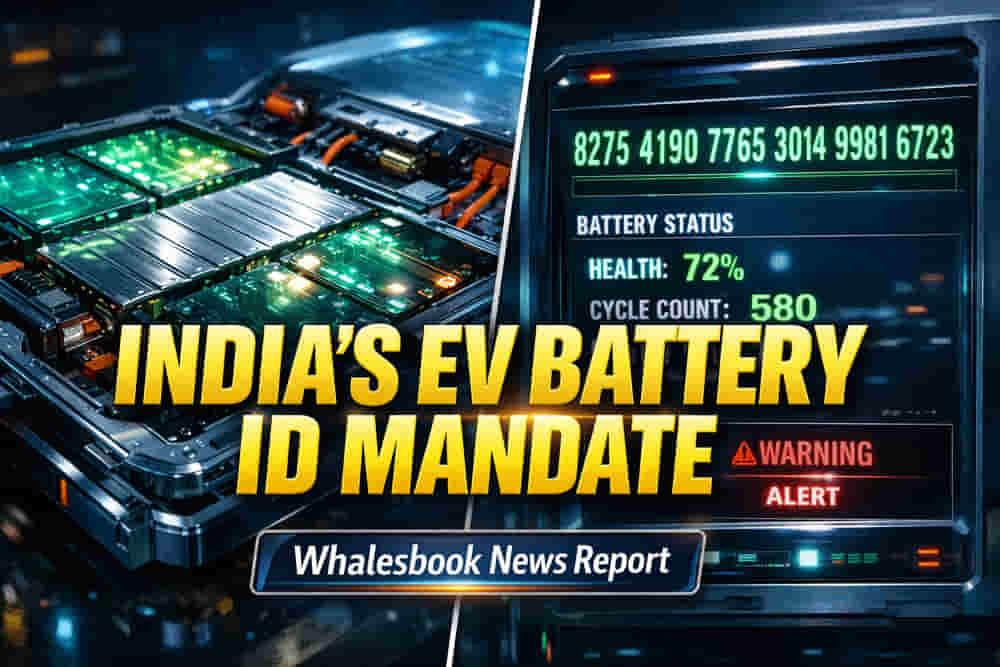
India's Ministry of Road Transport and Highways has proposed a 21-digit Battery Pack Aadhaar Number (BPAN) for electric vehicle (EV) batteries. Draft guidelines, issued January 2, establish a unique digital identity for batteries, aiming for end-to-end traceability covering raw materials, manufacturing, usage, and disposal.
Battery Pack Aadhaar Number Explained
The proposed BPAN system will embed critical information, including the Battery Manufacturer Identifier (BMI), Battery Descriptor Section (BDS), Battery Identifier (BI), Battery Material Composition Section (BMCS), Battery Carbon Footprint (BCF), and crucially, Battery Dynamic Data (BDD). The BDD will offer real-time insights into the battery's State of Health (SOH), its current status, and battery category, enabling timely diagnostics, repair, and maintenance. This system is slated to cover EV batteries, industrial batteries exceeding 2 kilowatt-hours (kWh) in capacity, and standard starting, lighting, and ignition (SLI) batteries.
Government Rationale and Benchmarking
Officials have stated the initiative aims to establish a system beneficial to the Indian market. While drawing inspiration from European Union regulations such as the EU Battery Passport, the government intends to implement a framework that avoids the data burden and infrastructure costs associated with EU-level requirements, particularly for India's price-sensitive mass-market batteries. India's electric vehicle sales have seen robust growth, yet the domestic market remains heavily dependent on imports of lithium-ion batteries, valued at approximately $3 billion in FY25. Furthermore, the BPAN system is expected to help the government verify the authenticity of claims regarding indigenously manufactured batteries under the ₹18,100-crore production-linked incentive (PLI) scheme for advanced chemistry cells.
Stakeholder Benefits and Financial Implications
The implementation of BPAN is poised to benefit a wide spectrum of stakeholders. For financiers who provide loans for EV purchases, especially for commercial use, tracking battery health is crucial for asset monitoring and risk assessment. Current lack of standardized frameworks complicates this, as noted by Dhiraj Agarwal, chief business officer at EV financier Mufin Green Finance. Insurers can also leverage this data for more accurate premium calculations. Buyers of second-hand EVs will gain increased confidence by having access to static data (origin, composition) and dynamic data (health, performance) provided by the BPAN, enabling more informed economic choices.