 Whalesbook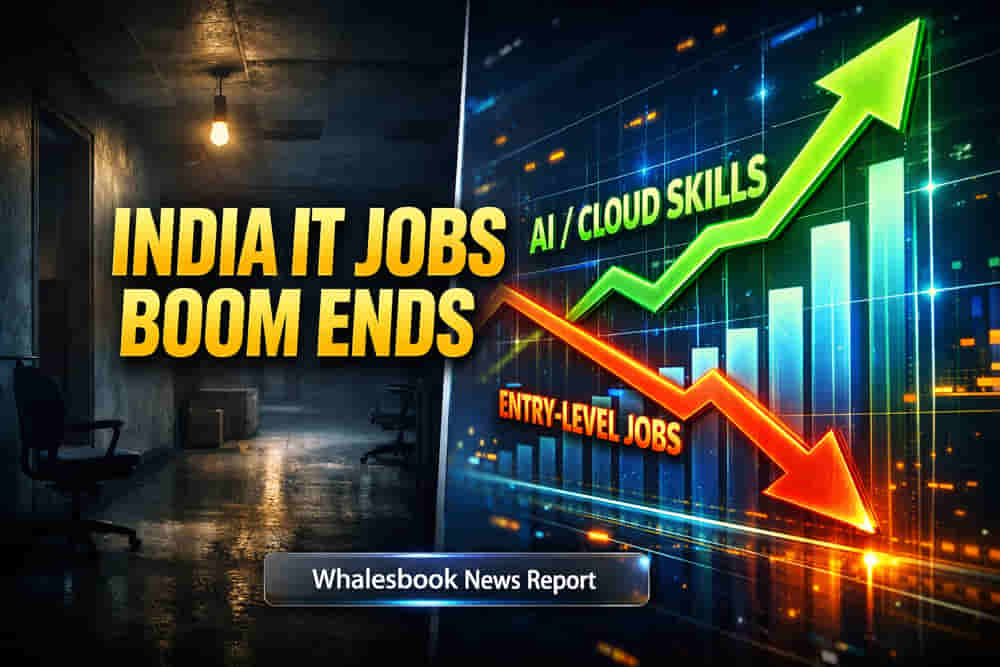


The Hiring Collapse
India's once-thriving IT services sector is experiencing a seismic shift, with major companies drastically curtailing hiring. The top five IT firms collectively added a mere 17 net employees in the first nine months of the current financial year. This represents a dramatic collapse from nearly 18,000 jobs created over the same period a year prior, signaling the end of an era of large-scale recruitment.
Industry experts anticipate this trend will persist. Net new hiring is expected to be significantly lower, primarily focused on replacing attrition and retirements. Companies are moving towards maintaining stable headcount, mirroring practices seen in other established industries, rather than aggressive expansion.
GCCs: The New Growth Engine
While traditional IT services firms slow down, a different model is booming: Global Capability Centres (GCCs). These multinational corporation-run hubs are expanding rapidly across India, handling complex technology, analytics, digital services, finance, and R&D for their parent companies. They are actively creating new jobs, but the demand is for highly specialized skills.
These GCCs are projected to become a major pillar of formal employment, potentially adding between 2.8 million and 4 million jobs by 2030. India already hosts over half of the world's GCCs, with these centres accounting for the vast majority of tech hiring in the current fiscal year. The focus is on high-value engineering and innovation.
AI and Automation's Role
The rise of artificial intelligence and automation is fundamentally reshaping the IT workforce. Tasks previously handled by large teams, including software testing, maintenance, documentation, and basic coding, are increasingly being automated. While AI may not yet be driving exponential revenue growth, it significantly reduces the need for mass hiring, particularly at junior and mid-level positions.
Generative AI, capable of creating new content, is being hailed as a "civilisational shift." Companies are adopting models where AI agents work alongside human employees to plan, act, and solve problems. This technological evolution directly impacts the demand for human capital.
Shifting Skill Demands
The future of tech hiring in India hinges on skill depth. Companies are aggressively seeking professionals with expertise in artificial intelligence, cloud infrastructure, cybersecurity, and data engineering. This demand contrasts sharply with the past, where mass recruitment of fresh graduates was common for large-scale delivery models.
Graduate hiring is now more selective, aimed at grooming future specialists. Professionals are increasingly being retrained through internal programs to upgrade their skills rather than relying on external hires. This indicates a move towards a "low-hire, low-fire" era where acquiring and retaining specialized talent is paramount.