 Whalesbook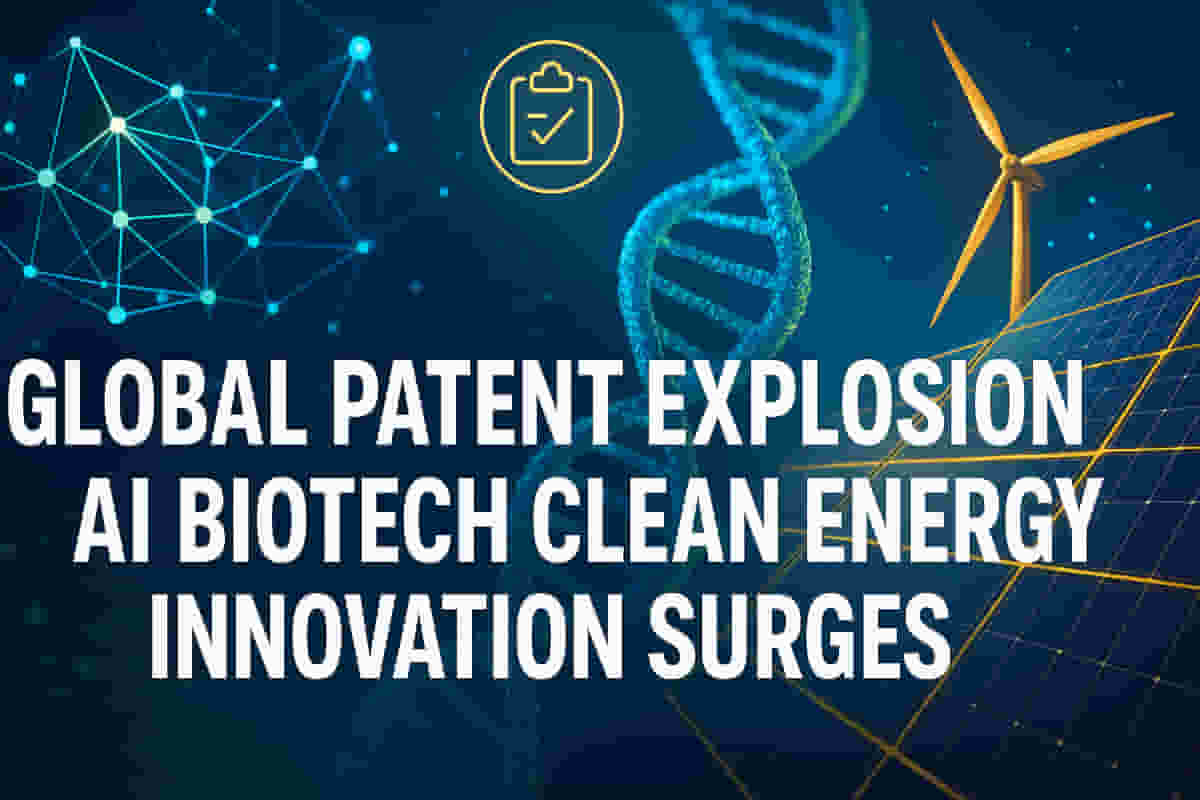
Global Patent Surge: AI, Biotech, Clean Energy Innovation Accelerates – Where Does India Stand?
Global patent filing trends across Artificial Intelligence (AI), Biotechnology, and Clean Energy reveal a world driven by unprecedented scientific progress and rapid innovation cycles. These pivotal sectors are now shaping national public policy, investment priorities, and intellectual property protection, indicating a dynamic shift in technological capabilities and global economic strategies.
Artificial Intelligence Patent Trends
Artificial intelligence has deeply integrated into daily life, powering everything from smart devices and autonomous vehicles to medical diagnostics and content recommendation systems. Major patent offices worldwide are seeing a significant increase in AI-related filings. These patents cover areas like training models, neural networks, natural language processing, robotics, and industrial automation. Inventors are seeking protection not just for final products but also for the underlying methods, data preparation techniques, and specialized hardware, such as chips designed for machine learning. Additionally, there's a growing focus on patents related to AI security, privacy, and bias correction, especially as AI influences sensitive sectors like finance and healthcare.
Biotechnology: A Patent Powerhouse
Biotechnology remains a highly patent-intensive sector, characterized by extensive research in genetics, molecular biology, personalized medicine, and biological engineering. Patent filings now frequently protect processes that manipulate biological systems, including gene editing techniques, engineered organisms, therapeutic molecules, and advanced diagnostic tools. Gene editing platforms are particularly prominent, with intense competition observed between research institutions. The sector also sees significant filings for biologics, personalized vaccines, and targeted therapies, which require substantial investment and stringent regulatory oversight. Agricultural biotechnology is also a key area, with filings for modified crops, drought-resistant seeds, and bio-fertilizers gaining traction.
Clean Energy Innovation Surge
Driven by climate change concerns and international commitments, clean energy has become a global priority. Patent filings in this sector have multiplied, with inventors focusing on solar technology, wind power, carbon capture, hydrogen systems, and energy storage solutions. Solar technology continues to be a dominant area, with innovations in cell efficiency, material improvement, and panel integration. Energy storage, particularly batteries with enhanced life and faster charging capabilities, is receiving significant attention to overcome existing limitations. Hydrogen-based technology, including electrolysers and fuel cells, is also appearing in an increasing number of patent portfolios, promising long-term growth.
India's Growing Role in Global Patents
Nations worldwide are implementing policies to encourage research and development, with many offering incentives for patent filings. While the United States, China, Japan, and the European Union remain leaders in patent filings for these sectors, developing nations like India are showing increasing participation. India's patent trends reveal strong growth, particularly in artificial intelligence and biotechnology, with contributions from research institutions, startups, and pharmaceutical companies. Filings in clean energy are also growing as India shifts towards non-fossil energy sources. Indian research institutions and companies are increasingly collaborating with foreign entities and utilizing international mechanisms for broader protection.
Challenges in Patent Examination and Enforcement
The surge in patent applications across these rapidly developing fields presents significant challenges for patent offices worldwide. Examiners require specialized scientific training, and many offices are implementing cooperative programs to improve efficiency and reduce duplication. Ensuring patent quality is crucial for long-term enforceability, with applicants preferring clear claims that can withstand judicial review. Jurisdictions are offering accelerated examination for green technology and AI to support timely commercialization. However, questions surrounding data ownership, attribution, transparency in AI, ethical considerations in biotech, and cost-effectiveness in clean energy continue to pose hurdles.
Impact
The accelerating pace of innovation in AI, biotechnology, and clean energy, as evidenced by global patent trends, is likely to drive significant investment and growth in these sectors. This could lead to the development of new products and services, increased competition among companies, and a reshaping of global economic landscapes. For India, increased participation in patent filings signals growing R&D capabilities and opportunities for its companies to become global players in these transformative industries. Policies and legal frameworks will need to adapt to foster innovation while balancing commercial interests with public welfare and ethical considerations.
Impact rating: 8
Difficult Terms Explained
- Patent Filings: The process of submitting an application to a government patent office to obtain a patent, which grants the inventor exclusive rights to their invention for a set period.
- Artificial Intelligence (AI): A field of computer science focused on creating systems that can perform tasks typically requiring human intelligence, such as learning, problem-solving, and decision-making.
- Machine Learning: A subset of AI where systems learn from data without being explicitly programmed, improving their performance over time.
- Neural Networks: A type of machine learning model inspired by the structure of the human brain, used for complex pattern recognition.
- Biotechnology: The use of living organisms or their components, such as cells or genes, to develop products or technologies.
- Gene Editing: A group of technologies that allow scientists to make precise changes to the DNA of an organism.
- Biologics: Medical products made from living organisms or their cells, such as vaccines, gene therapies, and antibodies.
- Clean Energy: Energy derived from natural resources that replenish themselves and have minimal environmental impact, such as solar, wind, and hydro power.
- Carbon Capture: Technologies designed to capture carbon dioxide emissions from industrial sources or the atmosphere to prevent them from entering the atmosphere.
- PCT International Patent Application Filing: The Patent Cooperation Treaty (PCT) system allows applicants to file a single international patent application, which serves as a request for patent protection in multiple member countries.