 Whalesbook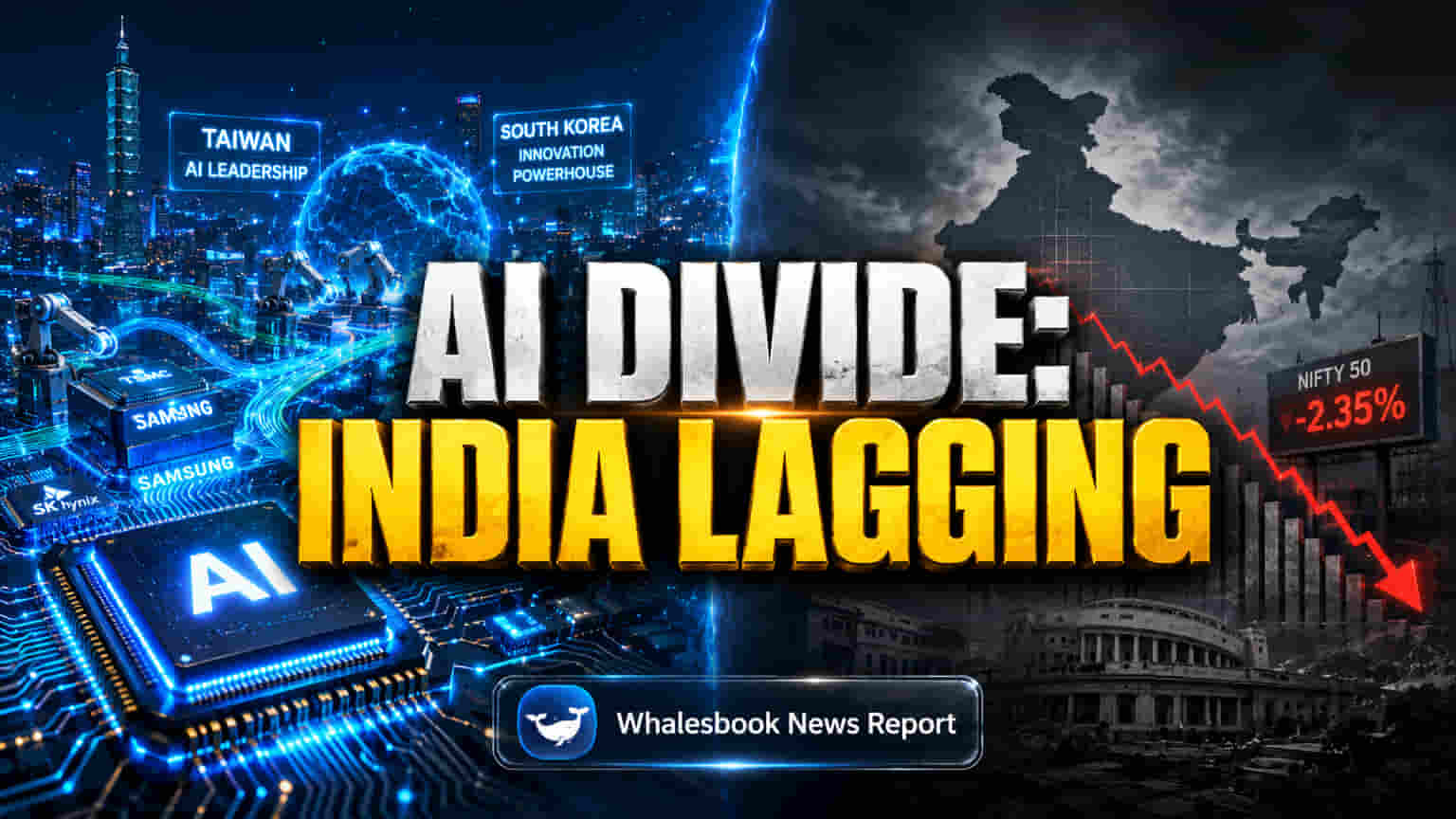


AI Chip Dominance Drives EM Shift
The sharp rise of Taiwan and South Korea in global emerging market indices signals a significant shift. These economies have integrated deeply into the AI value chain, commanding the manufacturing and memory infrastructure that powers artificial intelligence. This has driven their market capitalizations and index weights higher, reshaping the emerging market landscape. Meanwhile, India's ongoing underperformance highlights a growing gap in AI sector involvement.
AI Chip Dominance Drives EM Shift
Taiwan has firmly seized the top position within the MSCI Emerging Markets Index, now representing 24.84 percent of its weight, a significant shift from China's previous dominance. This ascent is powered by an AI hardware boom, with Taiwan Semiconductor Manufacturing Company (TSMC) alone accounting for over 40 percent of the TAIEX's market value. TSMC's role as the indispensable manufacturer of advanced AI chips for global tech leaders like Nvidia and Apple has driven its market capitalization to an estimated $1.8 trillion, contributing to Taiwan's total market cap nearing $4.6 trillion. The TAIEX itself reached an unprecedented 40,000 points in early May 2026, reflecting broad gains across the tech sector.
South Korea's Kospi index mirrors this AI-driven success, crossing the 7,000-point threshold for the first time on May 6, 2026. The nation's market capitalization now stands at approximately $4.59 trillion, surpassing Canada to become the world's seventh-largest equity market. This surge is predominantly attributed to memory chip giants Samsung Electronics and SK Hynix, whose HBM (High Bandwidth Memory) chips are crucial for AI applications. Samsung Electronics recently broke the $1 trillion market capitalization barrier, while SK Hynix also achieved record highs, contributing to the Kospi's stunning 75 percent year-to-date gain in 2026. Semiconductors now constitute roughly 60 percent of the Kospi's operating profit.
Valuations Contrast as AI Leaders Build Strengths
The stark divergence in market performance is evident in valuation metrics. As of early May 2026, the Kospi index exhibits a forward P/E ratio of 8.1, significantly lower than major markets like the S&P 500 (20.7) and Japan's Nikkei 225 (22.7), and even Taiwan's TAIEX (19.1). This low valuation, despite strong earnings growth, suggests a substantial re-rating potential for South Korean equities, supported by its vital role in the AI supply chain. TSMC's commanding lead in advanced chip fabrication, with 7nm and below nodes accounting for 74% of its wafer revenue, establishes a formidable moat. Similarly, Samsung and SK Hynix's dominance in HBM and other AI-critical memory solutions creates substantial barriers to entry.
India's AI Gap Limits Market Gains
In sharp contrast, India's equity markets have experienced a decline of approximately 7 percent year-to-date in 2026, following a modest 2 percent growth in 2025. While large Indian IT firms like TCS and Infosys contribute AI-related services, these are primarily application-layer businesses, lacking the foundational hardware and chip design capabilities that drive the current AI boom. India has no listed equivalent to TSMC or a robust pipeline of public AI chip design startups. India's absence from the core AI value chain means investors are missing out on a major growth area. Factors such as stretched valuations, subdued earnings, and foreign outflows have compounded India's underperformance, but the most significant handicap remains its lack of direct AI sector exposure. The Nifty 50 index trades at a P/E ratio around 21.2, a premium compared to South Korea's Kospi, despite lagging significantly in AI participation.
Outlook and Risks
Analyst outlook for the AI semiconductor sector is strong, with consensus estimates projecting over 200% earnings growth for Kospi companies in the next 12 months. Companies like TSMC forecast revenues to increase more than 30% in 2026, while Samsung expects continued strength in its memory business, anticipating the AI boom to continue through 2026. However, the concentration of this rally in a few semiconductor giants presents risks. A slowdown in AI spending or tighter global liquidity could lead to significant volatility. India's policymakers are encouraged to help domestic AI companies access capital markets sooner to foster future growth.