 Whalesbook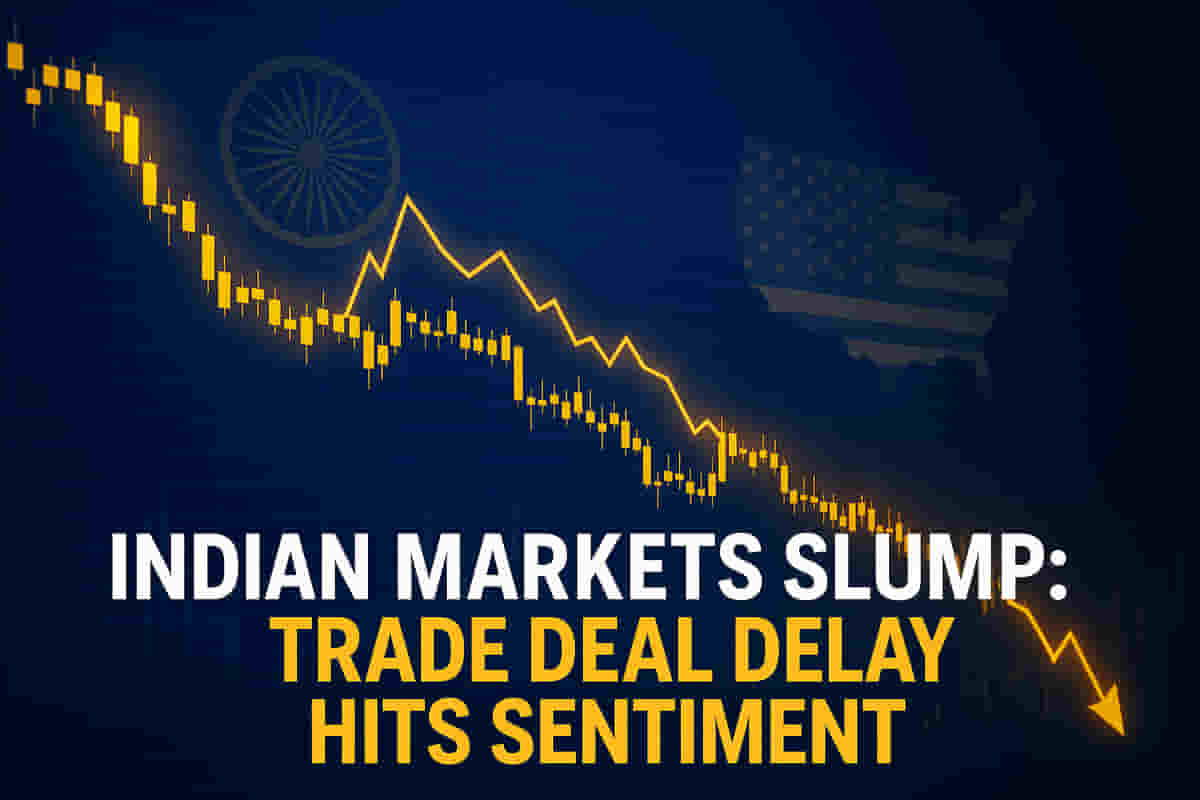
Indian Markets Open Lower Amidst Trade Deal Uncertainty
Indian benchmark stock market indices commenced Monday's trading session on a subdued note, continuing a period of sluggishness. The absence of positive market triggers, particularly the protracted delay in the anticipated US-India trade deal, has weighed significantly on investor sentiment.
The S&P BSE Sensex registered a decline of 394.84 points, trading at 84,872.82. Concurrently, the NSE Nifty50 lost 129.75 points, settling at 25,917.20 as of 9:29 am.
The Core Issue
Dr. VK Vijayakumar, Chief Investment Strategist at Geojit Investments Limited, highlighted the persistent drag on the market stemming from the elusive US-India trade agreement. This delay has a ripple effect, impacting India's export capabilities to the United States, contributing to a widening trade deficit, and exerting continuous downward pressure on the Indian rupee.
Expert Analysis and Future Outlook
Despite the current headwinds, Dr. Vijayakumar expressed optimism for the medium to long term. "The general expectation in the market is that India’s underperformance in 2025 is likely to be compensated in 2026," he stated. He pointed to India's robust macroeconomic indicators ('macros') and strong policy support as key strengths.
Recent fiscal and monetary stimuli aimed at boosting consumption and investment are beginning to yield tangible results. If this positive momentum is sustained, it could provide a much-needed uplift to corporate earnings in the fiscal year 2027. The expert community anticipates that India could outperform other emerging market ('EM') economies in 2026.
Global Context and Valuation Concerns
On the global front, a potential shift in the Artificial Intelligence ('AI') trade is being observed. Recent earnings reports from some AI companies in the United States have indicated signs of earnings stress. A weakening AI trade globally could prove beneficial for the Indian market, potentially diverting investment flows.
However, Dr. Vijayakumar cautioned investors to temper their expectations. He noted that the current high market valuations across segments warrant a prudent approach. While the macroeconomic landscape is favourable for India's outperformance, elevated stock prices could limit the potential for substantial gains in the short term.
Impact
This news directly affects investor sentiment and short-term market movements in India due to trade policy uncertainty. It highlights potential future outperformance but cautions against current high valuations. Investors may adopt a wait-and-watch approach. Rating: 7/10.
Difficult Terms Explained
Macros: Refers to the broad economic factors and conditions of a country or region, such as inflation, GDP growth, and employment rates.
Fiscal and Monetary Stimuli: Fiscal stimulus involves government spending and tax cuts to boost the economy. Monetary stimulus involves actions by the central bank, like lowering interest rates, to encourage borrowing and spending.
EM Universe: Refers to Emerging Markets, which are countries with developing economies that are moving towards industrialization and globalization.
AI Trade: Refers to economic activities, investments, and market trends related to Artificial Intelligence technologies, companies, and their products/services.