

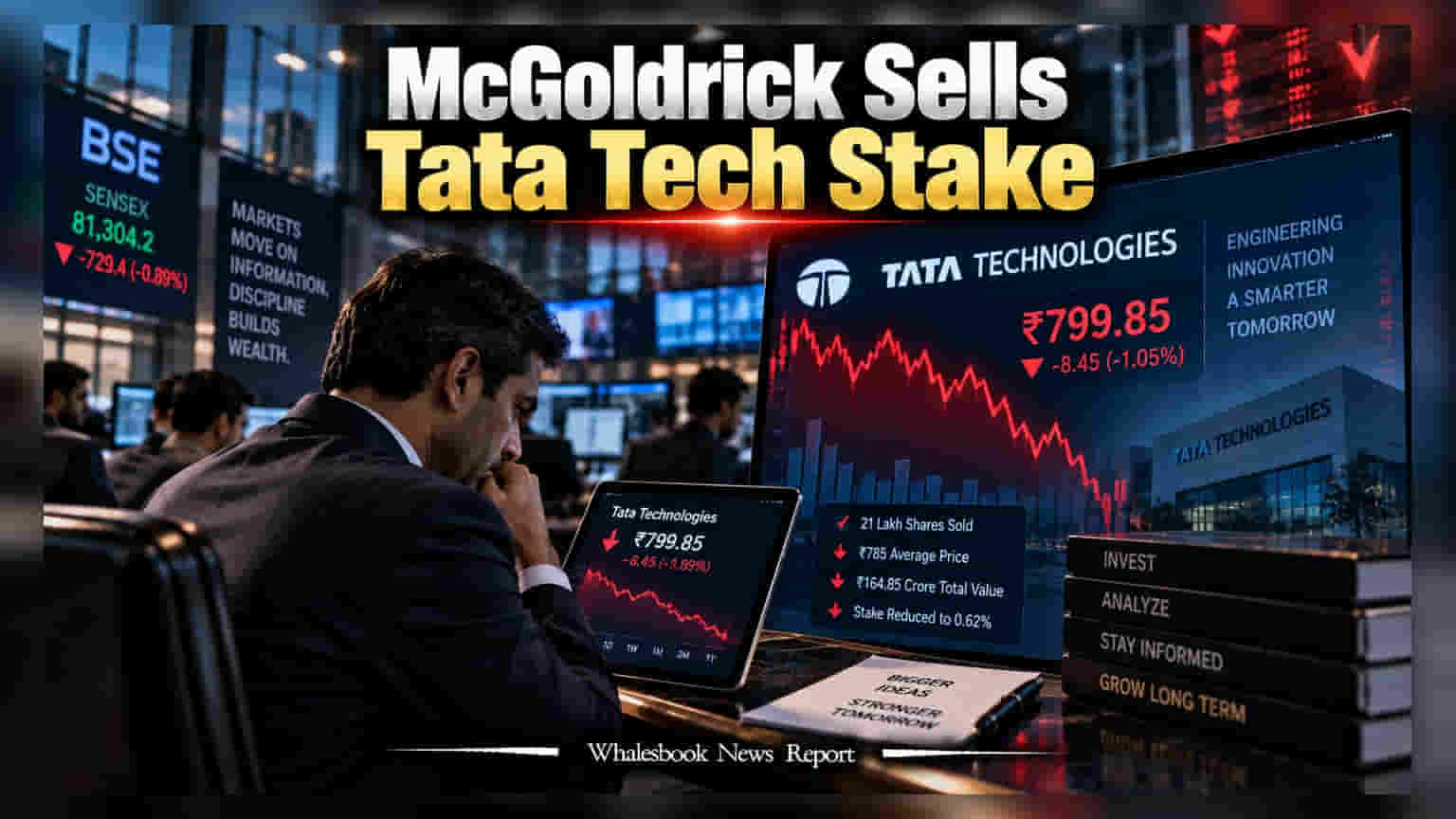
Former Tata Technologies CEO Patrick McGoldrick has sold a 0.51% stake in the engineering firm through block deals, raising approximately ₹165 crore. The shares were acquired by major institutional investors, including ICICI Prudential and Kotak Mahindra Mutual Fund. While institutional interest remains steady, the stock reaction follows a period where the company reported a decline in full-year net profit despite revenue growth.
Patrick McGoldrick, the former Managing Director and Chief Executive Officer of Tata Technologies, completed a stake sale in the company on Friday. He offloaded 2.1 million shares through block deals on the Bombay Stock Exchange, collecting a total of ₹164.85 crore. The transaction was executed at an average price of ₹785 per share.
This sale reduces McGoldrick's equity interest in the Pune-based firm to 0.62%, down from his previous holding of 1.13%. McGoldrick, who led the company for two decades before retiring in 2014, currently works as an Executive Director at RNT Associates International, a firm associated with the Tata Group.
Institutional demand played a significant role in this transaction. Large mutual funds and asset management firms stepped in to buy the shares, including ICICI Prudential Mutual Fund, Kotak Mahindra Mutual Fund, 360 One Asset Management, and Carnelian Asset Management & Advisors. This involvement from professional investors indicates that there was ready appetite for the stock, which closed at ₹799.85 on the day of the sale.
For investors, this exit happens at a time when the company's financial results show mixed signals. While Tata Technologies reported revenue of ₹5,505.57 crore for the full fiscal year 2026, up from ₹5,168.45 crore in the previous year, the bottom line tells a different story. The net profit for the year dropped to ₹546.59 crore from ₹676.95 crore in FY25. This indicates that the company has faced pressure on its profit margins or increased costs, which investors are currently evaluating.
Market observers often track insider sales to understand management's view on the company's future. While personal liquidity needs are common reasons for such sales, large exits by former leaders can sometimes lead to uncertainty among retail shareholders. Furthermore, the company continues to trade at a valuation that is higher than its historical average, meaning the stock is sensitive to any missed earnings expectations. Moving forward, the key factor for shareholders will be whether the company can reverse the trend of declining profits and demonstrate consistent growth in the coming quarters.