 Whalesbook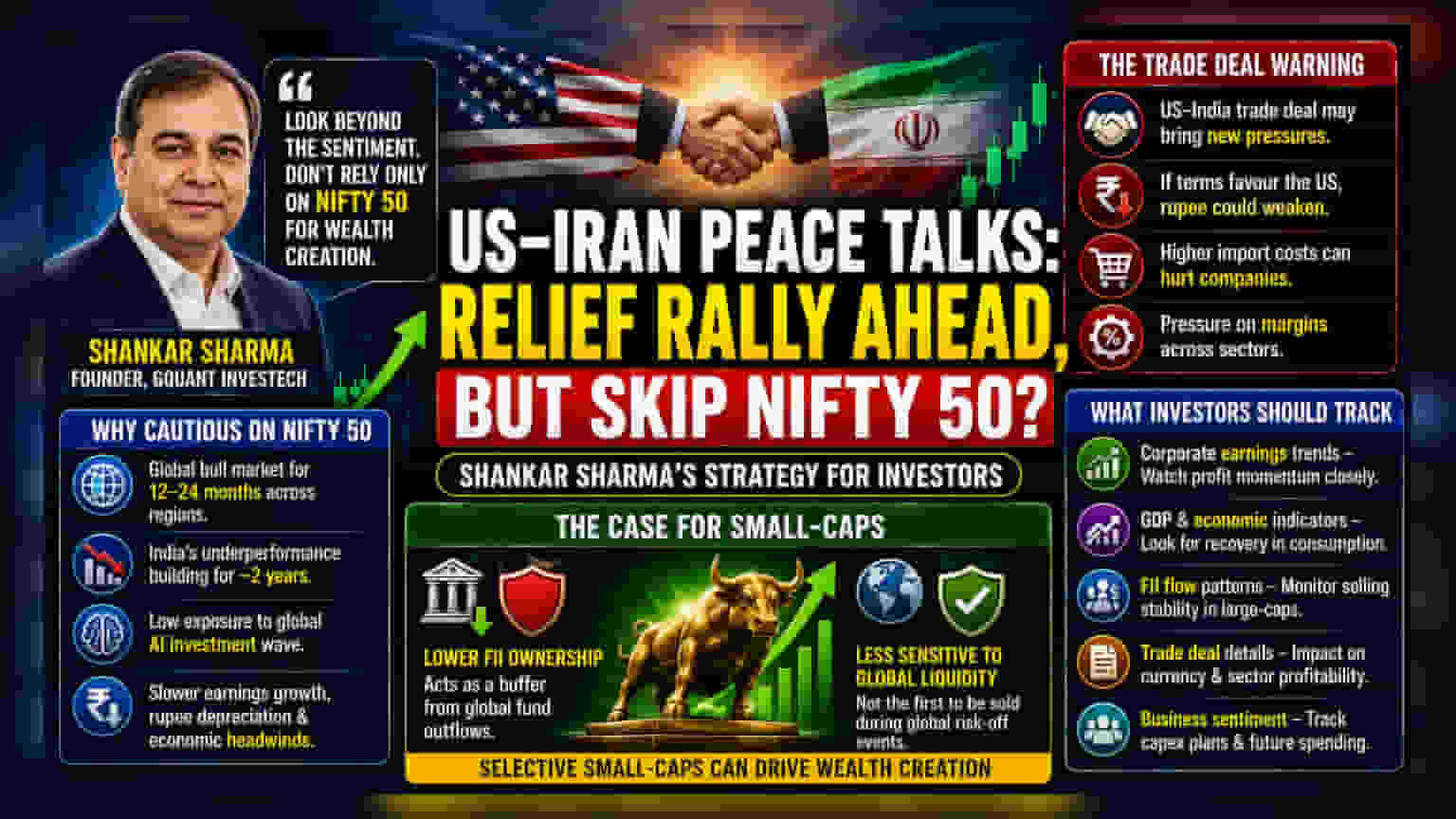


As global markets react to potential peace talks, expert Shankar Sharma warns against over-relying on Nifty 50. He points to the structural underperformance of large-caps and explains why the small-cap segment, with lower foreign ownership, may offer more sustainable wealth creation opportunities for long-term Indian investors.
What Happened
Global financial markets have seen a renewed wave of optimism following reports of potential peace talks between the United States and Iran. This development has triggered hopes of a broader relief rally in equity markets worldwide. However, Shankar Sharma, founder of GQuant Investech, has advised investors to look beyond the immediate market sentiment. While the easing of geopolitical tensions is a positive, he cautioned that Indian investors should not pin their hopes for sustained wealth creation solely on the Nifty 50, the country's benchmark index for large-cap companies.
Why The Nifty 50 View Is Cautious
Sharma challenged the common narrative that recent global market moves are primarily driven by the artificial intelligence boom. He argued that the strong performance in regions like Latin America and Central Europe suggests a broader global bull market that has been unfolding for the past 12 to 24 months. Regarding India, he noted that the country’s underperformance did not start with recent West Asian tensions but has been building for nearly two years. This sluggishness, he suggests, is rooted in structural factors: a lack of significant exposure to the global AI investment wave, a slowdown in corporate earnings growth, currency depreciation, and broader economic speed bumps. His view implies that simply buying Nifty 50 stocks may not yield the extraordinary returns investors might be expecting in the current environment.
The Case For Small-Caps
Despite the caution on large-caps, Sharma remains bullish on the small-cap segment. His argument rests on a key technical advantage: ownership patterns. Large-cap indices like the Nifty 50 have high foreign institutional investor (FII) ownership. This makes them highly sensitive to global liquidity shifts; when global investors decide to pull money out of emerging markets, they sell their most liquid holdings—the Nifty giants—first. In contrast, Indian small-cap stocks have significantly lower foreign institutional ownership. This lower foreign presence acts as a buffer, making them less prone to sudden, massive sell-offs triggered by global fund managers. For Sharma, this structural difference makes small-caps a better hunting ground for wealth creation, provided investors are selective.
The Trade Deal Warning
Investors should also monitor the potential US-India trade deal. While such agreements are often framed as positive for economic cooperation, Sharma warned that they could bring new pressures. If the terms of the deal favor the United States, it could create headwinds for the Indian rupee. A weaker currency typically leads to higher import costs, which can hurt companies reliant on imported raw materials, ultimately putting pressure on profit margins across various sectors. Investors should be aware that what appears to be a diplomatic victory might not always translate to an immediate gain for all Indian companies.
What Investors Should Track
As the market evaluates the news of peace talks and their potential to trigger a relief rally, there are several key factors to monitor:
- Corporate Earnings Trends: The ultimate driver of market performance is the health of company profits. Investors should watch whether earnings momentum improves or continues to face pressure.
- GDP and Economic Indicators: Broader economic growth data remains a critical barometer for the domestic market, especially as analysts watch for signs of a recovery in private consumption.
- FII Flow Patterns: Understanding whether foreign selling in large-caps is stabilizing is crucial, as this will determine the immediate direction of the Nifty 50.
- Trade Deal Details: Any official updates on trade negotiations between India and the US should be watched for their impact on sectors sensitive to currency fluctuations and trade tariffs.
- Business Sentiment: Keeping an eye on how local businesses are planning their future spending can provide a real-time signal on economic health, regardless of short-term market noise.