 Whalesbook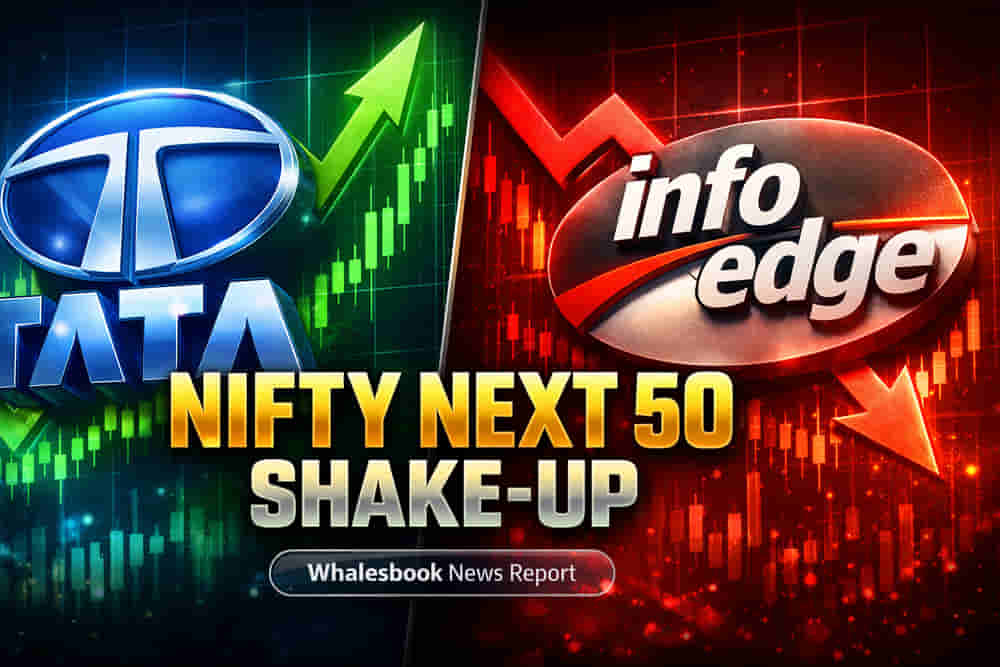
Nifty Rebalance: Capital Seesaws Force Strategic Reallocation
The anticipated reshuffling of the Nifty Next 50 index, slated for a March 30 implementation, is poised to inject substantial capital into specific stocks while prompting divestment from others. Analysts at Nuvama Alternative & Quantitative Research project that Tata Motors' inclusion alone could draw approximately ₹1,296 crore in passive inflows. HDFC Asset Management Company and Muthoot Finance are also positioned to receive significant investment, with estimated inflows of ₹734 crore and ₹625 crore, respectively. Tata Capital and ICICI Prudential Asset Management are forecasted to attract around ₹172 crore each. This influx of funds into these companies, particularly within the automotive and financial services sectors, signals a strategic shift in index fund mandates.
Exclusions and Sell-Off Pressure
Conversely, Info Edge (India) faces the prospect of substantial outflows, estimated at ₹716 crore, as it prepares for exclusion. ICICI Lombard General Insurance is also likely to see selling pressure, with outflows projected at ₹643 crore. Havells India and JSW Energy may experience outflows of roughly ₹471 crore and ₹344 crore, respectively. These movements are driven by index fund managers rebalancing their portfolios to align with the new index composition. Such exclusions can signal reduced liquidity and potentially place downward pressure on stock prices as passive funds divest their holdings.
The Capital Flow Conundrum
The Nifty Next 50, representing about 10.86% of the free float market capitalization on the NSE, acts as a crucial conduit for passive investment flows [13]. The impending inclusion of companies like Tata Motors (commercial vehicle) and HDFC Asset Management Company, along with expected inflows for Muthoot Finance and Tata Capital, highlights a potential rerating event. Tata Motors, with a current P/E of approximately 20.6 [2] and market capitalization around ₹1.68 lakh crore [3], operates in a cyclical automotive sector that often benefits from such liquidity boosts. HDFC AMC, a market leader in asset management with a P/E around 40.5 [6] and market cap near ₹1.16 lakh crore [6], presents a more defensive financial services play poised for steady capital accumulation. The magnitude of these inflows can temporarily decouple stock performance from underlying fundamentals, driven primarily by passive fund rebalancing ahead of the March 30 effective date.
Valuation & Sectoral Crosswinds
The market's broader sentiment remains cautiously optimistic, with analysts expecting range-bound trading in the Nifty 50 but with a positive bias following the resolution of trade deal uncertainties [8]. Mid-cap segments are also showing strength, with indices like the Nifty Smallcap 50 and 100 registering gains, potentially benefiting companies transitioning into larger indices [8]. However, sector-specific headwinds persist; information technology stocks are under pressure due to AI-related concerns, which could cast a shadow on companies like Info Edge, despite its online recruitment and real estate businesses [8].
Info Edge's P/E ratio, hovering around 89.1 [35] or 55.52 [9], appears steep when compared to its peers and the broader IT sector. This high valuation, coupled with exclusion from the index, presents a risk. In contrast, ICICI Lombard General Insurance, a leading non-life insurer with a P/E of 33.9 [7], faces outflows but operates in a relatively stable sector. Its market share in various segments, including fire and marine insurance, remains robust [7].
The Bear Case
While index inclusions often provide a short-term liquidity surge, historical analysis indicates that long-term gains from Nifty 50 inclusion can dissipate, with stocks sometimes underperforming the broader index over extended periods [14]. For Info Edge, exclusion from the index combined with its elevated P/E ratio presents a significant challenge. Its valuation metrics significantly outpace the median P/E of its peers [9]. Furthermore, while analysts maintain price targets, there have been reports of downgrades or maintained recommendations with reduced price targets, suggesting caution [23].
For ICICI Lombard, although it holds a dominant position in the general insurance market, a high share of motor-third party insurance exposes it to reserving risks due to the segment's long-tail nature [42]. This, combined with outflows, could create selling pressure. Tata Motors, despite a 'Strong Buy' consensus from many analysts, faces inherent cyclicality in the auto sector, and one analyst group maintains a 'Hold' rating with a lower target price [12, 15]. The significant variation in reported P/E ratios for Tata Motors across different sources (ranging from 20.6 to 71.15) also warrants scrutiny [2, 3].
Future Trajectory
Looking ahead, Tata Motors is supported by a 'Strong Buy' consensus from 18 analysts, targeting an average price of ₹506.78 [15]. HDFC Asset Management Company garners 'Buy' recommendations from firms like Nomura and Phillip Securities, with an average target price around ₹3,059.98 [18]. ICICI Lombard also sees analyst upgrades to 'Buy' with price targets near ₹2,230-₹2,250 [28]. Info Edge's outlook is more nuanced, with an average target price of ₹1530.25, indicating an upside potential, but this is contrasted by potential sector headwinds and mixed analyst commentary [23]. The official announcement of index changes is expected in the latter half of February, with markets poised to react in the run-up to the March 30 implementation date.