

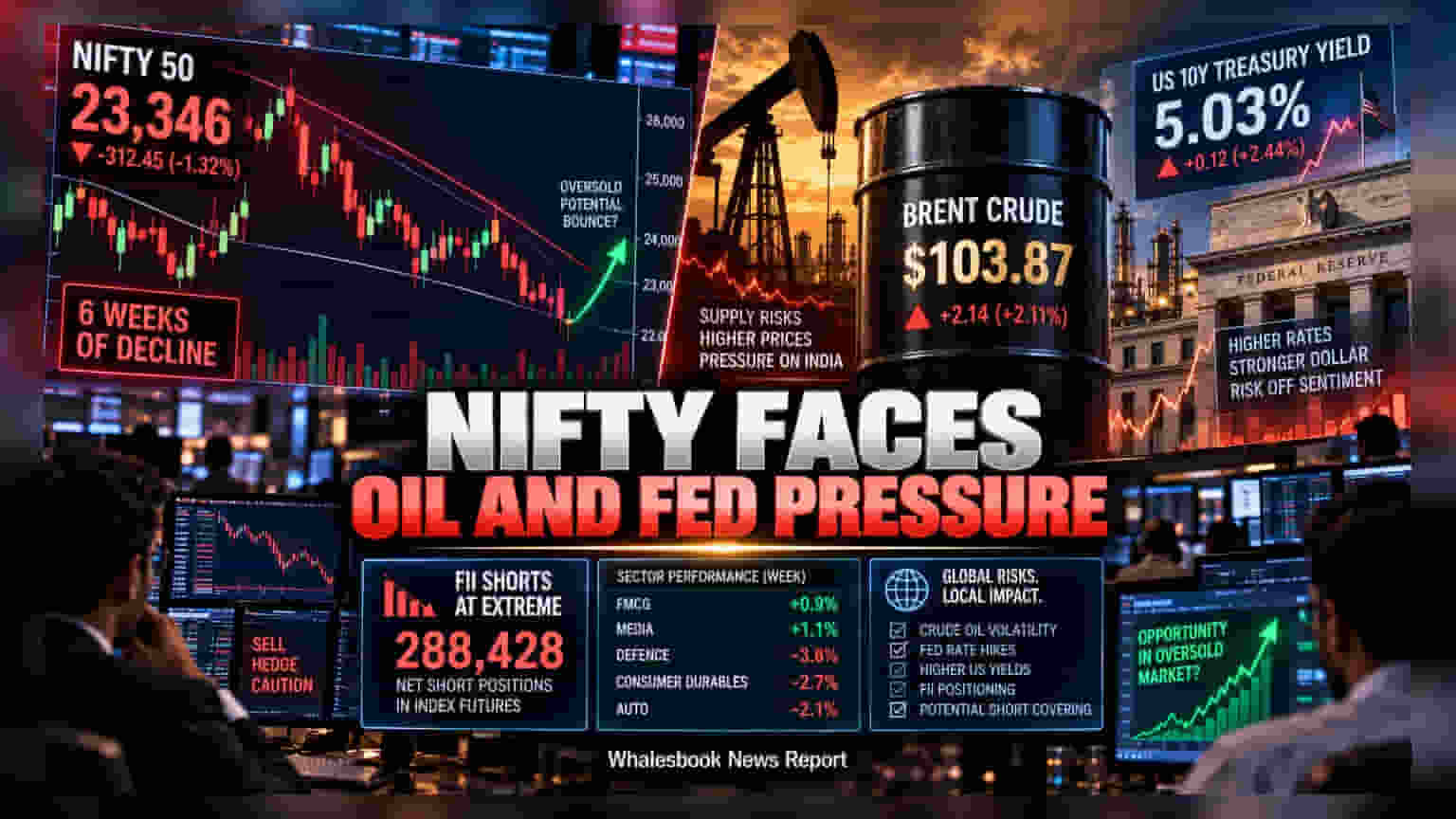
Indian markets continued their losing streak for the sixth consecutive week, closing at 23,346.40. Rising US Treasury yields, the Federal Reserve’s latest rate hike, and volatile crude oil prices dragged investor sentiment. While indices face technical pressure, record-high short positions by foreign investors indicate the market could see a sharp recovery if global factors stabilise.
The Nifty 50 extended its losing streak to six consecutive weeks, closing at 23,346.40. This recent slide highlights how much local equities are currently influenced by external global pressures rather than internal company-specific developments. The market's inability to hold ground reflects a cautious mood among investors as they navigate a trio of challenges: crude oil price fluctuations, rising US bond yields, and central bank interest rate decisions.
The most immediate pressure has come from the US Federal Reserve, which raised its benchmark interest rate by 25 basis points to a range of 3.75%-4%. When US rates rise, it often makes assets in emerging markets like India less attractive to global investors. Compounding this, the US 10-year Treasury yield surged to 5.03%, the highest level seen since 2007, drawing capital away from riskier assets.
Energy prices also played a major role. Brent crude oil prices remained erratic, climbing toward $108 per barrel at one point due to concerns about supply disruptions, before settling closer to $103. Since India imports a significant portion of its oil, high prices typically hurt the profit margins of Indian companies, particularly in the manufacturing and transport sectors.
Sector performance reflected these pressures. Defensive sectors like FMCG and Media managed to post gains of 0.9% and 1.1% respectively, suggesting that investors are seeking safer, more stable companies. In contrast, sectors highly sensitive to costs and interest rates, such as Defence, Consumer Durables, and Auto, faced steeper declines, with Defence dropping 3.8% and Durables falling 2.7%.
From a technical perspective, the market is currently in a delicate spot. The Nifty has fallen below its 40-week average, which generally signals that the trend is negative. A key detail for investors to watch is the position of Foreign Institutional Investors. Recent data shows a record high of 288,428 net short positions in index futures. This means many foreign investors have bet heavily that the market will continue to fall. While this highlights widespread pessimism, it also creates a setup known as a short-covering rally. If the market stops falling or global news improves, these investors will be forced to buy back shares to close their positions, which can often push the stock index up rapidly.
The near-term direction of the market will largely depend on whether these global factors—specifically oil prices and US bond yields—begin to settle. If global volatility eases, the current extreme level of negative positioning could act as a foundation for a rebound. However, until there is clarity on these external drivers, the market is likely to remain sensitive to any new negative news.