

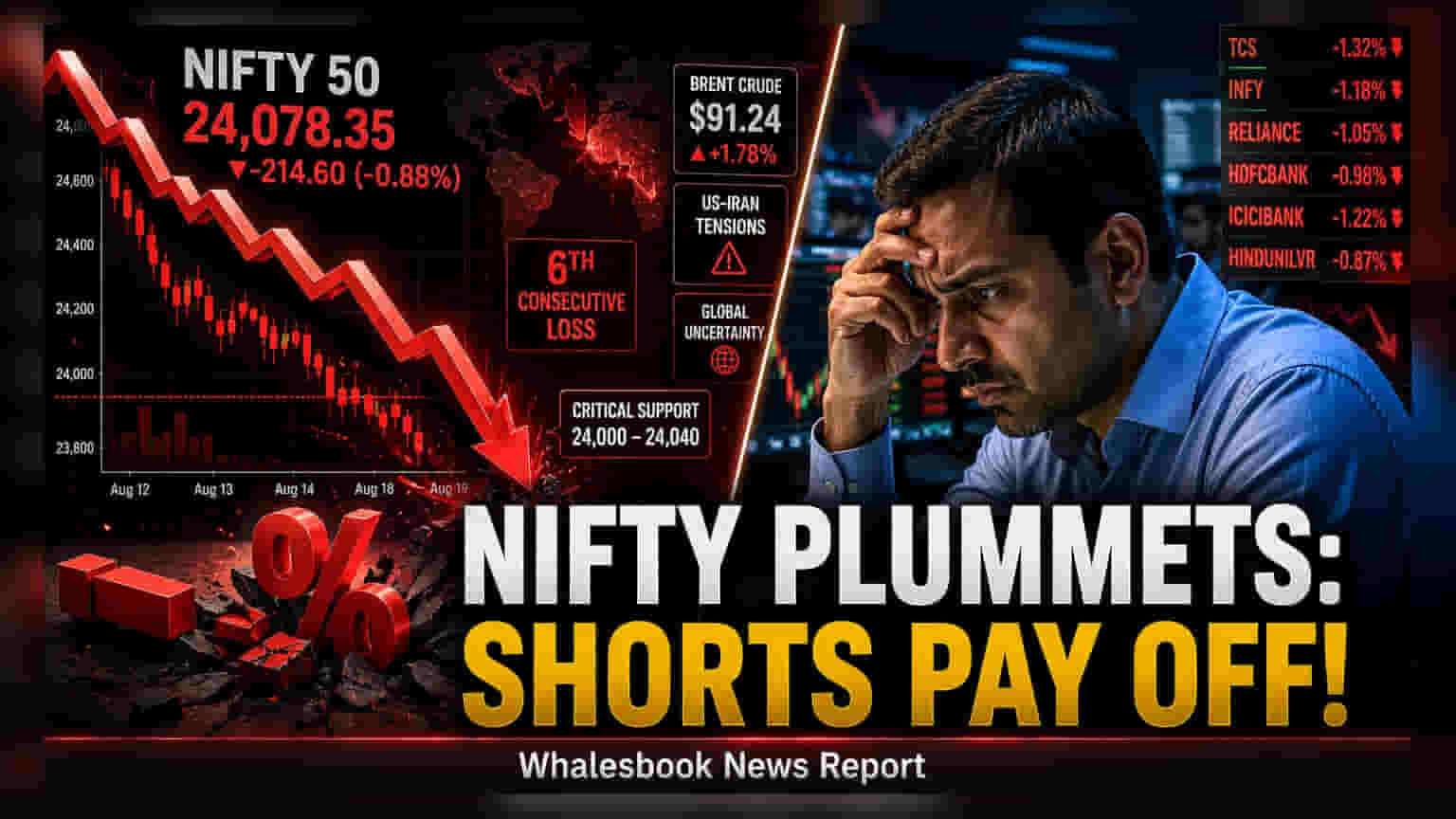
Nifty 50 Futures extended their losing streak to six sessions on August 19, 2026, as technical weakness and global headwinds dampened sentiment. The index is tracking below key support levels, with market participants monitoring the 24,000 mark as a critical stability zone amid rising crude oil prices and geopolitical uncertainty.
Nifty 50 Futures continued their downward momentum on Wednesday, recording a sixth consecutive day of losses. The index was seen trading below the 24,100 mark, reflecting a cautious mood as market participants react to both domestic technical setups and broader global developments.
Global Headwinds Impact Sentiment
The current market pressure is partly attributed to negative global cues. Rising Brent crude oil prices, which have recently crossed the $91 per barrel mark, are creating concerns about inflation and economic growth. Additionally, ongoing geopolitical uncertainty related to US-Iran relations has added to the cautious sentiment. These factors often lead to increased volatility and a tendency among investors to reduce exposure to riskier assets.
Technical Indicators and Support Levels
From a technical perspective, the index is currently trading below its 50-day and 100-day exponential moving averages (EMAs). In market analysis, these averages are often used to gauge the long-term trend; trading below them is frequently interpreted as a sign of waning momentum.
Market participants are closely observing the 24,000 to 24,040 zone. This area is widely viewed as a critical support level. If the index fails to hold this range, it may signal that the downward trend could extend further. On the upside, immediate resistance is pegged in the 24,280 to 24,300 range. For the market to regain a more stable footing, it would likely need to clear these resistance levels, which currently act as hurdles to any potential recovery.
What Investors Are Monitoring
The market’s focus remains on whether the index can establish a base near the 24,000 level. Investors and market watchers are tracking the stability of this support zone, as a decisive breach could trigger further corrections. Additionally, any major shift in crude oil prices or new developments regarding geopolitical tensions will be important factors, as these continue to influence broader market direction.
The overall atmosphere remains defensive, with participants looking for clear signs of demand returning to the index before shifting from a cautious outlook. The next significant updates will likely depend on how the index behaves at these critical support areas and whether global macro factors show signs of cooling down.