

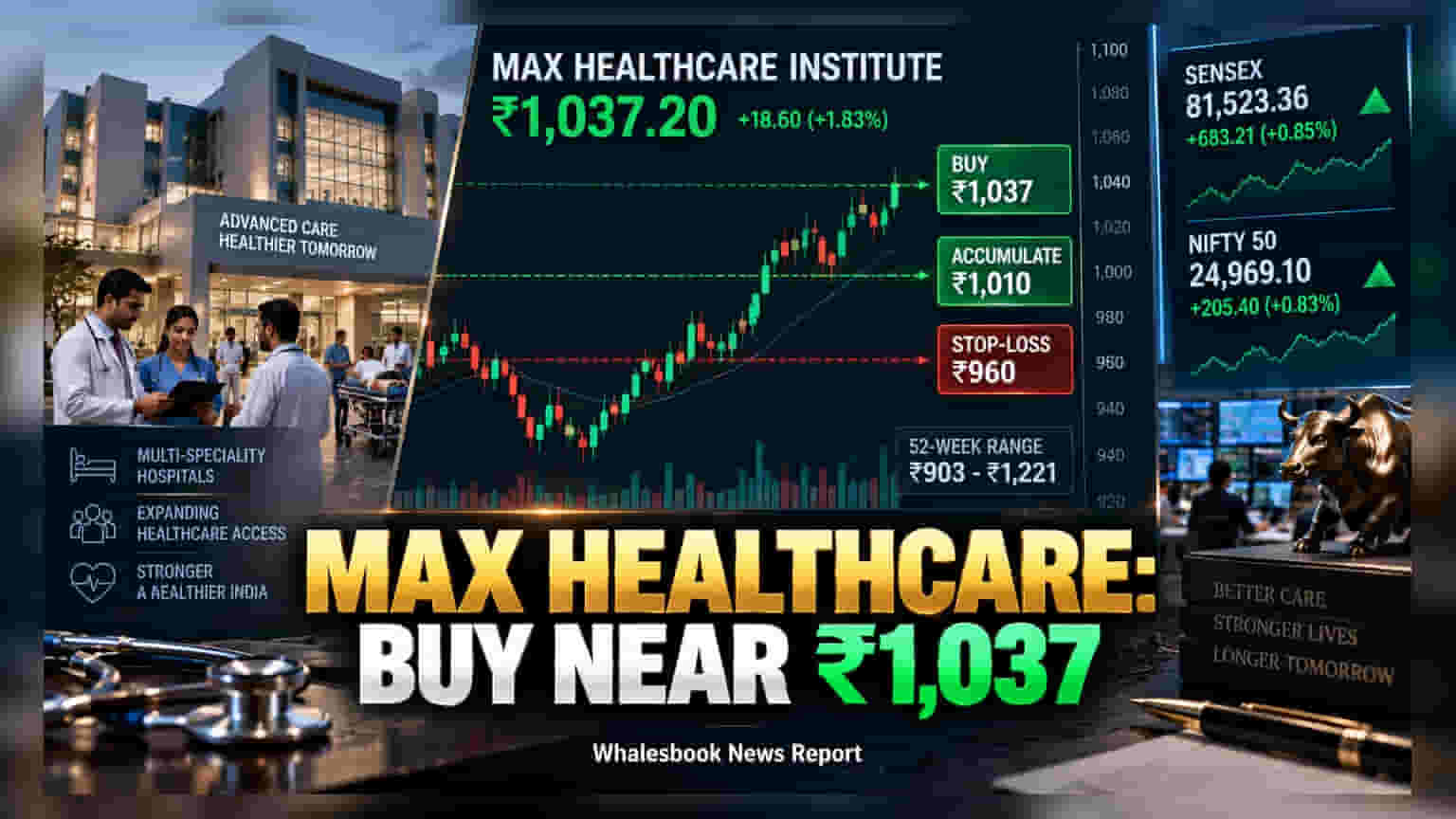
A technical trading setup has surfaced for Max Healthcare, suggesting an entry near ₹1,037 with a stop-loss at ₹960. This call focuses on short-term price levels rather than the hospital chain's fundamental business performance. Investors should note this is a tactical view without specific upside targets or a defined investment horizon.
A new tactical trading setup for Max Healthcare Institute has identified the ₹1,037 price level as a potential entry point for traders. The strategy outlines a structured approach to the stock, suggesting an initial purchase around ₹1,037.20, with a secondary accumulation zone if the price drops to ₹1,010. To manage downside risk, the setup places a stop-loss at ₹960.
It is important to understand that this technical call is based entirely on chart patterns and price levels. It does not incorporate the company’s recent earnings, hospital occupancy rates, expansion plans, or current valuation. Because the setup lacks a specific upside price target or a suggested time frame for holding the stock, it is treated as a short-term trading exercise rather than a long-term investment recommendation.
Business Context and Upcoming Events
While the trading setup focuses on price movement, Max Healthcare’s business operations continue to move forward with standard investor relations activities. The company has confirmed its participation in the Jefferies India Forum scheduled for September 16, 2026, and the J.P. Morgan India Conference on September 21, 2026. In its exchange filings, the company has clarified that it does not intend to share any unpublished, price-sensitive information at these events.
Investors tracking the stock should distinguish between these tactical price calls and the underlying business performance. The company’s share price has seen a 52-week trading range between ₹903 and ₹1,221. The current price of ₹1,037 sits comfortably within this range, reflecting the ongoing market sentiment toward the hospital sector.
Risks of Price-Only Trading
Trading setups that ignore fundamental factors carry specific risks. Because this strategy is built on price levels, it does not account for sector-specific pressures such as regulatory changes, rising operational costs in healthcare, or shifts in patient demand. If external factors or company-specific news negatively impact the stock, technical support levels may not hold as expected.
For those watching the stock, the most important updates will be the company’s actual financial performance in upcoming quarterly reports rather than specific trading levels. Traders should be aware that the defined stop-loss at ₹960 represents a downside risk of roughly 7.4% from the initial entry price of ₹1,037.