

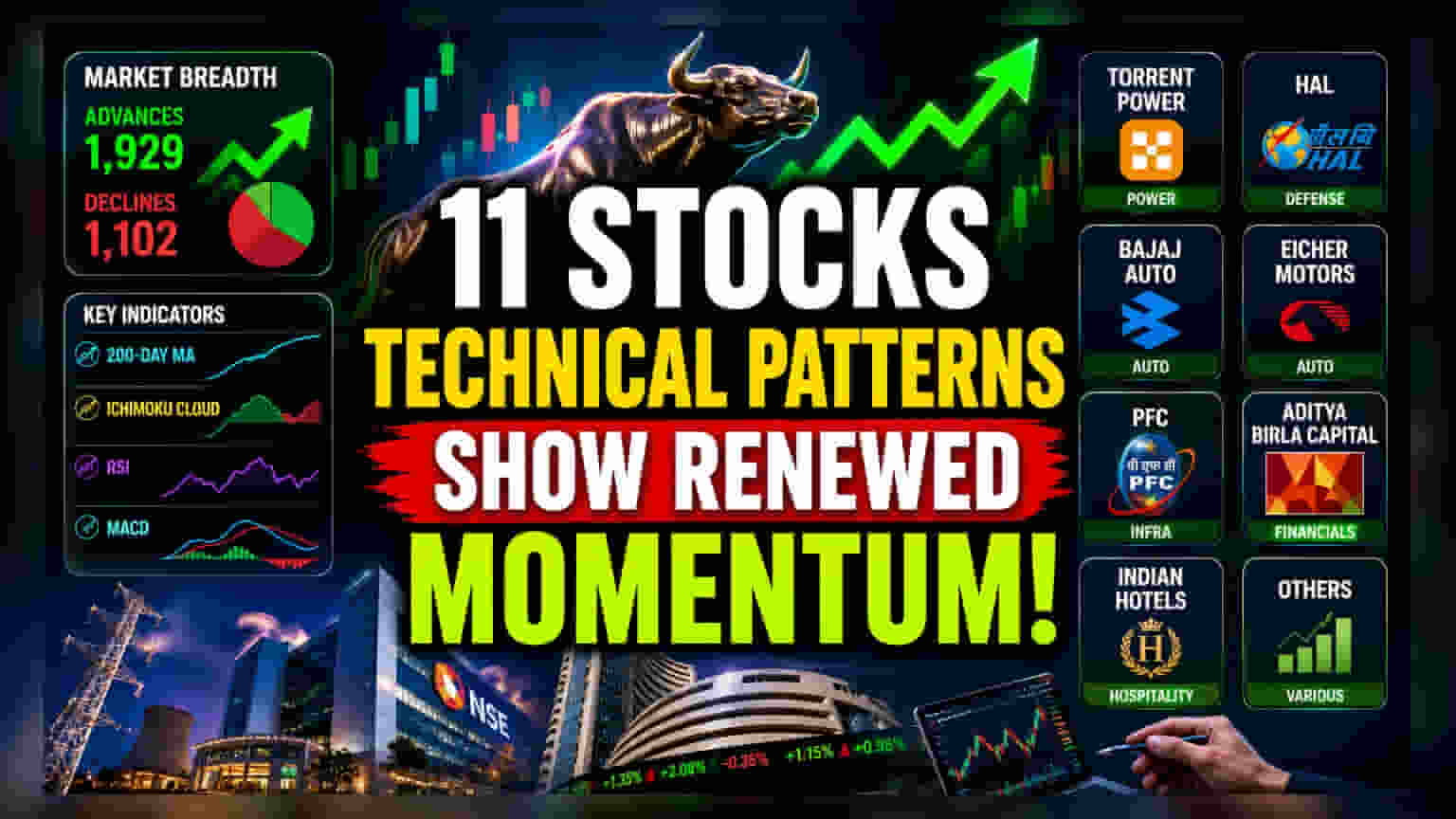
Technical analysts have highlighted eleven stocks, including Torrent Power, HAL, and Sun Pharma, noting specific chart patterns and momentum indicators. These observations reflect recent price activity in sectors like auto, power, and finance. Investors should note that technical setups track past and current momentum but do not guarantee future performance, especially during periods of market volatility.
What Happened
On June 23, market analysts pointed to specific technical patterns in eleven companies, suggesting renewed momentum in several segments. The broader market sentiment remained positive, with NSE data showing 1,929 shares advancing against 1,102 declining, indicating healthy market breadth. The observations focused on stocks like Torrent Power, Hindustan Aeronautics (HAL), and Bajaj Auto, highlighting how recent price movements, moving averages, and momentum indicators—such as the Relative Strength Index (RSI) and MACD—align to create specific technical setups.
Why Analysts Look at Technical Patterns
Technical analysis is a method used by traders to study past price data and volume to identify potential future trends. When analysts mention indicators like the '200-day moving average' or 'Ichimoku Cloud,' they are looking for zones where a stock price has historically found support (a floor) or resistance (a ceiling). For instance, stocks like Eicher Motors and Bajaj Auto were noted for approaching key support levels. Understanding these patterns helps traders identify potential shifts in buying or selling pressure, though these tools do not account for external events like company earnings, policy changes, or macro-economic shifts.
Sector-Specific Context
The stocks highlighted represent a mix of sectors currently in focus. In the auto space, companies like Eicher Motors and Bajaj Auto are often watched for demand trends in two-wheelers and premium motorcycles. In the power and infrastructure segment, entities like Torrent Power and Power Finance Corporation (PFC) are sensitive to energy transition policies and government infrastructure spending. Meanwhile, defense-related companies like HAL continue to be monitored for their order book visibility. Financial services and hospitality firms, such as Aditya Birla Capital and Indian Hotels, are often tracked based on broader economic growth and credit demand.
The Risks of Technical Trading
While technical analysis provides a framework for understanding market momentum, it is not a prediction of the future. A stock may break out of a chart pattern but can reverse quickly due to unexpected news, such as a regulatory change, a management issue, or a global economic shift. For example, defense sector stocks are highly sensitive to government budget cycles, while power sector performance can be affected by fuel costs and regulatory tariff decisions. Relying solely on technicals without considering the company’s underlying debt, cash flow, and competitive position can be risky for long-term investors.
What Investors Should Track
Investors following these trends should look beyond chart patterns. The most important monitorables include:
- Trading Volumes: A price movement supported by high volume is generally considered more reliable than one with low participation.
- Sector-Specific News: Keep an eye on sector-wide developments, such as raw material costs for auto companies or regulatory updates for the power sector.
- Market Context: Technical setups can fail during broad market corrections. Monitoring the Nifty and Sensex indices provides the necessary context for how individual stocks might behave.
- Fundamental Strength: Always verify whether the technical trend aligns with the company’s recent quarterly earnings and growth prospects.