 Whalesbook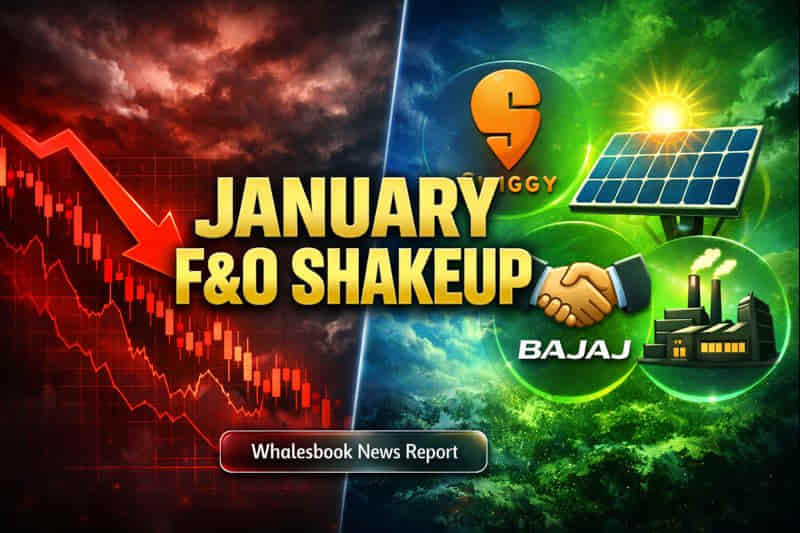
January F&O Series: New Rules, New Stocks, and Seasonal Headwinds
The Indian stock market ushers in the January Futures & Options (F&O) series with notable adjustments and historical patterns to consider. This new series, commencing on the first trading day of 2026, introduces revised lot sizes for key indices and expands the derivatives trading universe with the inclusion of four new stocks. Traders and investors will be closely watching these changes against a backdrop of seasonal trends and upcoming economic events.
Key Changes in Lot Sizes
A significant shift for the January series is the reduction in lot sizes. The Nifty lot size has been decreased from 75 contracts to 65 contracts. Similarly, the Nifty Bank lot size has been adjusted downwards from 35 contracts to 30 contracts. These adjustments are often implemented to manage market risk and potentially make derivatives trading more accessible by requiring less capital per contract, which could influence trading volumes and strategies.
Expansion of F&O Segment
The derivatives market is set to expand with the addition of four new stocks now available for Futures & Options trading. These include Swiggy, Bajaj Holdings & Investment Limited, Waaree Energies Limited, and Premier Energies Limited. The inclusion of these companies into the F&O segment can significantly impact their derivative trading dynamics, potentially increasing liquidity and offering new hedging and speculative opportunities for market participants.
Market Performance and Seasonal Trends
The preceding December series concluded with marginal gains for the Nifty, adding just 54 points. This follows a 51-point drop in November, indicating a period of consolidation. Looking ahead, the January series presents a recurring seasonal challenge. Historical data over the last four years shows a consistent pattern of negative returns for the Nifty during January. In 2025, the index saw a decline of 500 points (-2.1%), following similar drops in prior years, suggesting a cautious outlook based on past performance.
Rollovers and Foreign Institutional Investor Positioning
Rollover data, which indicates the continuation of open positions from one series to the next, shows figures below the three-month average. Nifty rollovers stood at 72.3%, compared to the average of 75.7%. Foreign Institutional Investors (FIIs) continue to maintain a net short exposure on the index, with their net long position at 9%. Historically, periods of lower FII positioning have sometimes coincided with healthy market returns, although past performance is not indicative of future results. Current FII short positions amount to 1.44 lakh contracts.
Upcoming Triggers for the Series
The January F&O series is poised to be influenced by several critical factors leading up to the Union Budget in February. Key developments include negotiations around the India-US trade deal, ongoing pre-budget consultations, foreign fund flows, and crucially, the third-quarter earnings reports from various companies. These events are expected to be major drivers of market sentiment and price action during the series.
Impact
These changes and market dynamics could lead to increased volatility, particularly around the introduction of new stocks in the F&O segment. The reduction in lot sizes may alter trading strategies, potentially drawing in more retail participation. The historical seasonal weakness in January, coupled with the upcoming economic and corporate events, sets the stage for a potentially eventful series.
Impact Rating: 7/10
Difficult Terms Explained
- Futures & Options (F&O): These are derivative contracts whose value is based on an underlying asset, like a stock or index. Futures involve an obligation to buy or sell at a predetermined price on a future date, while options give the buyer the right, but not the obligation, to do so.
- Lot Size: The standardized quantity of a particular security or derivative that must be traded. A reduction in lot size means fewer units are bundled together for trading.
- Rollovers: The process of extending an open futures or options position from its current expiration date to the next expiration date.
- Foreign Institutional Investors (FIIs): Overseas entities that invest in financial assets in another country. Their trading activity can significantly influence market movements.
- Net Short: When an investor has sold more contracts than they have bought for a particular asset, indicating a bearish stance.
- Seasonality: The tendency for financial markets or economic indicators to exhibit predictable patterns over specific periods, such as months or seasons.