

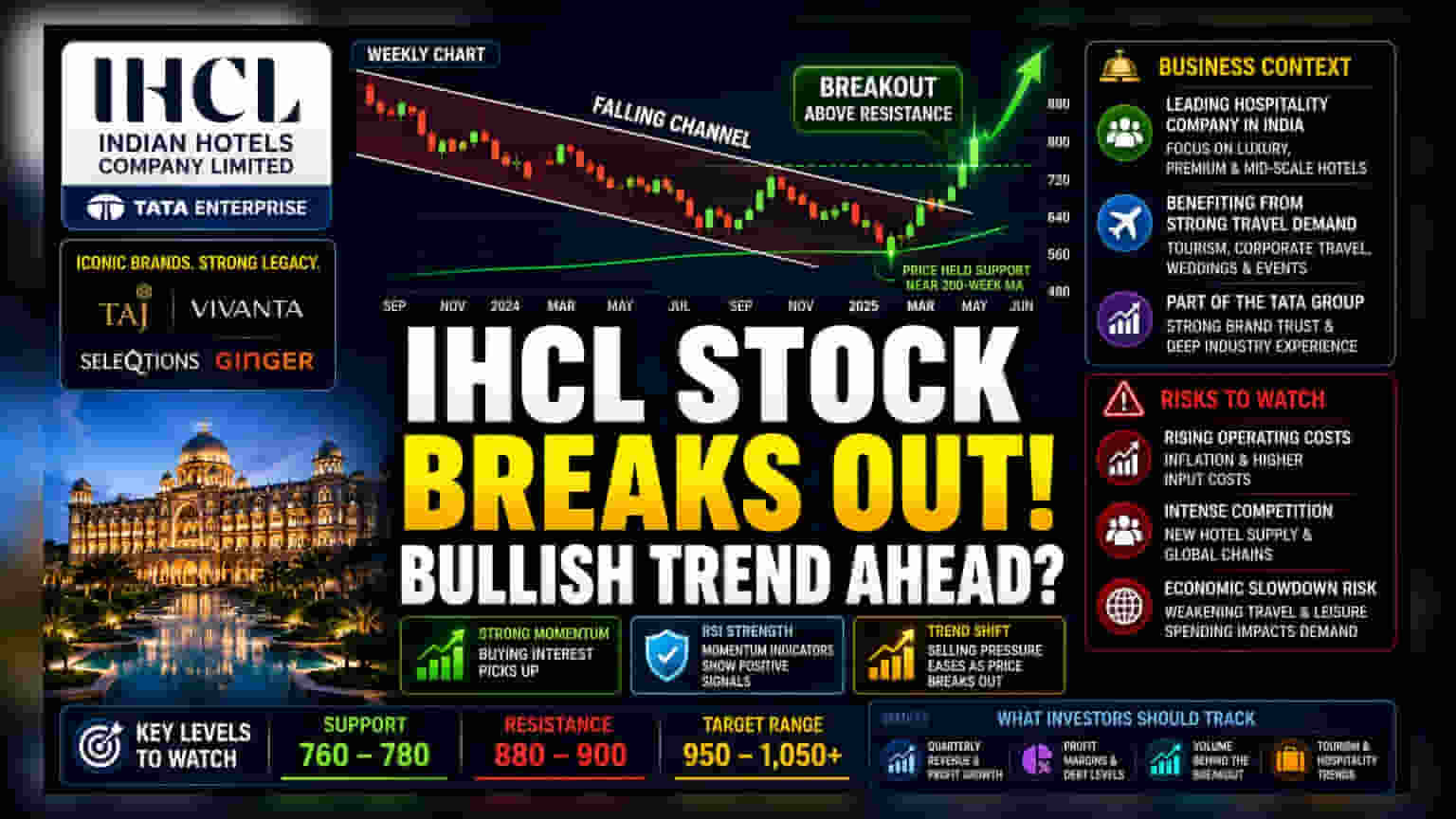
Indian Hotels (IHCL) stock has moved past a technical resistance level on its weekly charts, drawing attention from market observers. This development suggests a shift in short-term trend sentiment after a period of downward movement. While technical breakouts can signal renewed interest, investors often verify such patterns by looking at trading volumes and the underlying financial health of the hospitality business.
What Happened
Indian Hotels Company Ltd (IHCL) recently saw its stock price break through a key resistance level on its weekly charts. Market analysts tracking the stock noted that it had been trading within a "falling channel" pattern for several months, a shape often seen when a stock undergoes a sustained period of correction or consolidation. By moving above this resistance line, the stock has signaled a potential shift in its short-term trend, catching the attention of market participants who use chart patterns to gauge sentiment.
The Technical Perspective
For traders and analysts, a falling channel represents a period where the stock consistently makes lower highs and lower lows. When a stock breaks above the upper boundary of this channel, it is often interpreted as a sign that the selling pressure has eased and buying interest is returning. Market observers have noted that this move follows a period where the stock found support near its longer-term moving averages. Additionally, some momentum indicators, such as the Relative Strength Index (RSI), have shown strength, suggesting that the recent price movement is supported by consistent trading activity.
Business Context and Sector Trends
While technical charts show daily or weekly movements, the long-term health of Indian Hotels depends on the broader hospitality sector. As part of the Tata Group, IHCL operates well-known brands including Taj, Vivanta, SeleQtions, and Ginger. The company’s performance is closely tied to domestic and international travel demand, corporate travel budgets, and high-value events like weddings and conferences. In recent quarters, the Indian hospitality industry has benefited from increased tourism and business travel, though these segments are inherently cyclical and can be sensitive to overall economic growth.
Risks and Market Realities
Investors should keep in mind that technical patterns are not a guarantee of future price performance. The hospitality business faces specific risks, including rising operating costs, competition from new hotel chains, and the impact of inflation on consumer spending. If the economy slows, corporate travel and leisure spending—the main revenue drivers for premium hotels—can soften quickly. Furthermore, if a stock is trading at a high valuation, any disappointment in quarterly financial results can lead to a sharp correction, regardless of what the charts suggest. Technical indicators can also fail during periods of high market volatility or unexpected news.
What Investors Should Track
Those following the stock may want to look beyond chart patterns. The most important monitorables include the company’s quarterly revenue growth, profit margins, and debt levels, as these are the true drivers of long-term value. Investors should also observe whether the current price breakout is backed by high trading volumes, which would suggest conviction from institutional investors. Finally, keeping an eye on the broader tourism and hospitality sector trends will help determine if the stock’s movement is part of a larger industry recovery or an isolated event.