

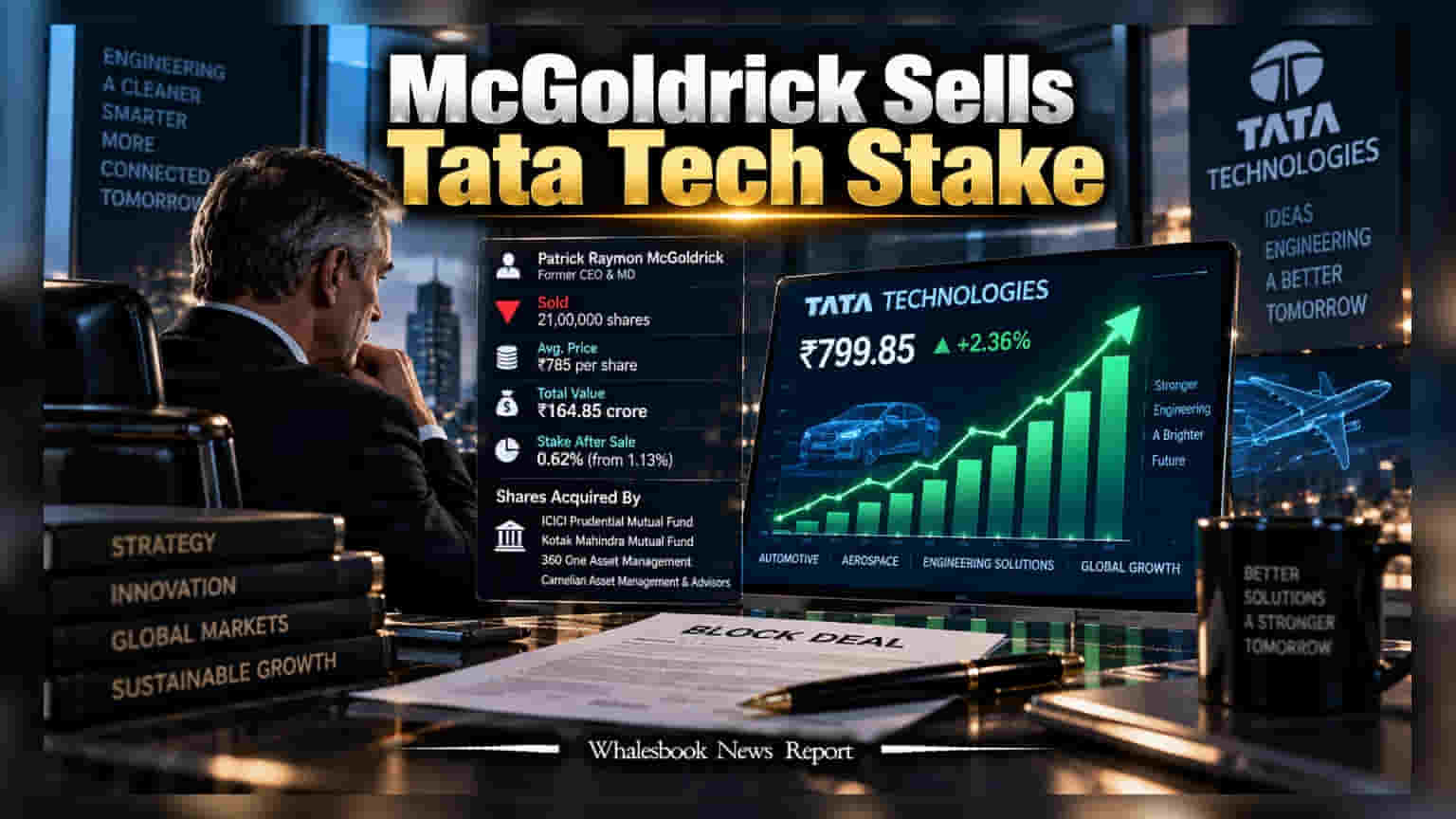
Former Tata Technologies CEO Patrick Raymon McGoldrick sold a 0.51% stake in the company for ₹164.85 crore in a block deal. Shares were absorbed by institutional investors, including ICICI Prudential and Kotak Mahindra Mutual Funds. While the transaction signals a partial exit by a long-term stakeholder, the market remains focused on the company's high valuation and its ability to sustain recent quarterly profit growth.
On September 4, 2026, Patrick Raymon McGoldrick, the former CEO and Managing Director of Tata Technologies, completed the sale of 21 lakh shares of the company. The transaction was executed through a series of block deals on the stock exchange at an average price of ₹785 per share, resulting in a total value of ₹164.85 crore. Following this sale, his equity stake in the product engineering services firm has decreased to 0.62% from 1.13%.
Institutional Demand and Market Reaction
The sale by a former top executive often draws investor attention, as such moves can sometimes lead to uncertainty regarding a company's future outlook. However, the market reaction to this transaction was stable, as shares of Tata Technologies closed at ₹799.85 on the day of the sale. The shares offloaded by McGoldrick were quickly acquired by several prominent institutional investors, including ICICI Prudential Mutual Fund, Kotak Mahindra Mutual Fund, 360 One Asset Management, and Carnelian Asset Management & Advisors. The willingness of these institutions to absorb the shares suggests that there is still significant interest in the company's growth story, which has helped balance the potential negative sentiment from the insider's exit.
Financial Context and Valuation
Tata Technologies is a significant player in the automotive and aerospace engineering sectors, and its recent financial performance has been a key monitorable. The company reported strong results for the quarter ending March 2026, showing a 15.1% quarter-on-quarter increase in operating revenue and a 30.7% rise in operating profit, or EBITDA. While these figures indicate that the company's core operations are growing, investors should also consider the broader valuation context. The stock currently trades at a price-to-book ratio of approximately 18.38. This indicates that the company carries a higher valuation compared to many peers, meaning the market has priced in expectations of consistent and strong future performance.
Moving forward, investors will be watching to see if the company can maintain its current trajectory in revenue and profit margins. As the firm continues to provide solutions for global original equipment manufacturers, the ability to balance its high market valuation with sustained financial growth will be the most important factor for shareholders to track. Future updates on operational efficiency and order book additions will provide further clarity on whether the company can justify its current price levels in the coming quarters.