 Whalesbook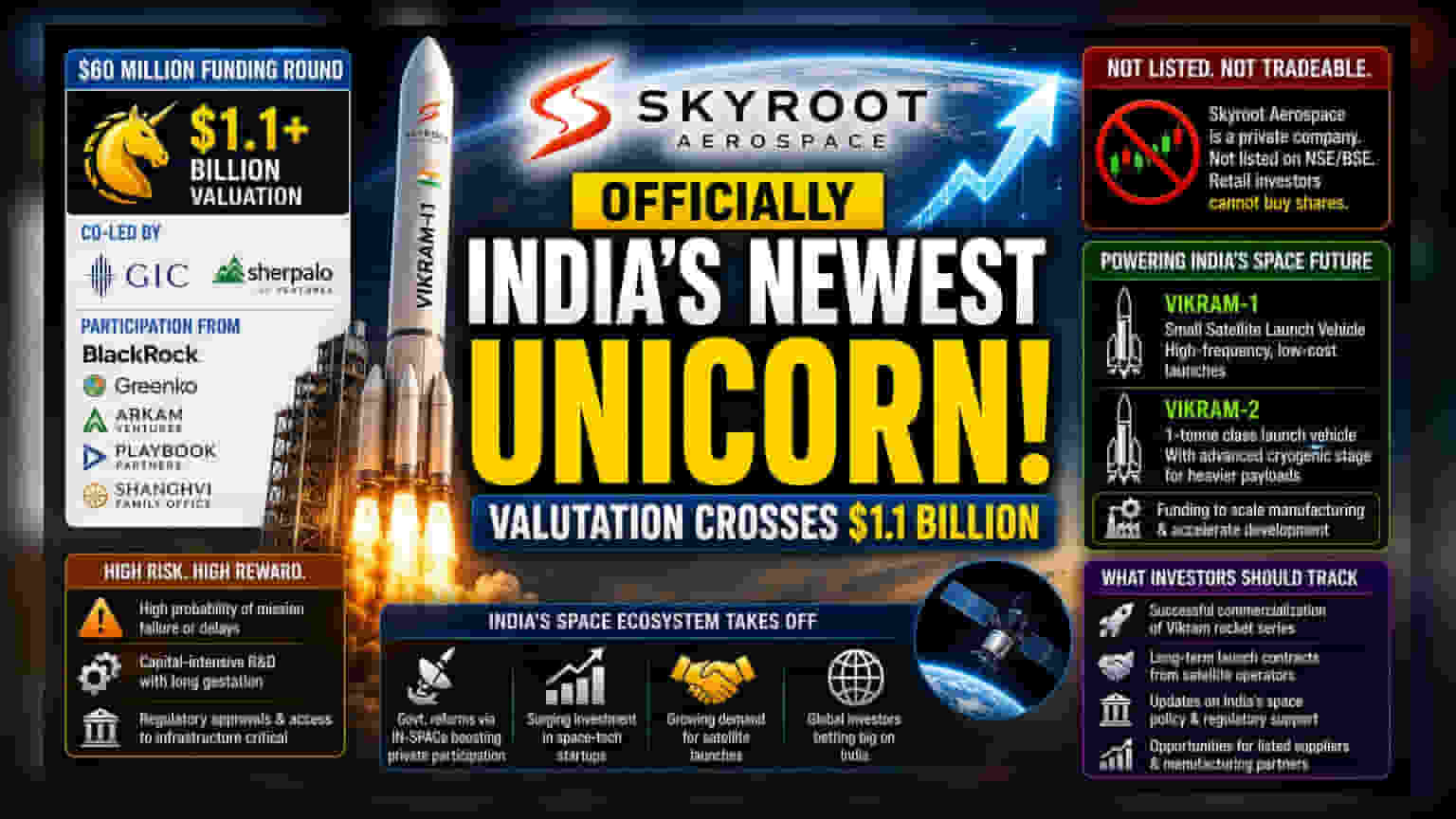


Skyroot Aerospace has reached a valuation of over $1.1 billion following a $60 million funding round. While this is a significant milestone for the Indian space-tech sector, it is important for stock market investors to note that Skyroot is a private company and not listed on the stock exchange. The funds will support the company's rocket manufacturing and development of its Vikram series.
What Happened
Skyroot Aerospace, an Indian space-technology company, has officially attained unicorn status. The company announced a $60 million funding round that has pushed its total valuation above $1.1 billion. This investment round was co-led by international investors GIC and Sherpalo Ventures, with participation from global giant BlackRock and other prominent entities including the founders of Greenko Group, Arkam Ventures, Playbook Partners, and the Shanghvi Family Office.
Why This Matters For Investors
For investors following the Indian stock market, it is essential to clarify that Skyroot Aerospace is a private startup. It is not listed on any stock exchange like the NSE or BSE. Therefore, retail investors cannot purchase shares of the company directly. However, the company’s valuation milestone highlights the growing interest and capital flow into the Indian space-tech ecosystem, which has been gaining momentum following the government's liberalized space policy.
The Business Roadmap
Skyroot Aerospace focuses on developing launch vehicles designed to carry satellites into space. The new capital is primarily earmarked to scale its manufacturing capabilities and accelerate the development of its Vikram rocket series. The company is working on the Vikram-1 rocket, aiming for a high frequency of successful launches. Additionally, the funding supports the advanced Vikram-2, a 1-tonne-class launch vehicle that features a more complex cryogenic stage, which is crucial for carrying heavier payloads into orbit.
Sector Context and Operational Risks
Space technology is a highly capital-intensive and research-heavy field. Unlike traditional manufacturing sectors, space companies face significant operational hurdles. A primary risk in this sector is the high probability of mission failure or delays. Every rocket launch involves extreme technical complexity, and even minor engineering issues can lead to expensive delays or loss of the payload.
Furthermore, the sector is heavily dependent on regulatory support. While the Indian government's IN-SPACe (Indian National Space Promotion and Authorization Centre) body is providing a framework for private players, the company’s success depends on continued access to government infrastructure and timely regulatory clearances. Investors in the broader space sector often compare companies like Skyroot with other emerging peers like Agnikul Cosmos or Bellatrix Aerospace, noting that the competitive landscape is rapidly evolving as these firms move from the prototype phase to commercial operations.
What Investors Should Track
While the company is not public, developments in the space sector offer important signals for listed companies that serve as suppliers, technology partners, or manufacturers to the aerospace industry. Key monitorables include the successful commercialization of the Vikram rocket series, the company's ability to secure long-term contracts from satellite operators, and any updates on India’s broader space policy which can impact the profitability of related listed manufacturing and engineering firms. Investors interested in this space should keep a close watch on government policies regarding satellite launches and space research, as these directly influence the addressable market for all private players in the ecosystem.