 Whalesbook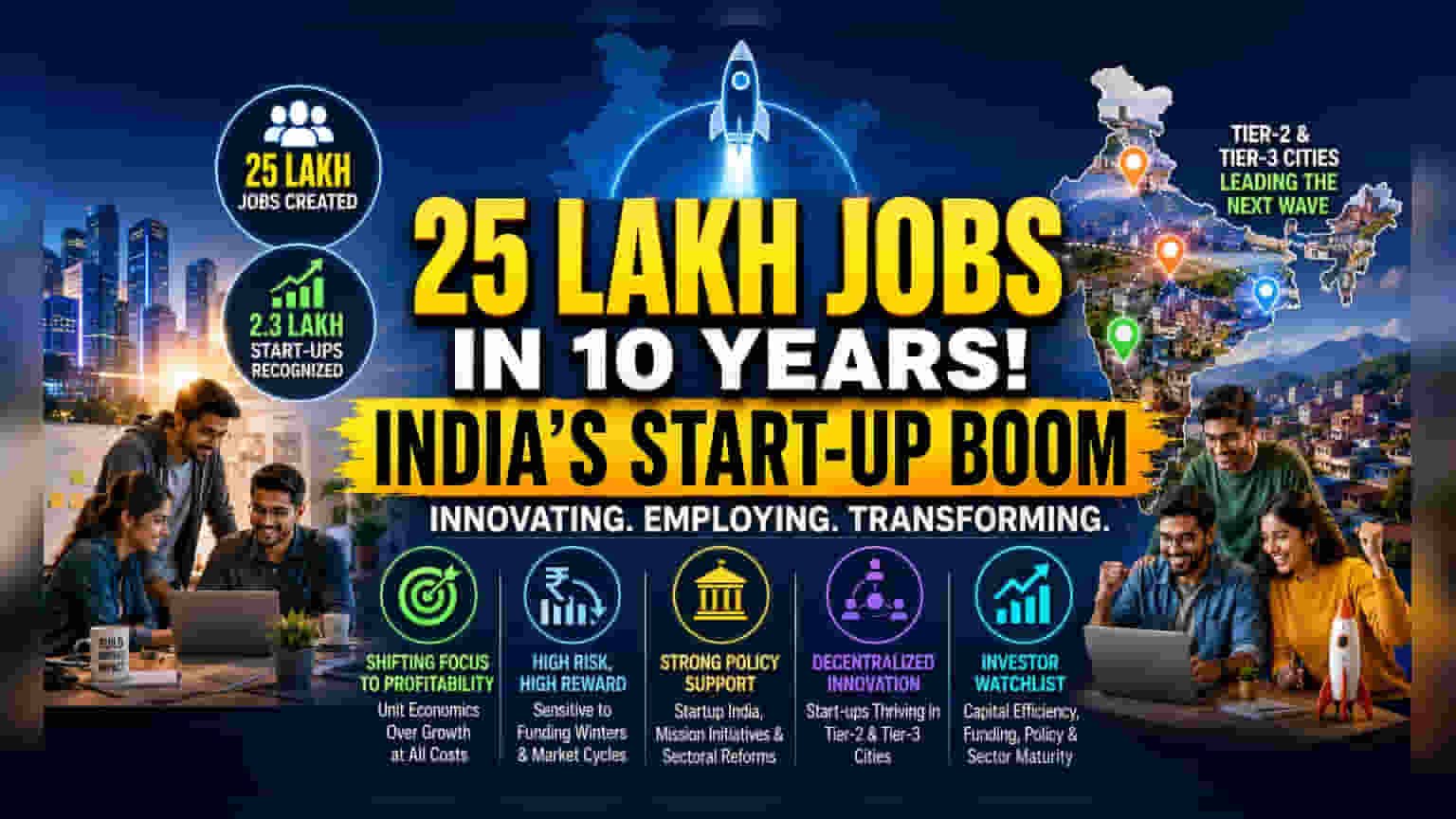


India’s start-up ecosystem has added 25 lakh jobs over the last ten years, supported by nearly 2.3 lakh new ventures. While this expansion highlights strong growth—particularly in Tier-2 and Tier-3 cities—investors should note that the sector is shifting its focus from rapid, cash-burning expansion toward sustainable, profitable growth.
What Happened
India’s start-up sector has created approximately 25 lakh jobs over the past decade, according to data shared by Union Minister Jitendra Singh at the RISE Conclave 2026. The country has now emerged as the world's third-largest start-up hub, with nearly 2.3 lakh recognized ventures. This significant rise is being attributed to government initiatives such as the Startup India program, which has provided regulatory support and tax incentives to entrepreneurs since 2015.
The Shift to Tier-2 and Tier-3 Cities
One of the most notable trends in this growth story is the geographic spread of innovation. While major metropolitan cities like Bengaluru, Mumbai, and Delhi were the original centers for start-up activity, there is a clear trend of new businesses emerging from Tier-2 and Tier-3 cities. This decentralization is helping to distribute economic opportunities and talent development across a broader part of the country. For investors, this shift suggests that local problem-solving and consumer-focused solutions in smaller markets are becoming viable business models.
The Move Toward Profitability
While the headline numbers on job creation and company formation are positive, the financial reality of the start-up sector has evolved significantly. In the past few years, the 'growth at all costs' model has faced scrutiny. Investors and venture capital firms are now placing a much higher premium on unit economics—the ability of a company to make a profit on each unit sold—rather than just expanding at the cost of heavy losses. This shift means that start-ups that were previously burning cash to acquire customers are now under pressure to prove that their business models can eventually become self-sustaining.
Why Start-up Jobs Carry Different Risks
For the broader economy, employment in start-ups is different from traditional corporate jobs. Start-ups are inherently high-risk, high-reward entities. They are often sensitive to 'funding winters,' periods where venture capital becomes scarce, forcing companies to cut costs or reduce headcount to survive. Investors looking at companies backed by start-ups, or those heavily reliant on partnerships with the ecosystem, should be aware that this employment growth can be volatile. If global funding conditions tighten or if specific sectors face a downturn, these job numbers can fluctuate more rapidly than in legacy industries.
The Regulatory and Sector Context
Government policy continues to play a major role in shaping this landscape. The opening of strategic sectors—such as space, nuclear energy, deep ocean exploration, and biotechnology—to private players is a structural change. For example, initiatives like the IndiaAI Mission and the National Quantum Mission are designed to create high-skill jobs in deep-tech areas. This policy support provides a safety net for innovation, but the long-term success of these companies will ultimately depend on their ability to commercialize their technology and generate consistent revenue.
What Investors Should Track
Investors monitoring the start-up ecosystem should focus on the following:
Capital Efficiency: Look for signs that companies are prioritizing cash flow and profitability over unbridled expansion.
Funding Environment: Keep an eye on venture capital inflow trends. A slowdown in global or local funding typically precedes a cooling in hiring activity within the start-up space.
Regulatory Support: Policy changes regarding tax, patent filings, and foreign direct investment can significantly alter the pace of innovation.
Sectoral Maturity: As sectors like aerospace and deep-tech mature, the focus will move from 'incubation' to 'commercial scale.' Watch for companies that successfully cross this bridge to generate actual sales and profits.