

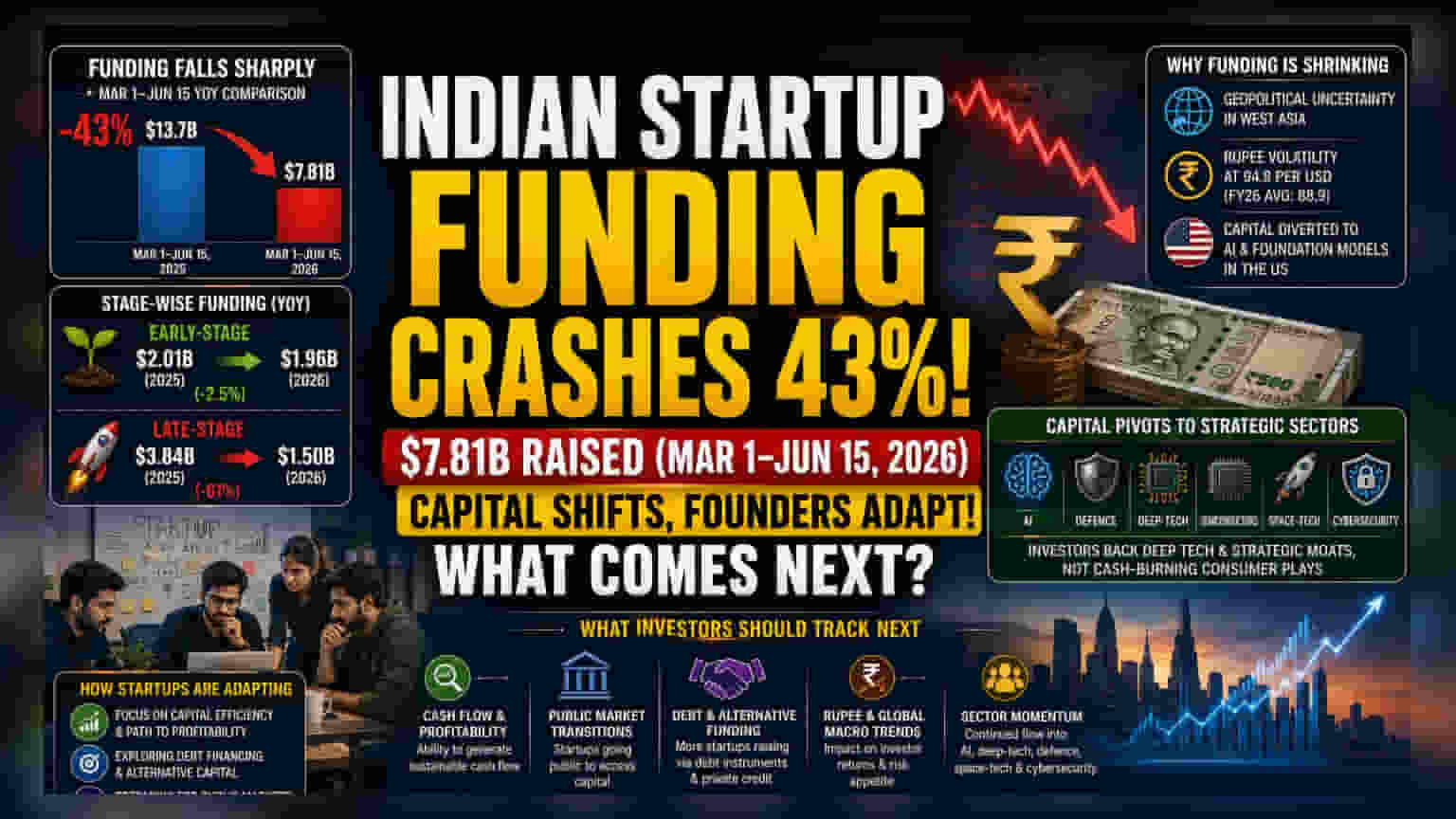
Funding for Indian startups fell 43% to $7.81 billion between March and June 2026, driven by West Asia geopolitical tensions and a depreciating rupee. Investors are shifting focus toward profitable firms and deep-tech sectors, moving away from cash-intensive consumer businesses.
What Happened
India’s startup funding environment witnessed a sharp contraction between March 1 and June 15, 2026, with total investments falling 43% year-on-year to $7.81 billion. This decline, down from $13.7 billion during the same period last year, reflects a significant shift in capital allocation as global uncertainty rises. The drop was particularly severe in late-stage funding, which plummeted 61% to $1.5 billion. In contrast, early-stage funding showed higher stability, recording a decline to $1.96 billion compared to $2.01 billion in the prior year.
Why Funding Is Shrinking
The primary driver behind the funding squeeze is the ongoing geopolitical uncertainty in West Asia, which has prompted investors to turn cautious and selective. This caution is amplified by currency volatility. With the Indian rupee trading around 94.8 per dollar at the end of March—weaker than the FY26 annual average of 88.9—global investors face difficulty underwriting returns. Consequently, capital is being diverted toward AI and foundation model companies in the United States, leaving less liquidity for the Indian market.
The Shift Toward Strategic Sectors
While broad funding has declined, investor interest is not disappearing; it is rotating. Capital is moving away from cash-burning consumer businesses and toward sectors viewed as strategic or essential. There is continued optimism in areas such as artificial intelligence, defence, deep-tech, semiconductors, space-tech, and cybersecurity. These sectors are attracting investments because they align with long-term technological needs and, in some cases, domestic supply chain resilience. This pivot reflects a broader strategy by venture capitalists to support startups that offer clear technical moats rather than just rapid user acquisition.
How Startups Are Adapting
The funding downturn is forcing a fundamental change in how Indian startups operate. Many founders are prioritizing capital efficiency and immediate paths to profitability over aggressive expansion. Startups that once relied on recurring equity rounds are now exploring alternative avenues, including debt financing and preparing for public markets. This move toward self-sustainability is becoming a necessity for firms that cannot access fresh venture capital under current market conditions.
What Investors Should Track Next
The key monitorable for the startup ecosystem in the coming months will be the ability of these companies to demonstrate positive cash flow or clear paths to profitability. Investors may track which startups successfully transition to public markets or debt-based financing models. Additionally, the continued impact of rupee volatility and global interest rate trends will remain critical factors that influence the appetite of Gulf Cooperation Council-based and other global investors toward the Indian startup landscape.