

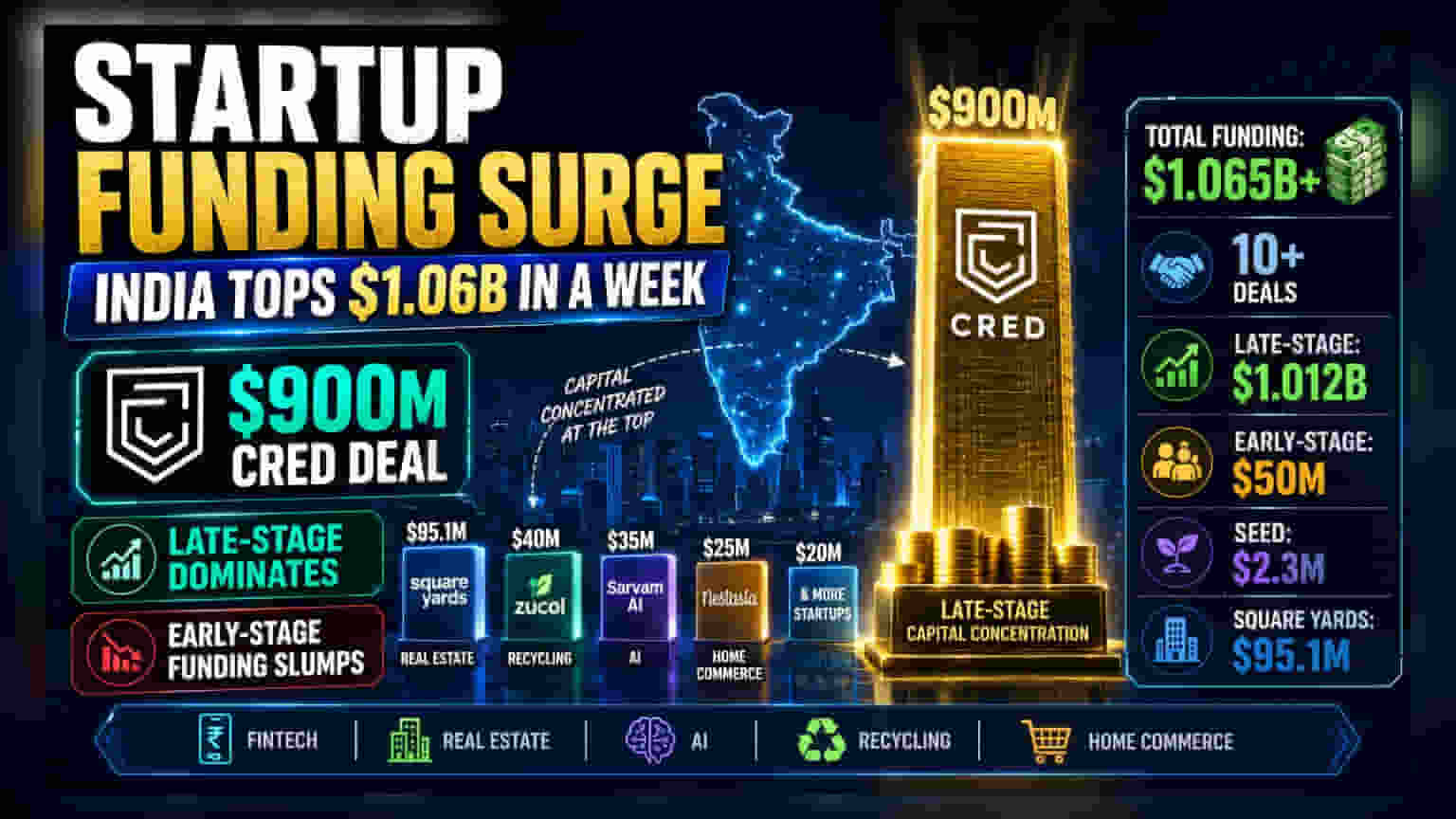
Indian startups secured over $1.065 billion in the week ending June 25, driven heavily by fintech unicorn CRED's $900 million fundraise. This sharp rebound highlights a growing investor preference for mature, late-stage businesses, while funding for early-stage startups remains limited.
What Happened
During the week of June 19 to June 25, the Indian startup ecosystem saw a significant surge in capital, with total funding crossing the $1 billion mark for the first time in several weeks. Startups collectively raised over $1.065 billion across more than 10 deals. This is a substantial jump from the previous week's total of approximately $350 million. The primary driver of this massive figure was the fintech unicorn CRED, which secured a $900 million funding round.
The Concentration Of Capital
While the total funding figure looks impressive, the structure of these investments reveals a specific market trend. Late-stage companies—those that have already established their business model and revenue streams—accounted for over $1.012 billion of the total. This means more than 95% of all money raised during the week went to mature companies rather than newer ventures.
Apart from the major round by CRED, the real estate platform Square Yards also managed to secure $95.1 million. This pattern suggests that investors are currently acting with high caution, preferring to put large amounts of money into a few high-conviction, established companies rather than spreading capital across many smaller or experimental projects.
The Early-Stage Funding Gap
While late-stage funding flourished, the early and seed-stage ecosystem struggled. Funding for early-stage startups dropped significantly to $50 million, down from $309.6 million in the prior week. The situation was even more difficult for seed-stage startups, which saw investments fall to just $2.3 million from $25.1 million previously.
This gap highlights a trend often called a "flight to quality." In uncertain market conditions, venture capital investors typically reduce their risk by avoiding early-stage experiments, focusing instead on companies that have already proven they can generate revenue and scale their operations. Other notable deals during the week included Coval.ai ($28 million), AllHome ($21 million), Recykal ($17.6 million), and Mitigata ($15 million).
What Investors Should Track Next
This week’s activity suggests that the Indian startup funding environment is currently defined by a small number of very large deals. For the broader ecosystem, the key monitorable will be whether this trend of "fewer but bigger" deals continues or if risk appetite returns for earlier-stage startups.
Investors and market observers will also watch if the capital influx into these late-stage companies translates into sustained profitability and operational efficiency. As high interest rates or broader economic concerns can impact the ability of startups to raise money in the future, the efficiency with which these companies utilize this massive capital injection will be crucial to their long-term health.