 Whalesbook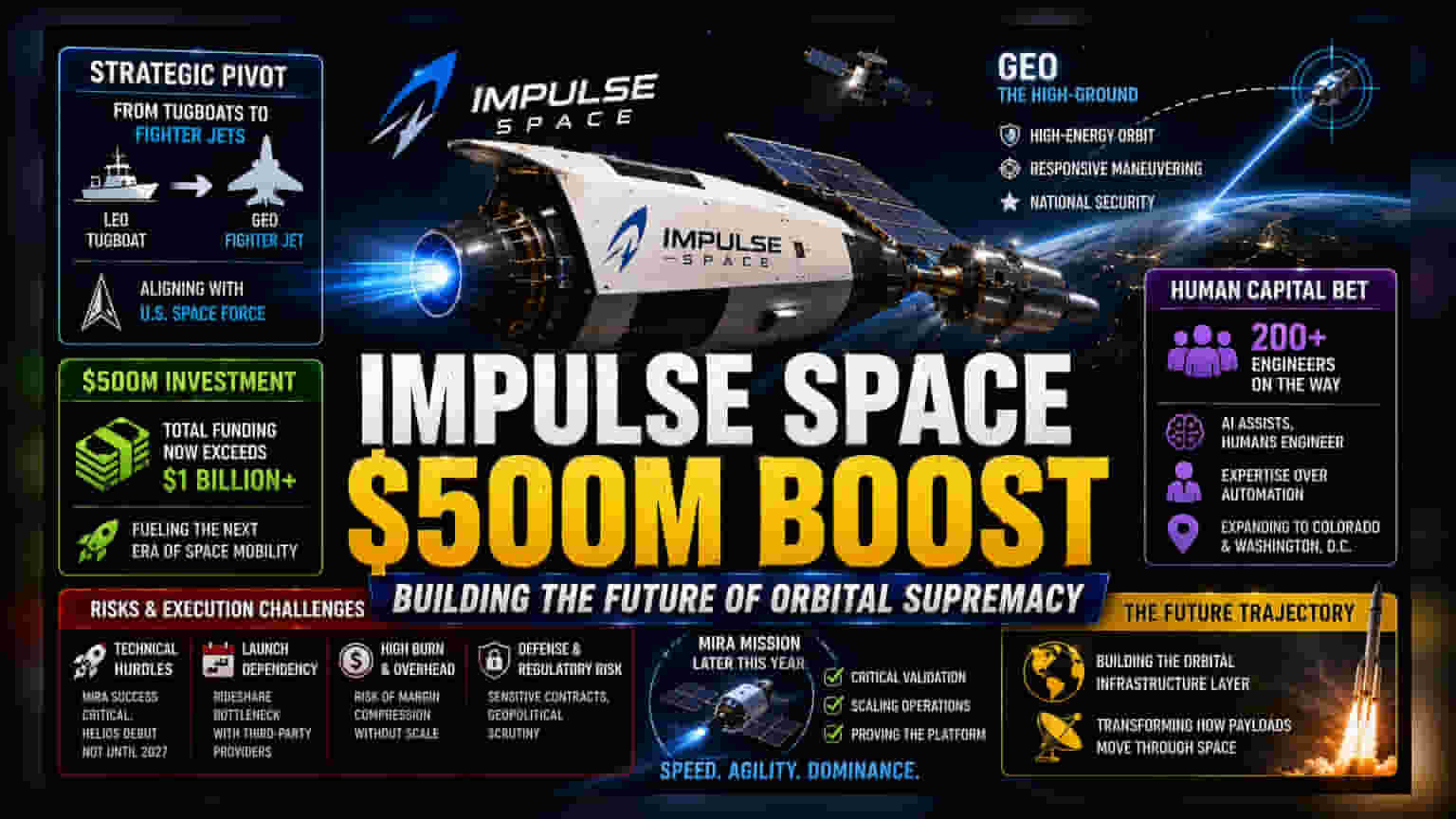


The Shift to Orbital Supremacy
The fresh $500 million infusion marks a structural evolution for Impulse Space. While originally conceived to service the low-Earth orbit (LEO) market, leadership acknowledged that the traditional 'tugboat' business model offered limited scale and thin margins. By pivoting toward high-energy geostationary orbit (GEO) operations—often described internally as 'fighter jets' for space defense—the firm has aligned itself with the U.S. Space Force’s surging budget. This transition is not merely cosmetic; it represents a move from commodity delivery to specialized, responsive maneuvering, positioning the company to capture value in a sector where speed and orbital agility are increasingly treated as matters of national security.
The Human Capital Bet
Against a backdrop of widespread industry automation, Impulse Space is bucking the trend by aggressively hiring 200 additional engineers. President and COO Eric Romo has been clear that while AI assists in software workflows, it remains insufficient for the high-stakes, hardware-intensive challenges of space vehicle design. This philosophy prioritizes experienced human ingenuity over reliance on deep learning models, a stance underscored by CEO Tom Mueller’s pedigree as the original propulsion architect at SpaceX. The company’s move into secondary tech hubs like Colorado and Washington, D.C., suggests that management is prioritizing the acquisition of deep-domain expertise over the cheaper, centralized labor models found in legacy aerospace corridors.
The Forensic Bear Case: Risks and Execution
Despite the significant valuation, investors must contend with operational volatility. The company’s Mira platform has navigated technical hurdles, and the transition to the more complex Helios vehicle—not expected to fly until 2027—introduces substantial execution risk. Unlike established prime contractors, Impulse Space relies heavily on rideshare access through third-party launch providers, creating a potential bottleneck. If future launch schedules tighten or if customer demand for same-day GEO deployment does not materialize as forecasted, the company may find itself burdened by heavy manufacturing overhead and high burn rates. Furthermore, the firm's proximity to sensitive defense contracts with entities like Anduril Industries places it in the crosshairs of evolving geopolitical regulatory oversight, where the margin for error is non-existent.
Future Trajectory
With total funding now exceeding $1 billion, the company is effectively building a new layer of infrastructure for the burgeoning space economy. The upcoming Mira mission later this year will serve as a critical validation point for these scaled-up operations. If successful, Impulse Space is positioned to become a foundational utility in the orbital ecosystem, transforming how commercial and government payloads navigate the 75 trillion cubic miles between Earth and higher orbits.