 Whalesbook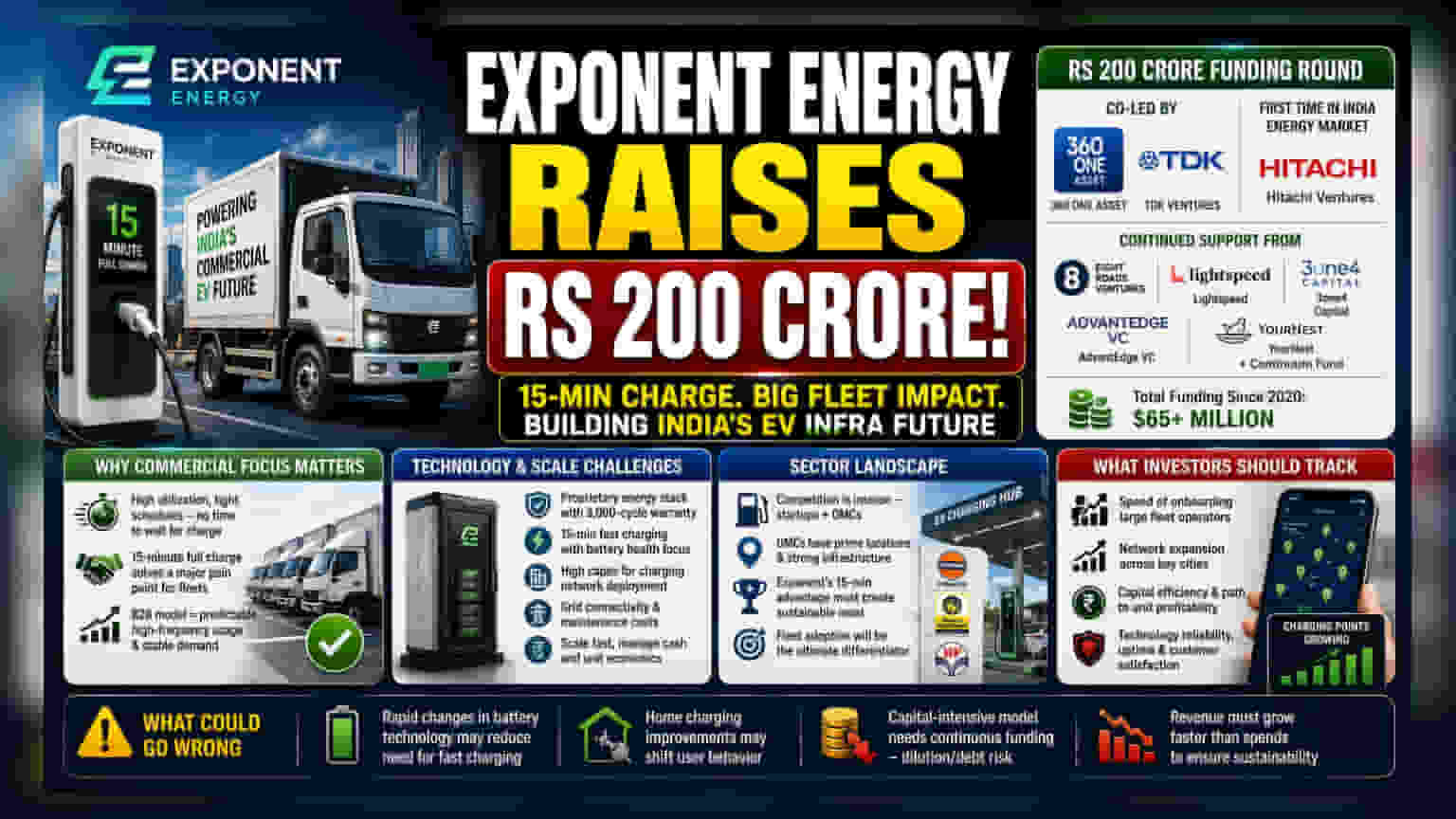


Exponent Energy has secured Rs 200 crore from 360 ONE Asset and TDK Ventures to scale its rapid-charging technology. Focused on commercial electric vehicles, the company plans to expand its network across India. For investors tracking the EV sector, this funding underscores the growing demand for high-utilization, fast-charging solutions, though the space remains capital-intensive and highly competitive.
What Happened
Exponent Energy, a Bengaluru-based startup specializing in energy solutions for electric vehicles, has successfully raised Rs 200 crore in a new funding round. The investment was co-led by 360 ONE Asset and TDK Ventures. Notably, this round also saw participation from Hitachi Ventures, marking its first entry into India’s energy market. Existing investors, including Eight Roads Ventures, Lightspeed, 3one4 Capital, AdvantEdge VC, and YourNest, continued their support, with YourNest also providing additional funding through its Continuum Fund.
The company plans to use this capital to increase its physical presence across more Indian cities, widen its reach into new commercial vehicle categories, and boost its research and development efforts. Since its founding in 2020, the company has raised over $65 million, signaling strong interest from venture capital firms in the electric vehicle infrastructure space.
Why The Commercial Focus Matters
Unlike many EV firms that target personal car owners, Exponent Energy has carved a niche by focusing exclusively on commercial vehicles. For investors in the broader auto and EV sector, this is a strategic distinction. Commercial vehicles, such as those used for last-mile delivery, operate on tight schedules and high utilization rates. This means they cannot afford to wait hours for a battery to charge.
By providing a solution that claims to offer a full charge in 15 minutes, the company aims to solve a major pain point for fleet operators. This business-to-business (B2B) model is often considered more stable than the business-to-consumer (B2C) model because it relies on predictable, high-frequency usage. If the technology proves reliable at scale, it could become a significant part of the logistics and transport value chain.
Technology and Scaling Challenges
The core of the company's offering is its proprietary energy stack, which aims to provide rapid charging while maintaining battery health, backed by a 3,000-cycle warranty. While the technology is a key differentiator, the challenge for any charging infrastructure player lies in the sheer cost of setting up the network.
Building physical charging stations requires high capital spending. The company must now prove it can deploy these stations in high-density areas where commercial vehicles operate, while also managing the costs associated with grid connectivity and hardware maintenance. The ability to expand geographically without burning through cash is the primary test for any infrastructure-heavy startup.
Sector Context and Competition
The electric vehicle charging sector in India is becoming increasingly crowded. It is not just startups like Exponent Energy competing for space; large Oil Marketing Companies (OMCs) like Indian Oil, Bharat Petroleum, and Hindustan Petroleum are rapidly converting their existing petrol pumps into EV charging hubs.
These public sector giants have a massive advantage: existing real estate in prime locations. Startups in this space must offer specialized technology or superior service to compete against the network density of established energy players. For investors, the long-term success of this company will depend on whether its 15-minute charging speed can create a sustainable business advantage that attracts fleet operators away from general-purpose charging networks.
What Could Go Wrong
The biggest risk in the EV infrastructure space is the pace of technological change. If battery technology evolves to a point where vehicles can travel much longer distances on a single charge, or if home-charging becomes more efficient, the need for rapid-charging stations could shift. Additionally, as a capital-intensive business, the company faces the constant pressure of needing more funds to scale, which could lead to equity dilution or debt pressure if revenue does not grow in line with spending.
What Investors Should Track
Investors tracking the EV ecosystem should monitor how quickly the company can onboard large fleet operators. Adoption by logistics and e-commerce companies will be the real test of whether the 15-minute charging claim translates into actual operational efficiency. Furthermore, keep an eye on how the company manages its capital spending in the coming quarters. The speed of network expansion and the ability to achieve profitability on its charging units will be critical indicators of long-term viability.