

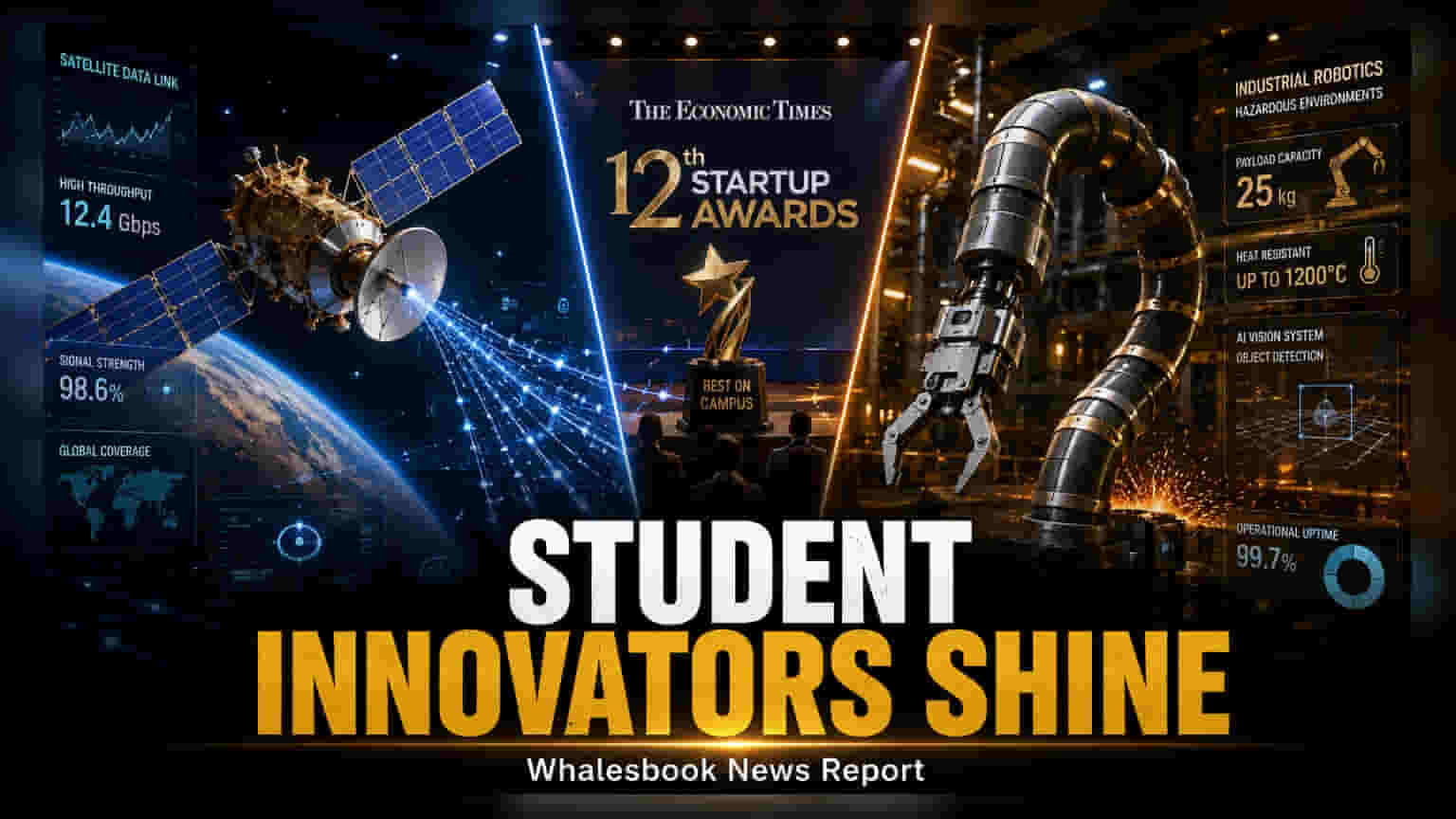
The Economic Times Startup Awards 2026 have named student-founded nominees for the 'Best on Campus' category, showcasing growth in sectors like spacetech, robotics, and AI. These ventures are private companies, not listed on public stock exchanges, meaning they differ significantly from public stocks in terms of liquidity and risk profile for investors.
The Economic Times has announced the shortlist for the 'Best on Campus' category at its 12th annual Startup Awards. This recognition highlights a shift in the Indian innovation landscape, where student entrepreneurs are moving beyond academic projects to build commercially viable businesses.
Unlike standard campus ventures, the companies nominated for this award have already demonstrated real-world application, investor backing, or meaningful customer engagement. The nominees reflect a strong trend toward deep technology, with companies focusing on complex areas like satellite propulsion, industrial robotics, and AI infrastructure.
Among the highlighted ventures is Bengaluru-based Qosmic, which works on satellite data transmission solutions, and Armatrix, which develops robotics for hazardous industrial environments. Other nominees include Panoculon Labs, focusing on vision hardware; Dream Aerospace, which builds satellite propulsion systems; and Plenome Technologies, which creates AI infrastructure and applications. These startups illustrate how Indian students are increasingly targeting specialized sectors such as aerospace and artificial intelligence rather than traditional digital service models.
For investors monitoring the Indian market, it is essential to distinguish these entities from publicly traded stocks. All these companies are private startups. They are not listed on the National Stock Exchange (NSE) or the Bombay Stock Exchange (BSE), and therefore, their shares are not available for trading by retail investors in the public market. There is no daily price movement, no quarterly public financial report, and no easy way to buy or sell stakes in these firms as one would with a listed company.
Investing in such early-stage companies involves a different risk profile compared to public equity. These startups are often in the process of proving their technology, finding a stable customer base, and securing recurring funding to scale operations. A primary risk for any investor in this space is liquidity. Unlike public stocks where an investor can exit a position at market price, selling a stake in a private startup is complex and usually requires a secondary market transaction or a long-term hold until a potential acquisition or public listing occurs.
Furthermore, these companies rely heavily on continuous capital from venture funds and private investors. Their financial health, profit margins, and debt levels are not publicly disclosed, making it difficult for outsiders to assess their operational stability. The path to profitability is often long, and there is a high risk of failure if the product does not achieve widespread adoption or if the capital needed for expansion dries up.
Investors interested in this sector should watch for commercial milestones, such as successful pilot projects, patent approvals, or strategic partnerships, rather than stock market metrics. These developments often serve as stronger indicators of whether a startup has the potential to grow into a sustainable business in the long term.