 Whalesbook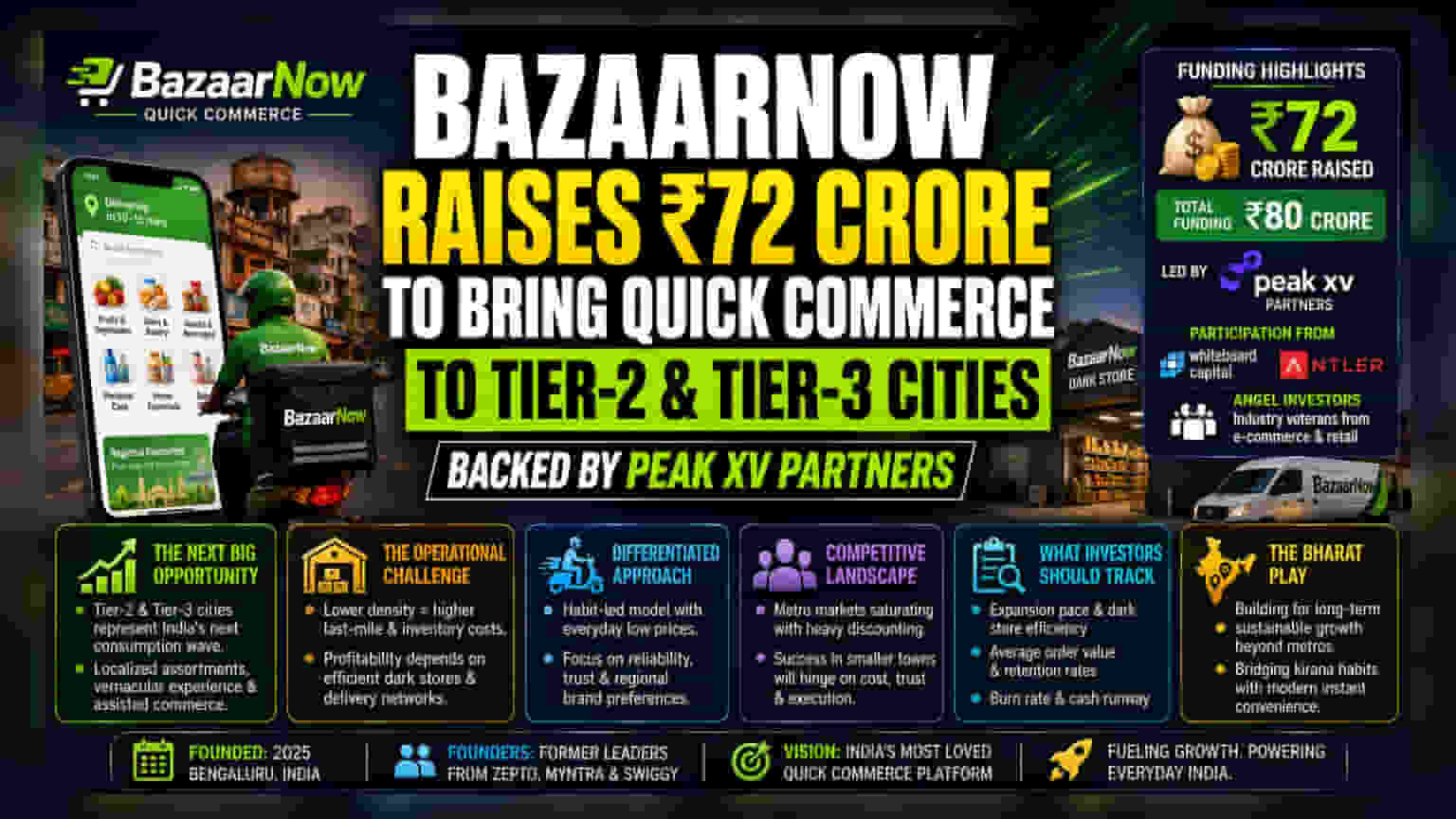


Quick-commerce startup BazaarNow has secured ₹72 crore in funding led by Peak XV Partners to expand its grocery delivery model into Tier-2 and Tier-3 Indian cities. The company aims to tailor its service to local shopping habits rather than replicating metro-centric models, focusing on regional assortment and value-conscious consumers. Investors are closely monitoring how the firm balances unit economics with the operational challenges of lower-density markets.
What Happened
BazaarNow, a Bengaluru-based quick commerce startup, has successfully raised ₹72 crore in a funding round led by Peak XV Partners. The investment round also saw participation from existing backers Whiteboard Capital and Antler, alongside several prominent angel investors including industry veterans from the e-commerce and retail sectors. Founded in 2025 by former executives from Zepto, Myntra, and Swiggy, the company has now raised a total of ₹80 crore. The capital is designated to fuel the firm's expansion into Tier-2 and Tier-3 cities, aiming to strengthen its supply chain infrastructure and enhance its technological capabilities.
Why This Matters for Investors
The quick commerce sector in India has largely been defined by explosive growth in Tier-1 metros, where high population density makes 10-minute delivery models viable. BazaarNow’s entry into smaller towns represents a strategic pivot toward the 'Bharat' consumption story. While metro-focused models rely heavily on high-frequency ordering, premiumization, and aggressive discounting, the company is positioning itself to capture demand in markets where consumer behavior is fundamentally different. By prioritizing regional assortments, vernacular-first digital experiences, and assisted commerce features, the platform attempts to bridge the gap between traditional kirana shopping and modern instant delivery.
The Operational Challenge
Expanding quick commerce into smaller urban clusters introduces distinct structural risks compared to the metro-first strategy of incumbents like Zomato-owned Blinkit, Swiggy Instamart, or Zepto. Quick commerce operations typically require high order density to achieve profitability at the dark-store level. In Tier-2 and Tier-3 cities, population density is often lower, which can increase the cost of last-mile delivery and inventory management per order. Investors often scrutinize whether platforms can maintain healthy profit margins without relying on the heavy discounting and coupon-based customer acquisition strategies that characterize metro markets. The core test for BazaarNow will be demonstrating that its 'habit-led' model—which avoids complex discount structures in favor of fair, everyday pricing—can deliver sustainable unit economics in less dense regions.
Peer and Sector Context
The quick commerce landscape in India is highly competitive, with deep-pocketed listed and unlisted giants dominating the top 10–15 cities. As these metro markets move toward saturation and intense competitive pricing, the shift toward smaller towns is viewed as the next phase of sector growth. Unlike the larger players that prioritize ultra-fast 10-minute delivery, the success of new entrants in smaller towns may hinge on optimizing for cost, reliability, and regional brand preferences rather than sheer speed. The ability of a startup to navigate infrastructure gaps, such as road connectivity and digital supply chain maturity, will be a defining factor in its ability to compete against both established e-commerce platforms and local kirana networks.
What Investors Should Track
The primary monitorables for this venture include the pace of expansion and the company's ability to maintain efficient dark-store operations as it moves beyond its pilot markets. Key metrics to watch will be the average order value (AOV), customer retention rates in smaller towns, and the burn rate associated with establishing the supply chain. Further, any updates regarding future funding rounds or expansion into new geographic clusters will provide insight into whether the company is successfully replicating its initial pilot success. Management's commentary on navigating competition from both organized retail and traditional unorganized grocery players will also remain critical for understanding the company's long-term competitive advantage.