

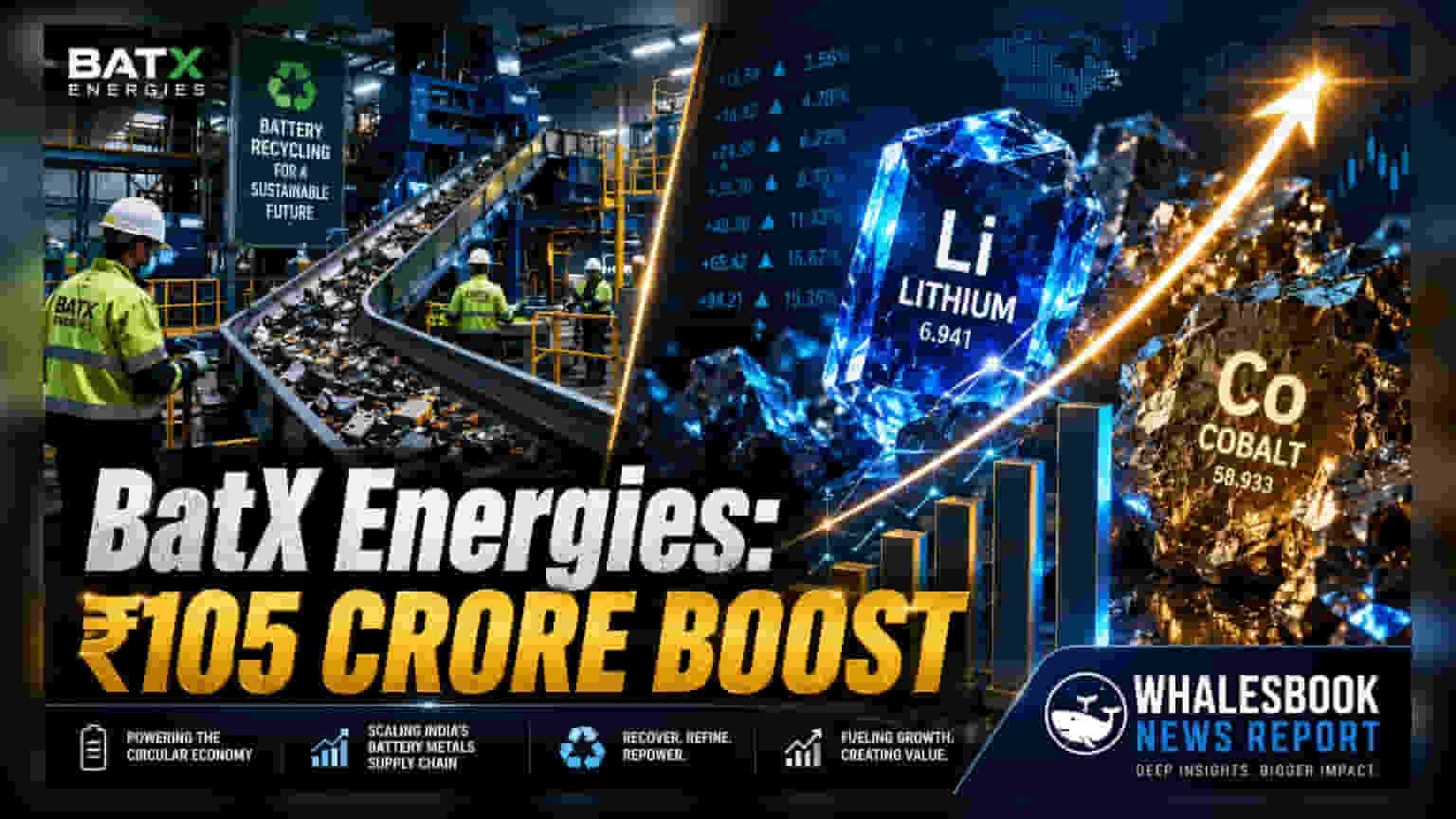
BatX Energies secured ₹105 crore in a Series A funding round led by IvyCap Ventures. The Gurugram-based firm plans to use the capital to increase its battery recycling and refining capacity in India. This investment highlights the rising focus on 'urban mining' for critical minerals, though the sector faces challenges in raw material collection and evolving battery technologies.
What Happened
Gurugram-based battery recycling startup BatX Energies has raised ₹105 crore in a Series A funding round. The investment was led by IvyCap Ventures, with participation from existing investors such as Zephyr Peacock, the Mankind Pharma Family Office, the Excel Industries Family Office, and JITO. This follows a previous funding round in December 2023. The company specializes in extracting valuable materials like lithium, nickel, cobalt, and graphite from used batteries and manufacturing scrap to reintroduce them into the battery supply chain.
Scaling the 'Urban Mining' Model
The company plans to use these funds to expand its recycling and refining infrastructure. As India pushes for faster adoption of electric vehicles (EVs), the demand for battery metals is rising rapidly. BatX operates on a model often called "urban mining," where valuable minerals are recovered from end-of-life batteries rather than being mined from the earth. The company currently reports a battery shredding and hydrometallurgy (a chemical process to extract metals) capacity of 5,000 metric tonnes annually each, along with a network of smaller collection and processing facilities across India.
The Sector Context and Investor View
While this is a private market deal, it reflects a broader trend in the Indian industrial sector: the search for critical mineral security. Investors are increasingly looking at companies that can reduce India's reliance on imported raw materials for batteries. In the listed market, companies like Gravita India have long established themselves in the lead-acid battery recycling space. However, lithium-ion battery recycling—the segment BatX operates in—is a newer and more complex technology frontier. Unlike lead-acid batteries, which are simpler to recycle, lithium-ion batteries require advanced chemical processes and must adapt quickly to changing battery chemistries like LFP (Lithium Iron Phosphate) versus NMC (Nickel Manganese Cobalt).
The Real Risks in Recycling
For investors observing the sector, it is important to understand that scaling a recycling business is not just about capital; it involves significant operational hurdles. The primary risk in this sector is raw material collection. Collecting high volumes of used batteries from a fragmented market is difficult and costly. Furthermore, battery technology is evolving rapidly. A recycling plant optimized for one type of battery may require costly upgrades if the market shifts to a different battery chemistry. Finally, profit margins in the recycling business are sensitive to global commodity price fluctuations, as the value of the recovered metals changes daily based on international markets.
What Investors Should Track Next
For those interested in the battery supply chain and circular economy, the next important markers for the sector will be the stability of collection networks and the ability of companies to maintain high recovery yields as battery types evolve. Additionally, tracking government policy, specifically regarding Extended Producer Responsibility (EPR) norms that mandate recycling, will be a key indicator of how fast the sector can grow in India.