

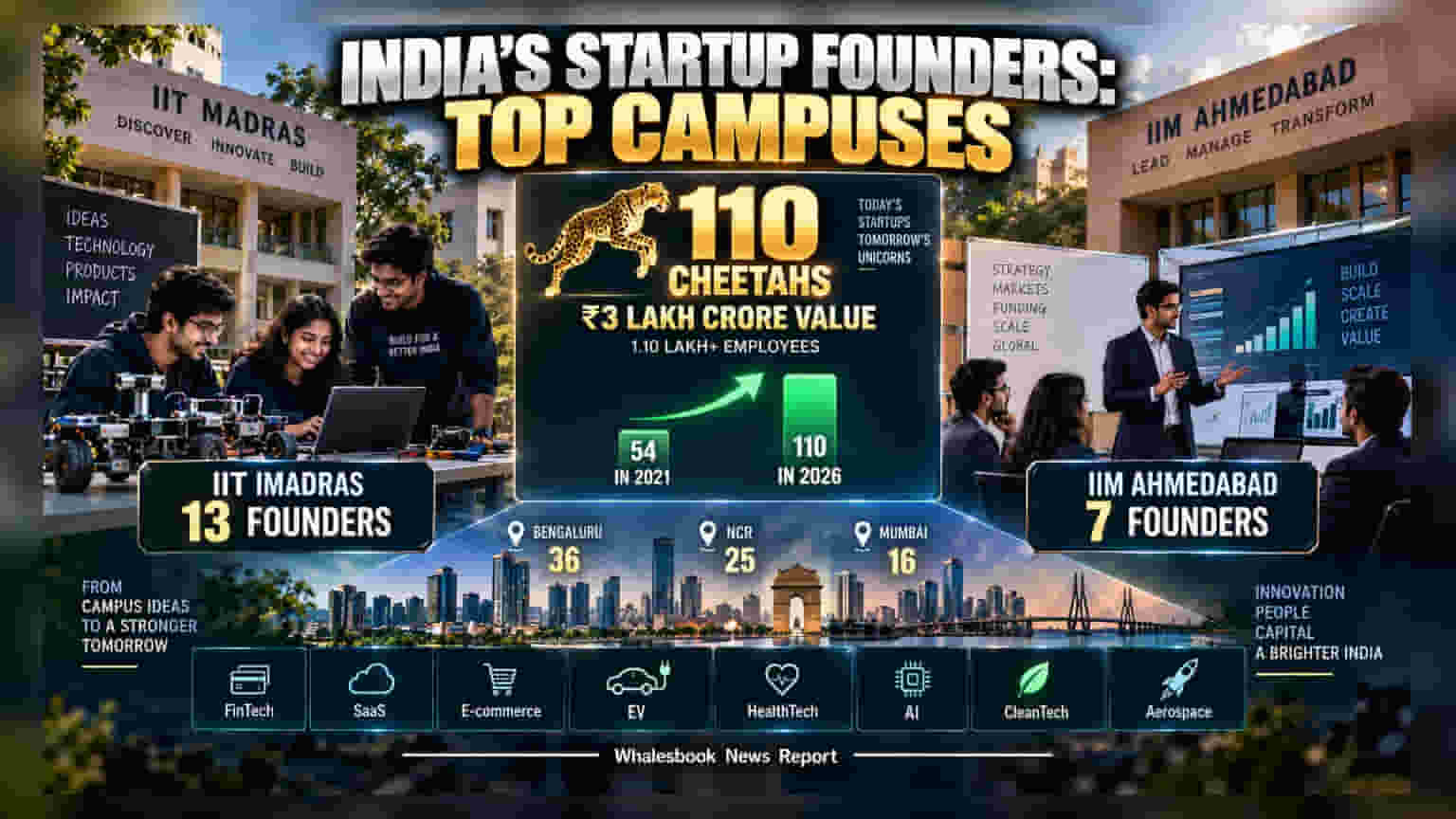
The 2026 ASK Private Wealth Hurun India Cheetah Index identifies 110 high-growth startups valued at ₹3 lakh crore, signaling a strong pipeline for future market listings. With IIT Madras and IIM Ahmedabad leading as top alma maters, the index reveals a shift toward deeper technology and engineering-led ventures.
The startup ecosystem in India continues to expand, with the 2026 ASK Private Wealth Hurun India Cheetah Index identifying 110 companies that are currently valued between $200 million and $500 million. This cohort of high-growth ventures, which the index terms as 'Cheetahs,' has more than doubled from the 54 companies recorded when the index was first launched in 2021. Collectively, these startups now hold a combined valuation of approximately ₹3 lakh crore and support a workforce of over 1.10 lakh employees.
Academic Pipelines and Innovation
A notable trend in the 2026 index is the academic background of the founders. IIT Madras has emerged as the primary undergraduate institution for the founders of these high-growth companies, followed by IIT Bombay and the University of Delhi. At the postgraduate level, IIM Ahmedabad leads the list, with the Indian School of Business and IIM Lucknow also featuring prominently. This concentration suggests that elite engineering and management institutions continue to serve as the foundational hubs for India’s entrepreneurial talent, often providing the initial networks and technical expertise required to scale new businesses.
Sector Shifts and Geographic Focus
While the index reflects a dominance of digital-first sectors, the composition of these startups is evolving. FinTech remains the largest sector with 17 companies, followed closely by software-as-a-service providers with 16 and e-commerce platforms with 12. However, there is a visible move toward more complex industries. Emerging sectors such as clean technology, aerospace, and defence are gaining traction, indicating a shift from purely consumer-facing applications to more specialized, engineering-heavy business models. Aerospace and defence, in particular, have seen a notable increase in the number of Cheetahs compared to previous years.
Geographically, the startup landscape remains highly concentrated. Bengaluru leads the list by hosting 36 of these companies, while the National Capital Region accounts for 25 and Mumbai hosts 16. These three hubs collectively contain about 70% of the entire Cheetah cohort, benefiting from established infrastructure, access to venture capital, and deep pools of technical talent.
Investor Perspective
For investors and market observers, these Cheetahs represent the future pipeline of the Indian public market. The index classifies these companies as having the potential to reach Unicorn status—a valuation of $1 billion or more—within five years. Several companies from the cohort have already made transitions, with ten graduating to Gazelle status, three reaching Unicorn status, and six companies entering the public markets this year.
However, it is important to understand the nature of these assets. These startups are unlisted and private, which means they do not offer the same liquidity as stocks traded on the NSE or BSE. Investing in this space carries significant risks, as these companies are often in a high-burn phase, rely heavily on continuous rounds of private equity funding, and are sensitive to macroeconomic shifts that can restrict capital availability. Their eventual success depends on operational execution, market demand, and their ability to successfully transition to a profitable, publicly traded model in the coming years.