

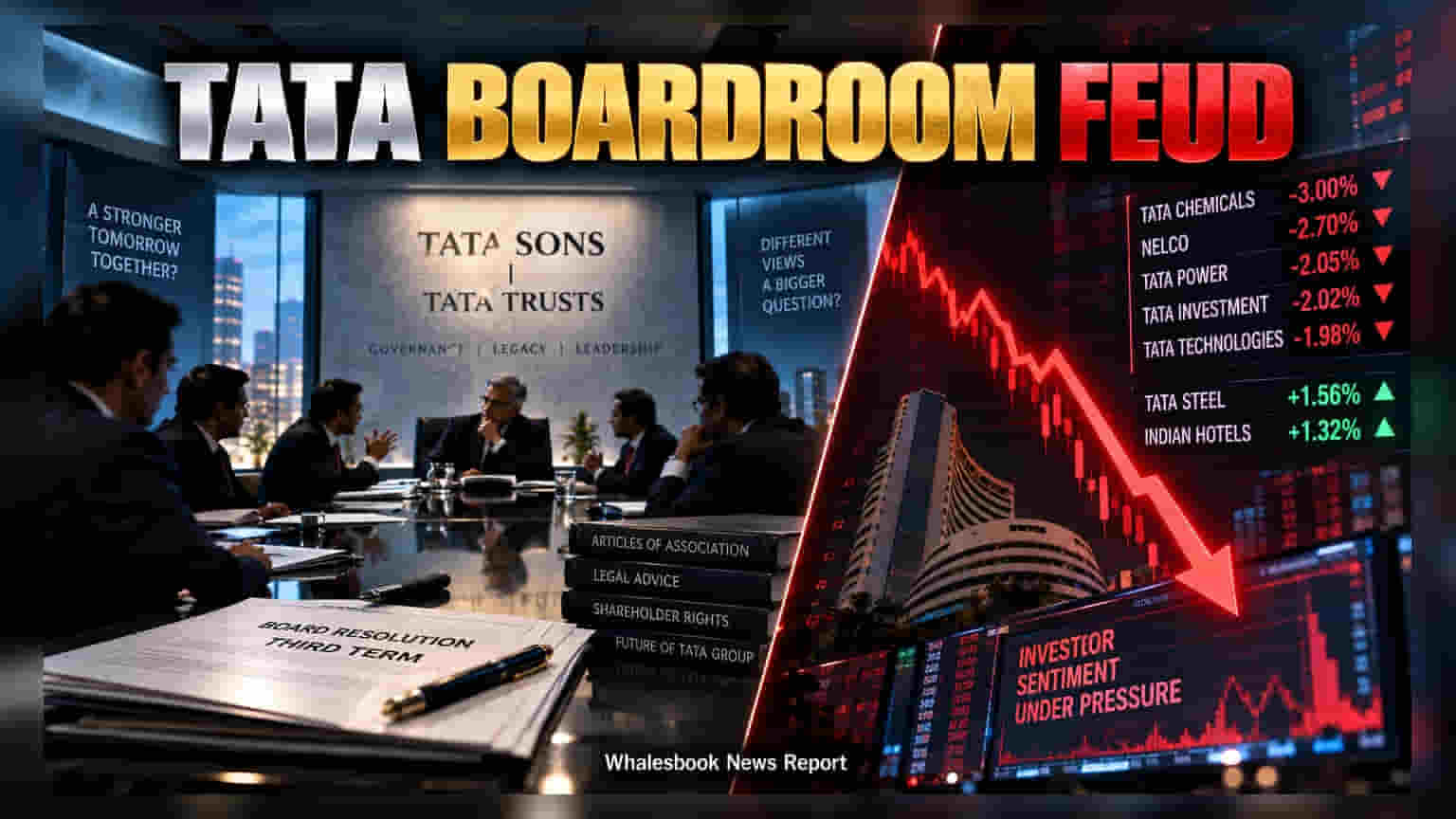
Shares of several Tata Group companies faced pressure on Monday after a disagreement emerged between Tata Sons and its primary shareholder, Tata Trusts, regarding the reappointment of Chairman N Chandrasekaran. With Noel Tata casting a dissenting vote, the dispute highlights potential governance uncertainty. Investors are closely monitoring the situation, as the group's historical market valuation premium has long been linked to its stable leadership and corporate governance standards.
The Tata Group, often viewed as a benchmark for corporate governance in India, is facing internal friction at its holding company level. On Monday, shares across the conglomerate saw a mixed reaction following news of a dispute between Tata Sons and Tata Trusts. The disagreement centers on the September 17 board resolution that cleared the way for a third term for Executive Chairman N Chandrasekaran. While the board approved the move with a 4:1 majority, Noel Tata, representing the 66% stakeholder Tata Trusts, cast the sole dissenting vote.
This division has sparked concern regarding the procedures followed during the board vote, with reports indicating that Tata Trusts contends the Articles of Association of Tata Sons may not support resolution by simple numerical majority. The mention of senior legal counsel involvement has further fueled speculation that the matter could move toward formal litigation, adding a layer of complexity to the group's leadership transition.
Market reaction was swift, reflecting investor nervousness regarding the stability of the conglomerate. Tata Chemicals saw its share price decline by approximately 3%, while NELCO dropped 2.7%. Other group entities, including Tata Power, Tata Investment Corporation, and Tata Technologies, also recorded losses of around 2%. Despite this, the impact was not uniform across all group companies; shares of Tata Steel and Indian Hotels bucked the trend, recording moderate gains. This divergence suggests that investors are currently distinguishing between the governance uncertainty at the holding company and the operational performance of individual business units.
For investors, the primary concern lies in the potential impact on the group's valuation premium. Historically, the market has assigned higher price-to-earnings multiples to Tata entities, partly due to the stability and transparency associated with the group's leadership. If the standoff between Tata Sons and Tata Trusts persists or escalates into a prolonged legal battle, it may create uncertainty that affects this stability premium. Since N Chandrasekaran had previously signaled an intention not to seek another term, the current dispute over his reappointment adds further complexity to the narrative.
The next important updates for shareholders will be any formal clarification from Tata Sons regarding the board's decision-making process, any potential legal filings by Tata Trusts, and whether the group seeks an internal resolution to bridge the divide between the two parties.